Magnacrus

Magnacrus is an accepted genus of theraphosid tarantulas in the subfamily Ornithoctoninae, established in 2025 by Hoang, Yu, Wendt, West, and von Wirth. The current World Spider Catalog recognizes two accepted species in the genus: Magnacrus tongmianensis and Magnacrus taynguyenensis. The type species is Citharognathus tongmianensis, which was transferred into Magnacrus when the genus was erected.

The genus was proposed to clarify the placement of a distinctive Vietnamese ornithoctonine lineage that had previously been treated under Citharognathus. In the original 2025 paper, M. tongmianensis was transferred from Citharognathus and redescribed, while M. taynguyenensis was newly described from Vietnam. The same paper emphasized that the type locality historically associated with M. tongmianensis is potentially erroneous and that the species likely does not actually inhabit China, even though the current catalog still lists its distribution as “Vietnam, China?” pending full resolution.

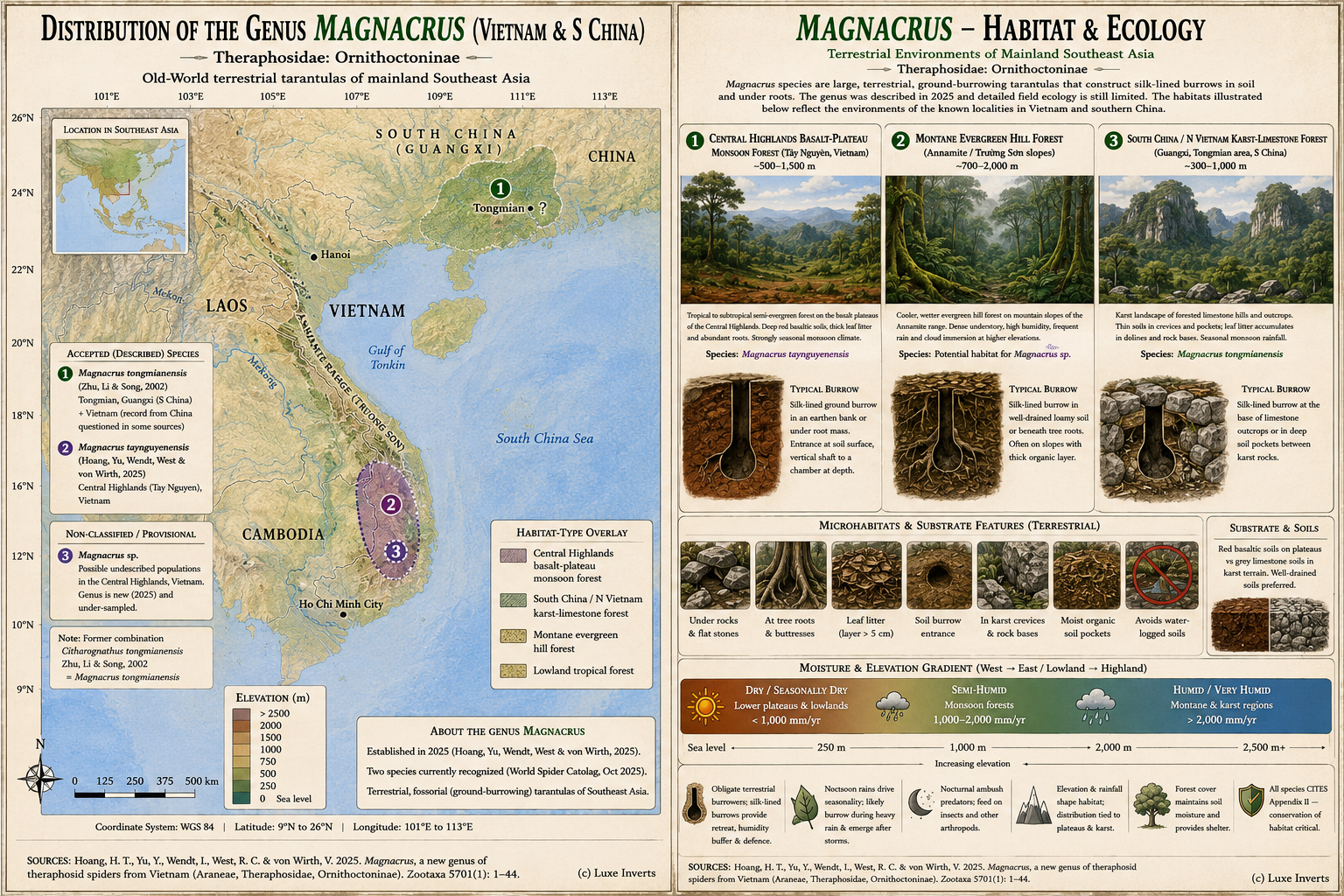
In ecological terms, Magnacrus is best understood as a Vietnamese fossorial ornithoctonine genus rather than an arboreal one. The published natural-history notes for both accepted species describe self-excavated burrows in clay-like soil, with M. tongmianensis documented from low elevations below 600 meters at the fringes of secondary forest and plantations, and M. taynguyenensis documented from highland sites at roughly 1,400–1,600 meters in pine-forest landscapes with grassy, low-shrub understory.

Magnacrus tongmianensis

Magnacrus tongmianensis is the type species of Magnacrus and the nominal species on which the genus is based. It was originally described in 2002 by Zhu, Li, and Song as Citharognathus tongmianensis, based on female material, and was transferred to Magnacrus in 2025 during the revision that established the genus. The current catalog lists the species as accepted and records its distribution as Vietnam, China?, while also noting the 2025 transfer and the first description of the male.

The species is scientifically important because it anchors the genus concept itself. Hoang and colleagues redescribed it from Vietnamese material and argued that the long-cited Chinese type locality is probably the result of historical trade-related confusion rather than a true reflection of its natural range. Their paper noted a distribution gap of more than 1,200 kilometers between Tongmian and the Vietnamese material and stated that the species likely does not inhabit China.

Common name: No universally standardized scientific common name; in the hobby it has circulated under informal labels such as “Vietnamese Stout-Leg Earth Tiger.”
Origin: Vietnam; the World Spider Catalog currently lists Vietnam, China?, but the 2025 revision argues the Chinese record is probably erroneous.

Natural habitat: Low-elevation fossorial habitat at the fringes of secondary forest or plantations, with burrows in clay-like soil among shaded vegetation.
Lifestyle: Old World fossorial theraphosid that excavates and occupies its own retreats.

Adult size: Large-bodied fossorial tarantula; a standardized mature legspan is not synthesized in the formal taxonomic literature.
Growth rate: Not standardized in the primary taxonomic literature.
Temperament: No formal behavioral diagnosis exists, but the 2025 natural-history notes state that extracted individuals become very defensive and will readily bite if further provoked.
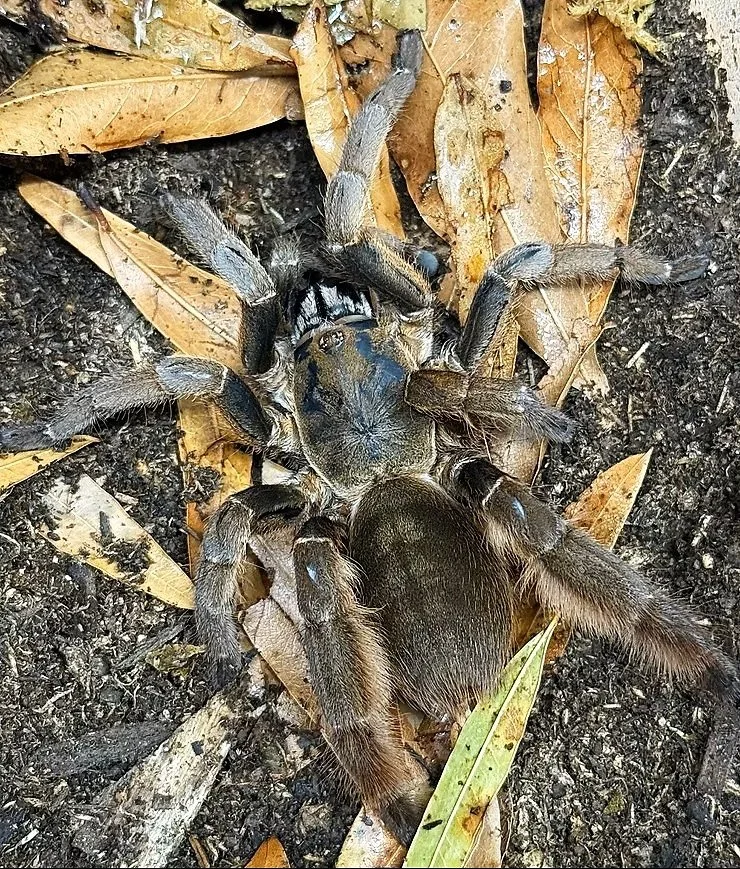
Color & appearance: In scientific terms, identification depends on the 2025 redescription and associated somatic and genital morphology; in hobby usage the species is often noted for its robust build and unusually stout leg proportions.

Species History

Magnacrus tongmianensis entered the literature in 2002 as Citharognathus tongmianensis. It remained under that combination in later secondary treatments and the 2008 revision of Chinese theraphosids before being transferred to Magnacrus in 2025. The current World Spider Catalog records that transfer explicitly and also notes that the 2025 paper provided the first description of the male.

Its later taxonomic history is especially significant because it was the species through which Magnacrus was defined. In establishing the genus, Hoang and colleagues designated Citharognathus tongmianensis as the type species and used it as the principal reference point for separating Magnacrus from Citharognathus. As a result, M. tongmianensis is not only an accepted species but also the taxonomic anchor for the entire genus.

The species also illustrates how trade history can complicate taxonomy. The 2025 paper explicitly questioned the original Chinese locality and suggested that Tongmian functioned as a cross-border collection and shipping hub for Vietnamese tarantulas. The authors reported repeated unsuccessful searches for the species in Tongmian and stated that the available evidence makes a true Chinese distribution doubtful.

Natural Habitat

Published natural-history notes place M. tongmianensis at low elevations below 600 meters in the Central Highlands of Vietnam. The original habitat described in the 2025 paper consisted of a landscape where former tropical deciduous lowland forest had been heavily altered into agricultural areas, rubber plantations, and small fragmented secondary forests. Within that mosaic, the species was found in self-excavated fossorial retreats on gently sloped ground among shaded vegetation in clay-like soil.

The burrows described for adult females averaged about 5 centimeters in diameter and 40 centimeters in length, ran somewhat parallel to the ground surface, and curved upward to a blind terminal chamber. The entrance rim was reinforced with silk and surrounding organic debris, and foliage was often arranged around the entrance in a way that appeared to divert rainwater away from the burrow opening. Occupied retreats were usually silked over during the day.

In husbandry terms, that published natural-history account is most consistent with a setup emphasizing deep substrate, stable retreat structure, moderate moisture in the lower layers, and protection from waterlogging rather than an arboreal enclosure. That interpretation is grounded in the described burrow architecture and low-elevation fossorial habitat rather than in generalized hobby convention alone.

Our Specimen

Coming soon

Magnacrus taynguyenensis

Magnacrus taynguyenensis is the second and most recently described species in the genus. It was described as new in 2025 by Hoang and colleagues and is currently recorded only from Vietnam in the World Spider Catalog. The original description included both sexes, making it the only species of Magnacrus described as new directly within the genus rather than transferred from an earlier combination.

As currently understood, M. taynguyenensis represents a highland Vietnamese member of the genus that is scientifically important because it broadens the known ecological and geographic scope of Magnacrus. Whereas M. tongmianensis is associated with lower-elevation disturbed forest margins and plantation edges, published natural-history notes place M. taynguyenensis in higher-elevation settings of roughly 1,400–1,600 meters in the Central Highlands.

Common name: No universally standardized scientific common name; in the hobby it has commonly circulated under informal labels such as “Vietnam Highland.”
Origin: Vietnam.

Natural habitat: Highland fossorial habitat in Vietnam’s Central Highlands; the published natural-history notes describe pine forest with grasses and low bushes, with burrows in clay-like soil on gently sloped roadside embankments.
Lifestyle: Old World fossorial theraphosid that excavates its own retreats.

Adult size: Large-bodied fossorial tarantula; a standardized mature legspan is not synthesized in the formal taxonomic literature.
Growth rate: Not standardized in the primary taxonomic literature.
Temperament: No formal behavioral diagnosis exists in the taxonomic literature.
Color & appearance: Public live-image and hobby descriptions remain more limited than for longer-established Asian theraphosids; formal identification depends primarily on the original 2025 description and associated diagnostic morphology.

Species History

Magnacrus taynguyenensis was described in 2025 in the same paper that erected Magnacrus as a genus. Unlike M. tongmianensis, it did not pass through an earlier formal species name in another genus before its current placement. Its status is therefore comparatively straightforward: it is an accepted species described originally as Magnacrus taynguyenensis.

Its scientific significance lies in showing that Magnacrus is not a monotypic genus defined around a single transferred species, but a distinct Vietnamese lineage with at least one additional formally described congener. The 2025 paper described both male and female material and thereby established M. taynguyenensis as a fully diagnosed second species within the genus from the moment of publication.

In hobby circulation, this species had already been known informally before its formal description, especially under “Vietnam Highland” labels. The 2025 paper effectively regularized that undocumented hobby entity into a formally named taxon, making M. taynguyenensis a good example of a Southeast Asian theraphosid that moved from informal trade recognition into published taxonomy.

Natural Habitat

The published natural-history notes for M. taynguyenensis place the species in Vietnam’s Central Highlands at elevations of about 1,400–1,600 meters. The general habitat was described as pine forest with an understory of grasses and low bushes, which distinguishes it from the lower-elevation plantation-edge and fragmented-secondary-forest habitat documented for M. tongmianensis.

The species was found in self-excavated fossorial retreats on gently sloped ground among shaded vegetation in clay-like soil on roadside embankments. Even from the limited publicly accessible summary, that record makes clear that M. taynguyenensis is not an arboreal trunk-dweller but a true burrowing ornithoctonine associated with cool-to-moderate highland terrain and structurally stable soil.

In husbandry terms, the most defensible scientific interpretation is a fossorial setup with substantial substrate depth, secure burrow-supporting soil structure, moderate moisture, and good ventilation rather than an arboreal enclosure. Because the public natural-history summary is shorter than the one available for M. tongmianensis, those husbandry implications should still be treated as conservative inferences from documented retreat type, elevation, and habitat structure.

Our Specimen

Coming soon