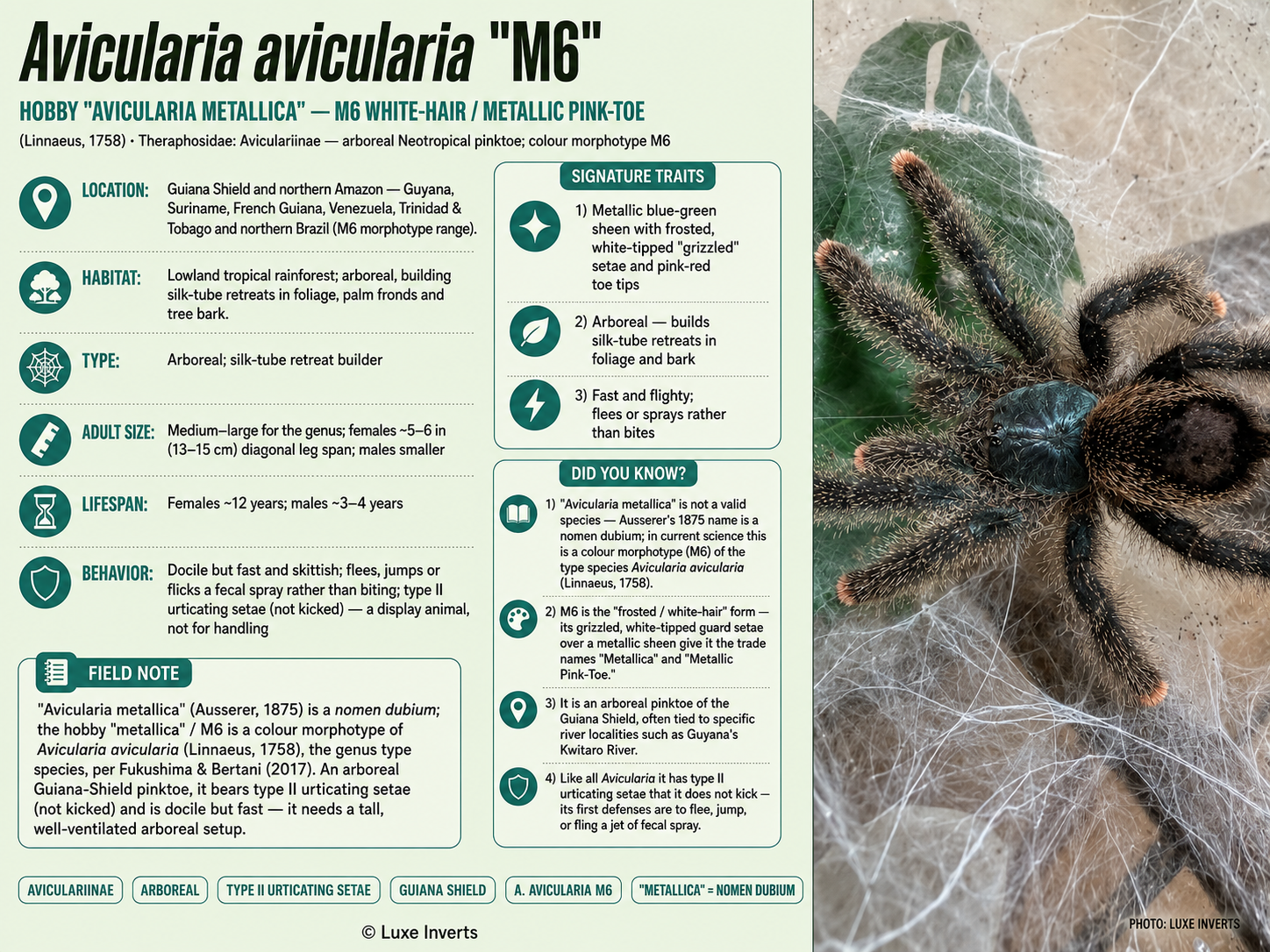

Avicularia
Avicularia Lamarck, 1818 is the namesake genus of the subfamily Aviculariinae, a Neotropical lineage of strictly arboreal theraphosids whose type species, Avicularia avicularia (Linnaeus, 1758), is one of the oldest validly named tarantulas on the books — Linnaeus described it as Aranea avicularia from a Surinamese specimen and the genus has been a fixture of Neotropical theraphosid taxonomy ever since. For most of the 20th century Avicularia functioned as a catch-all for small-to-medium South American "pinktoes" and accumulated dozens of nominal species, trade forms, and locality variants of unclear identity. The standing of the genus was fundamentally rewritten by Fukushima and Bertani's revision (2017, ZooKeys 659: 1–185), which redescribed the type species from a neotype, restricted Avicularia to twelve valid species, and either erected or restored four sister genera — Caribena, Iridopelma, Pachistopelma, and Ybyrapora — for taxa that had long been parked under the Avicularia umbrella. Several familiar hobby names (most prominently A. metallica, A. braunshauseni, and A. geroldi) were placed as junior synonyms in that revision, though they remain in continuous trade use.
Modern Avicularia are distributed across the Guiana Shield, the Amazon basin, and the eastern Andean foothills from southern Venezuela and Trinidad through the Guianas, Brazil north and south of the Amazon, eastern Ecuador, eastern Peru, and northern Bolivia. Habitat preference is uniformly arboreal across the genus, but climatic envelope is not: lowland congeners (A. avicularia, A. juruensis, A. variegata) are animals of warm, humid lowland rainforest, while several Andean-foothill species (A. hirschii, A. purpurea) extend into measurably cooler and more seasonal montane forest. Husbandry that works for Suriname-source A. avicularia is materially different from what serves A. purpurea or A. hirschii, and treating the genus as a single thermal envelope is the most common cause of failed long-term keeping.
The genus is diagnosed in part by Type II urticating setae — present in all true Avicularia and the four sister genera carved out in 2017, and not produced by the much larger Theraphosinae lineage that contributes most of the rest of the South American tarantula fauna. Type II setae are not kicked from the opisthosoma; they are pressed onto a perceived threat by direct opisthosomal contact, an active-defense mode that is materially less hazardous to a keeper than the kicked Type I and III setae of Brachypelma, Grammostola, and relatives. The active defensive repertoire of the genus is otherwise dominated by flight: rapid sprint, lateral jump, and the well-documented drop reflex from elevated anchors. The drop reflex, rather than venom (which is mild across the genus and produces only transient localized effects in documented bites), is the principal practical hazard during enclosure work, since arboreal falls of even modest distance produce far more serious injuries than any envenomation in this group.
In the wild, Avicularia construct tubular silken retreats anchored in tree hollows, palm-leaf axils, bromeliad whorls, and under loose bark, typically 1–5 m above ground and rarely below the understory canopy. Adult females are strongly site-fidelitous and persist in a single retreat across multiple molting cycles; mature males abandon the retreat, descend, and undertake the prolonged wandering search for receptive females typical of the family. Diet is dominated by canopy and understory invertebrates, with opportunistic predation on small lizards, frogs, and nestling birds documented in field accounts of the larger congeners. The opisthosomal silk also serves as a tactile communication and prey-detection medium across the dense webbing of the retreat lining, and Avicularia are among the most reliably and visibly webbed of any captive theraphosid — a substantial part of the visual appeal of the genus in collections.
Captive husbandry across the genus expects a tall, cross-ventilated arboreal enclosure considerably taller than wide, a vertical cork slab or hollow as the primary anchor for retreat construction, mid-70s to low-80s °F for lowland species and a 5–8 °F downward shift for the Andean-foothill congeners, and ambient humidity in the 65–75% range maintained primarily through a moist substrate base and periodic light misting — never through reduced ventilation or a sealed lid. Stagnant air combined with chronically saturated substrate is the single most consistent cause of the so-called "sudden Avicularia death syndrome" (SADS) and is responsible for the genus's outsized share of unexplained adult mortality in the hobby; cross-ventilation on the front face of the enclosure rather than added humidity is the standard fix. No Avicularia species is currently CITES-listed, and none has a published IUCN Red List assessment at the species level; habitat loss to selective logging, road-driven Amazonian deforestation, and continued direct collection of the more colorful congeners for the international hobby are the meaningful contemporary conservation concerns. Taken as a whole, Avicularia is the visual archetype of the New World arboreal theraphosid — heavily webbing, brilliantly iridescent, surprisingly delicate in husbandry, and the lineage from which an entire subfamily takes its name.