

Scolopendra
The centipedes we label under Scolopendra belong to one of the oldest formally named arthropod genera. Carl Linnaeus established Scolopendra in 1758 in the 10th edition of Systema Naturae, the starting point for modern zoological nomenclature. Of the handful of species he originally placed there, only Scolopendra gigantea and S. morsitans are still recognized in the genus today, with S. morsitans later chosen as the official type species by the International Commission on Zoological Nomenclature to stabilize the name’s usage.
Across the 18th and 19th centuries, naturalists like William Leach, Thomas Say, George Newport and others described many of the giant “tropical centipedes” that hobbyists now recognize as staples of the trade—species such as S. heros, S. subspinipes, S. dehaani and S. cingulata. By the early 20th century, Scolopendra was firmly established as the flagship genus in the family Scolopendridae, with major monographs by workers such as Carl Attems laying the groundwork for modern taxonomy and identification.
Today, Scolopendra is a species-rich genus of large, predatory centipedes distributed throughout tropical and warm-temperate regions worldwide, with more than 100 described species and subspecies and new taxa still being added through modern revisions and phylogenetic studies. Many of the giants popular in the hobby—like S. gigantea, S. heros and S. subspinipes—are ecological top predators in leaf litter and soil communities, capable of taking everything from insects to small vertebrates. Their combination of ancient name, long taxonomic history and ongoing scientific interest makes Scolopendra one of the most iconic invertebrate genera represented in the hobby.
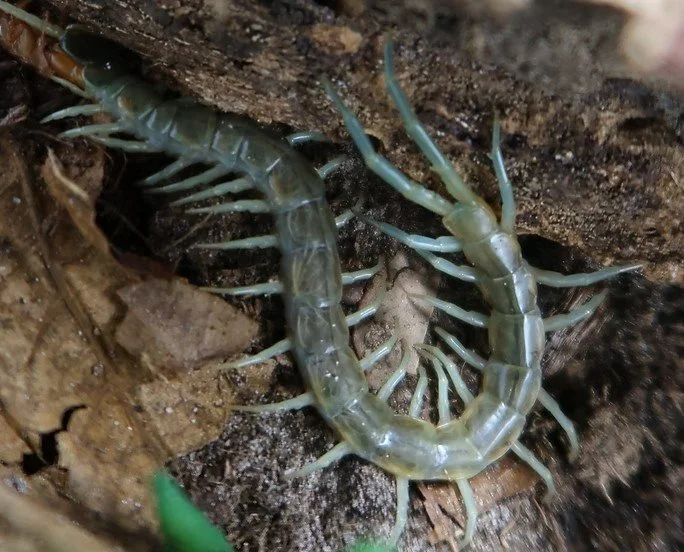
Scolopendra hainanum
Common name: Chinese Giant Tiger Leg Centipede / Chinese Tiger Centipede
Origin: Native to Hainan Island and parts of southern China, in warm tropical and subtropical forests.
Lifestyle: Nocturnal, ground-dwelling predator. Spends the day hidden under bark, leaf litter and in burrows, emerging at night to hunt insects and other invertebrates.
Adult Size: Typically around 8–9 in (21–23 cm) in length, placing it among the larger Scolopendra species.
Growth Rate: Moderate to fast. Given regular feeding and warm temperatures, juveniles can reach adult size in a few years, comparable to other large Asian Scolopendra (inferred from care information and reported sizes in the hobby).
Temperament: Very defensive, fast and high-strung. This species is not handleable; it will readily threat-posture and may strike if disturbed. Bites are considered medically significant and should be avoided.
Color & Appearance: A heavy-bodied, high-contrast centipede with a dark, almost black body and striking yellow-orange to red legs often showing “tiger” banding, plus a reddish to orange head and terminal legs. A darker color form of this species can be found, referred to by hobbyists as Scolopendra hainanum 'Black'.
Species history
Scolopendra hainanum is a relatively recently described giant centipede from Hainan Island in southern China. It was formally named in 2012 by Christian Kronmüller, who separated it from the complex of animals long lumped under S. subspinipes after reviewing that species group in detail.
In the hobby, this centipede was widely traded for years as S. subspinipes “tiger leg” or “Chinese tiger” before its true status was clarified. Kronmüller’s work showed that the distinctive South Chinese form—with its heavy build, dark body and bold orange-to-yellow legs—represented a separate species now known as S. hainanum (also listed under the spelling S. hainana in some taxonomic databases).
Since its description, S. hainanum—commonly called the Chinese Giant Tiger Leg Centipede—has become one of the most sought-after Asian Scolopendra in the trade, appreciated for its size, high-contrast coloration and “tiger” banding along the legs. Wild populations are centered on Hainan and nearby parts of southern China, where it lives as a fast, powerful nocturnal predator.
Natural habitat
Scolopendra hainanum is native to Hainan Island and nearby parts of southern China, where it lives in warm, humid, subtropical forests. It is most often found in and under rotting wood, leaf litter and loose soil, using deep cover, mossy ground and bark crevices as daytime retreats. Field records and climate data from Hainan indicate consistently high humidity, heavy seasonal rainfall and mild winters, creating a permanently damp forest floor with plenty of hiding spots and invertebrate prey.
In nature this “Chinese Giant Tiger Leg” centipede behaves as a nocturnal, ground-hunting predator, emerging at night to roam through cluttered forest microhabitats while spending the day hidden in secure, shaded cavities.
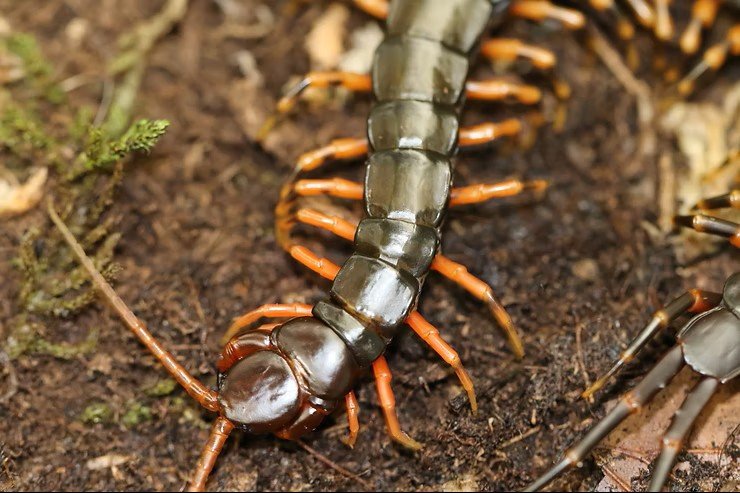
Scolopendra subspinipes ‘Piceoflava’ / ‘Sulawesi’
Common name: Sulawesi white-leg / Sulawesi tiger centipede
Origin: Sulawesi, Indonesia, though some hobbyists claim to have obtained them from Thailand.
Lifestyle: Terrestrial, ground-dwelling centipede that shelters in substrate/cover and behaves like other scolopendromorphs as a nocturnal predator.
Adult size: Typically ~18–22 cm (7–9 in), with some sellers reporting ~20–30 cm (8–12 in) depending on specimen/locality.
Growth rate: Moderate to slow—in the S. subspinipes complex, juveniles may take ~3–4 years to reach full adult size (highly dependent on feeding and temps).
Temperament: Fast and defensive; may jump
Color & appearance: Known for high-contrast “banded” look (dark body with lighter/yellowish banding/tergite patterning) and hobby lines described as black-leg or white-leg forms; some taxonomic notes describe a distinctive yellowish coloration on posterior tergite areas.
Species history
The current consensus among myriapodologists is that Scolopendra subspinipes ‘Piceoflava’ is part of the S. subspinipes species complex. Many hobbyists list it as Scolopendra sp. ‘Piceoflava’, though there is no real basis for this distinction due to a lack of material and molecular data.
Natural habitat
This locality of S. subspinipes lives in of Sulawesi, Indonesia. The type locality is from Tomohon (North Sulawesi) which is characterized by volcanic highlands, tropical rainforests, and rainfall year-round. This is a ground-dwelling, nocturnal centipede that spends daylight hours under leaf litter, rocks, bark, and rotting wood, so a proper enclosure should include a hide and a few inches of substrate for burrowing.
Scolopendra heros
Common name: Giant desert centipede is typical though there are many others for specific localities (i.e. Texas redheaded centipede)
Origin: Southwestern United States and northern Mexico.
Lifestyle: A fast, ground-dwelling predator that shelters under stones/logs/leaf litter and hunts other arthropods (and sometimes small vertebrates). Often described as primarily nocturnal, though it may be encountered active in daytime.
Adult size: Typically 6-8” though individuals nearly 12” are not unheard of, especially in captivity. This is the largest Scolopendra in the continental United States.
Growth rate: Moderate/variable—like other centipedes it grows by molting through multiple instars, and maturity timing can vary with conditions and feeding.
Temperament: Fast, defensive, and can be aggressive; capable of a painful venomous bite and may also pinch/grab with rear legs when threatened.
Color & appearance: Varies greatly by locale but the most commonly observed has orange tergites with the rear tergites being black as well as the head capsule. Yellow or orange legs appears to be a universal trait across all localities.
Species summary
Scolopendra heros—commonly called the giant desert centipede or giant redheaded centipede—is a large North American scolopendrid centipede known for its bold “warning” coloration and powerful predatory lifestyle. It was described by Girard in 1853, and modern taxonomic catalogs list it as a valid species; several historical names and subspecies have been associated with it (synonyms and named variants exist in the literature).
Natural habitat
Scolopendra heros occurs across the south-central and southwestern United States and into Northern Mexico. Despite the common name, it is found in both arid/semi-arid and woodland habitats in parts of its range. While S. heros is nocturnal like other Scolopendra species, it is found foraging during the day quite often. When it is not hunting for prey, it can be found under rocks, logs, and any other hiding place that provides shelter from the hot desert sun.