

Acanthoscurria
The genus Acanthoscurria was established in 1871 by Austrian arachnologist Anton Ausserer. Its most famous member, Acanthoscurria geniculata, was actually described earlier, in 1841, and later became the type species for the group. In the 19th and early 20th centuries, many large South American tarantulas were shuffled between several now-obsolete genera before being brought together under Acanthoscurria.
Today, Acanthoscurria includes more than thirty recognized species spread across much of tropical South America, where they live as robust, ground-dwelling spiders in forest floors, leaf litter, and shallow burrows. Over the last few decades, taxonomists have revisited the group, synonymizing old names, describing new species, and resolving long-standing mix-ups in the hobby—most famously the “A. brocklehursti” name, which is often applied in the pet trade to banded forms of A. geniculata rather than to the original scientific species.
We follow the current World Spider Catalog and recent revisions to ensure that all Acanthoscurria are correctly identified (at least until the next revision).
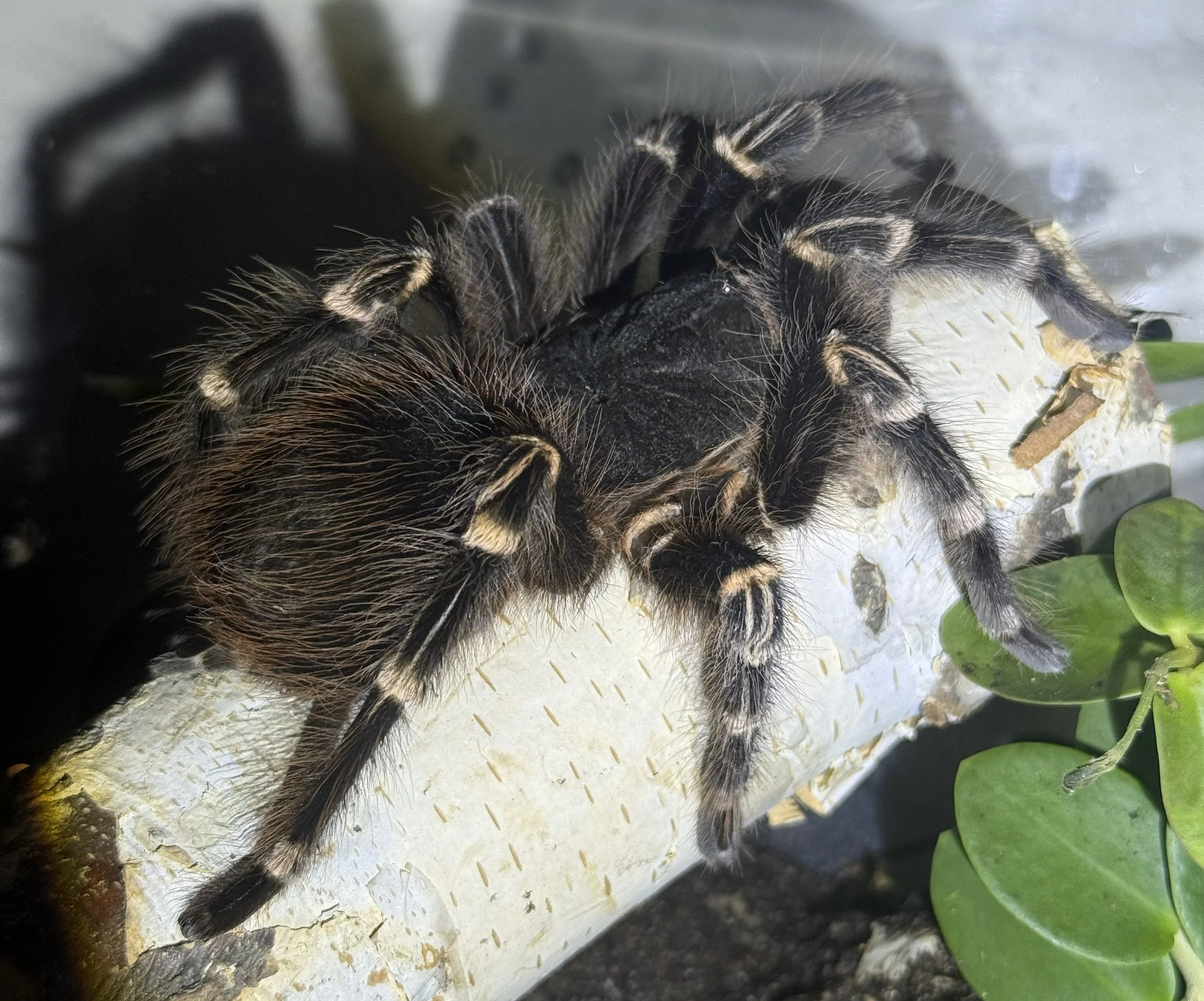
Acanthoscurria geniculata
Acanthoscurria geniculata—the Brazilian Whiteknee—is a large, terrestrial New World tarantula admired for its bold, high-contrast look: a deep, velvety dark body accented by bright white “knee” banding on the legs. It’s also famous for an intense, fast feeding response and an active “out and about” presence once settled, making it a staple display species in the hobby.
As a ground-dweller, A. geniculata typically establishes a secure retreat and may dig or remodel the area into a shallow burrow. When threatened, it often relies on urticating hairs (hair-kicking) and quick retreats rather than prolonged “stand and fight” behavior—though individuals can be bold and defensive if repeatedly disturbed. Adult females are commonly reported around 8 inches (20–21 cm) diagonal leg span, with males usually smaller and leggier. Growth is generally considered fast for a large terrestrial, which is part of its popularity for keepers who enjoy watching a specimen develop into a full-sized adult.
Common name: Brazilian Whiteknee Tarantula; in scientific contexts, the binomen Acanthoscurria geniculata is preferred.
Origin: Brazil.
Natural habitat: Brazilian forest habitat; best interpreted as a terrestrial, ground-associated tarantula from the northern forests of Brazil.
Lifestyle: New World terrestrial theraphosid.
Adult size: Large terrestrial tarantula; hobby and care sources commonly place females up to about 8.25 inches (21 cm) diagonal leg span, though catalog-level taxonomic sources do not standardize a single mature size value.
Growth rate: Fast in hobby and care literature; not standardized in the primary taxonomic literature.
Temperament: No formal behavioral diagnosis exists; non-taxonomic care sources commonly describe the species as defensive, especially when disturbed.
Color & appearance: Species recognition in the scientific literature is based on morphology and patterning; in live and hobby contexts, it is especially noted for a dark body with bold white leg banding.
Species History
Early description (1800s):
The species first entered science in 1841, described by C. L. Koch under the then broad, catch-all mygalomorph name Mygale geniculata. The type material referenced in modern revisions traces to northern Brazil (Rio Branco region, modern Roraima) and was collected during early natural history expeditions.
In 1850, Koch listed it under a different genus concept as Scurria geniculata, reflecting how tarantula classification was still taking shape and names moved frequently as authors refined group boundaries.
Placement in Acanthoscurria (late 1800s):
In 1871, Anton Ausserer established Acanthoscurria and transferred the species to Acanthoscurria geniculata—the combination used today. Importantly, A. geniculata is treated as the type species for the genus, meaning it anchors what “Acanthoscurria” is defined to be.
In 1896, F. O. Pickard-Cambridge published additional work on theraphosids from the Lower Amazon, including treatment/illustration that helped strengthen the species’ identity in the literature and broaden its documentation beyond the earliest material.
20th century to modern revisions:
Through the 1900s, A. geniculata continued to appear in taxonomic and identification works as authors refined theraphosid characters and compared populations across northern Brazil and the Amazon region.
In 1972, a very similar tarantula was described as Acanthoscurria transamazonica from Pará (Marabá).
A major modern milestone came in 2014, when a detailed revision of Brazilian Amazonian Acanthoscurria concluded that A. transamazonica is a junior synonym of A. geniculata, consolidating records under one species and clarifying diagnostic traits and distribution.
Today, Acanthoscurria geniculata remains one of the most recognizable “classic” terrestrial tarantulas in the hobby—an outcome of both its unmistakable patterning and the stabilizing effect of modern taxonomic work.
Natural Habitat
Acanthoscurria geniculata is native to northern Brazil, strongly associated with the Amazon Basin. In the wild it inhabits the rainforest ground layer, where conditions are typically warm, humid, and stable relative to more seasonal environments.
You can think of its habitat in three layers:
Biome: Lowland tropical rainforest (Amazonian region).
Microhabitats: Leaf litter, root systems, fallen wood, and protected soil pockets.
Shelter style: Shallow burrows or retreats under roots, logs, and leaf litter, often positioned to provide security while allowing quick access to passing prey.
This natural history aligns with its captive behavior: it benefits from a secure hide, ground space, and a substrate deep enough to let it dig and “settle in” like it would beneath rainforest cover.
Our Specimen
“Marge” is a huge 8 inch A. geniculata that is always out on display. She is a very aggressive eater and highly responsive to any movement or enclosure arrangement. She has been a wonderful addition to our collection.
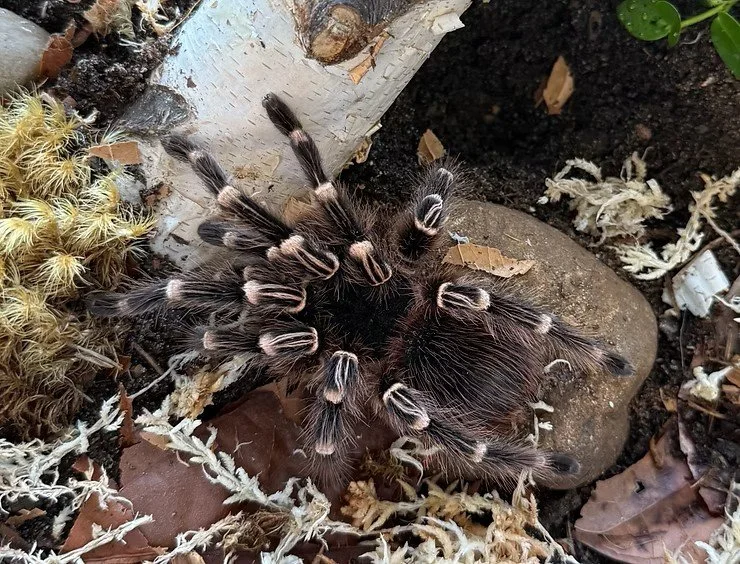
Acanthoscurria Musculosa
Acanthoscurria musculosa is a medium-to-large South American terrestrial tarantula best known in captivity for its dark, velvety appearance, robust build, and classic “ground-dwelling burrower” lifestyle. Like many New World terrestrials, it spends much of its time anchored to a secure retreat, and when comfortable it will sit at the entrance waiting for vibrations that signal prey. When threatened, it typically relies on speed, retreat, and urticating hairs rather than prolonged confrontation.
Adults are generally dark brown to black overall, with a plush, “velvet” look that can appear especially rich after a fresh molt. Some individuals show subtle tonal variation as the setae age—shifting from glossy black toward darker brown or charcoal—and may display faint leg banding/striping depending on lighting and specimen condition. In scientific measurements of large females, body length can be around 7 cm, with long legs giving an overall large, imposing footprint.
Because “Black Velvet” is used loosely in the hobby, it’s worth presenting this species on your site as a central South American Acanthoscurria with a burrow-based lifestyle, strong feeding response, and classic New World defense strategy (hair-kicking).
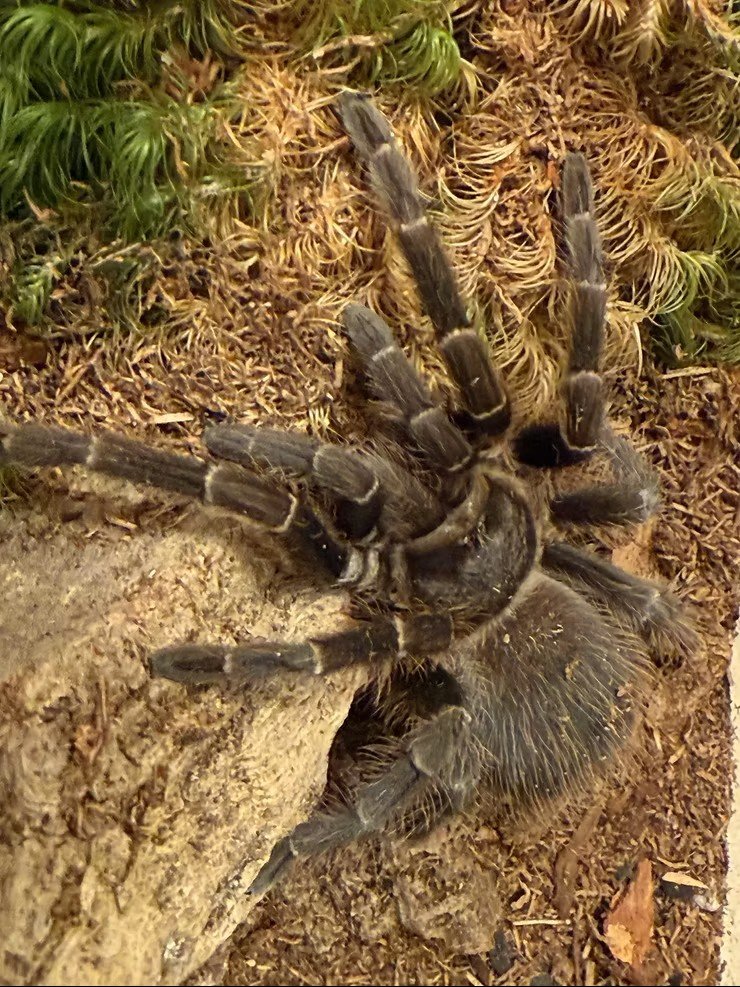
Common name: No universally standardized scientific common name; in hobby usage it is sometimes referred to as the Black Velvet Tarantula or Acanthoscurria musculosa.
Origin: Bolivia, Paraguay, and Argentina.
Natural habitat: South American terrestrial habitat; best interpreted as a ground-associated theraphosid rather than an arboreal species.
Lifestyle: New World terrestrial theraphosid.
Adult size: Medium to large terrestrial tarantula; hobby sources commonly place adults at about 5–6 inches, though catalog-level taxonomic sources do not standardize a single mature size value.
Growth rate: Not standardized in the primary taxonomic literature.
Temperament: No formal behavioral diagnosis exists; non-taxonomic sources sometimes describe the species as comparatively calm with humans but highly food responsive.
Color & appearance: Species recognition in the scientific literature is based on morphology and patterning; in live and hobby contexts it is often described as dark brown to black with a velvety appearance.
Species History
1892 — Original description: The species was first described by Eugène Simon (1892) from a male specimen; historical literature cites San Matéo, Bolivia in connection with the original material and early concept of the species.
Early 1900s — similar names enter the literature: Closely related or similar-appearing taxa were described in the genus (including A. sternalis in 1903, plus other names used historically in comparisons), contributing to a long period of confusion and mixed identifications in collections.
1923–1969 — additional redescriptions and expanded sampling: Authors revisited A. musculosa using material from regions near Bolivia, including Mato Grosso (Brazil) specimens used in mid-century and later redescriptions, helping document female morphology and variation.
2000s — confusion persists with “look-alike” species: The genus Acanthoscurria contains multiple dark terrestrials that can be difficult to separate without mature specimens and careful examination, and misidentifications remained common in both literature and the hobby.
2020 — modern taxonomic consolidation: A major modern revision treated A. musculosa as the senior species, synonymizing some previously separated names (including A. sternalis and A. hirsutissimasterni) under A. musculosa, stabilizing the species concept and updating distribution understanding.
Natural Habitat
Acanthoscurria musculosa is associated with central South America, and modern catalogs list its distribution as Bolivia, Paraguay, and Argentina, with historical records also tying it to localities near the Bolivia–Brazil–Paraguay region. In broad ecological terms, this places the species in and around landscapes such as the Gran Chaco (a mosaic of dry forests, thorn scrub, savannas, and seasonally wet areas) and the Pantanal system (a massive seasonal floodplain wetland spanning Brazil, Bolivia, and Paraguay).
On the ground, this translates to a spider adapted to life at soil level, where a secure retreat is essential for buffering heat, humidity swings, and predators. Like many terrestrial theraphosids in these regions, it’s best thought of as a burrow-associated ambush predator: it uses a protected hide (often a burrow or reinforced shelter under cover) as a permanent base, emerging primarily for feeding and (in mature males) for seasonal wandering.
Our Specimen
“Onyx” (pictured above) is an adult male who recently molted (hence the confirmation of gender). He is always on display and is highly reactive to any type of engagement with his enclosure. Onyx has been a consistent eater for us over the past year plus. He has a bit of an attitude. I would like to finding a breeding mate for him but adult females are difficult to locate.
Acanthoscurria sp. Maldonado
Acanthoscurria sp. “Maldonado” is a locality-based trade name used in the hobby for a large, terrestrial South American tarantula associated with the Puerto Maldonado / Madre de Dios area of southeastern Peru. Like many Acanthoscurria, it’s typically a ground-dwelling ambush predator that appreciates a secure retreat and will often excavate or reinforce a burrow once settled. Keepers commonly describe a strong feeding response, heavy “home-base” behavior (staying close to the retreat), and the classic New World defense strategy of retreat + urticating hairs when stressed.
Because it’s sold as “sp.” (species undetermined), this animal should be presented as a Peru locality form rather than a fully described species. The name you’ll see in listings—often written as Acanthoscurria sp. “Maldonado” or “maldonadensis”—is best treated as an ID label used by the trade until formal scientific work ties the population to an existing described species or a new one is published.
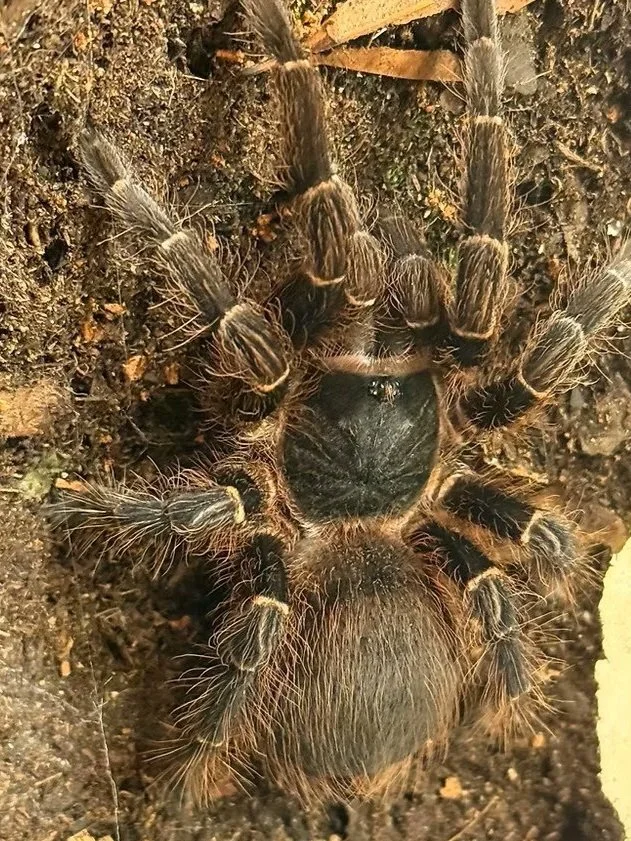
Common name: No universally standardized scientific common name; in hobby usage this tarantula is often sold as the Maldonado Birdeater or Acanthoscurria sp. “Maldonado.”
Origin: Southeast Peru, especially the Madre de Dios / Maldonado region in public trade usage.
Natural habitat: Peruvian tropical terrestrial habitat; best treated as a ground-associated tarantula rather than an arboreal species.
Lifestyle: New World terrestrial theraphosid in hobby treatment.
Adult size: Large terrestrial tarantula; public trade listings commonly place adults up to about 15 cm, though catalog-level taxonomic sources do not standardize a single mature size value under this trade label.
Growth rate: Moderate in public hobby and vendor descriptions; not standardized in the primary taxonomic literature under this label.
Temperament: No formal behavioral diagnosis exists; public trade listings commonly describe it as semi-aggressive.
Color & appearance: This is best treated as a hobby or trade designation rather than a currently accepted scientific species name in the World Spider Catalog, so formal species recognition is not standardized under “Acanthoscurria sp. Maldonado.”
Species History
Genus background:
The genus Acanthoscurria was established in the 19th century and today includes multiple robust, terrestrial tarantulas across South America—many of which can look very similar without mature specimens and detailed examination.
Where “Maldonado” comes from:
The “Maldonado” name appears to be derived from Puerto Maldonado, the regional hub city in Madre de Dios, Peru.
In the tarantula hobby, “sp. Maldonado / maldonadensis” is used to indicate a locality-identified animal that hasn’t been confidently matched to a currently recognized scientific species name.
Why the scientific name is written as “sp.”:
The World Spider Catalog’s current Acanthoscurria species list does not include a valid species named maldonadoensis, supporting the idea that this is not an accepted scientific species name at present.
Some vendors and keepers still use “maldonadensis” informally, but it should be treated as a trade label, not a confirmed taxonomy.
Natural Habitat
Region:
This locality form is associated with the Peruvian Amazon, especially the Madre de Dios region around Puerto Maldonado—an area widely recognized for extremely high biodiversity and extensive lowland rainforest.
Climate and environment:
Puerto Maldonado sits in a hot, humid tropical rainforest setting at low elevation (roughly a couple hundred meters above sea level), with a true rainforest climate. The surrounding landscape is dense Amazonian forest (“selva”), with deep leaf litter, roots, fallen wood, and moist soils that provide ideal conditions for ground-dwelling theraphosids.
Microhabitat and shelter use (what it likely does in the wild):
Like many terrestrial tarantulas in rainforest regions, it likely relies on protected ground retreats—using soil pockets, natural crevices, root tangles, and burrows under cover (logs/roots/leaf litter) to stabilize humidity and temperature and to avoid predators. This matches why captive specimens typically thrive when given deep substrate and a secure hide.
Our Specimen
“Mahogany” is a sub-adult 5.5 inch a. Maldonado. Although little is know, other than where they are likely found, this specimen is clearly Acanthoscurria. When Mahogany was obtained, it was cinnamon brown and fuzzy. After a molt, it turned into a tank-like body with dark brown coloration. Our specimen is an obligate burrower and is rarely seen. It is a consistent eater with very spicy attitude. Mahogany has shown defensiveness on a number of occasions.