
Anqasha

Anqasha is a recently erected South American genus of the family Theraphosidae established on the basis of morphological and biogeographic evidence that segregated a clade of high-altitude Andean species from previously encompassing genera. Members are associated with the montane and puna biomes of the central Peruvian Andes, where they occupy rocky slopes, crevices, and tussock grasslands at elevations considerably higher than those tolerated by most Neotropical theraphosids.

Species within the genus are comparatively small-bodied relative to lowland theraphosids, an ecomorphological pattern common among high-altitude Andean arachnids, and they exhibit life-history traits consistent with cooler, more thermally variable environments, including reduced growth rates and extended intermolt intervals. Adult leg span is modest, generally falling in the range of 2.5 to 4 inches. Retreats are typically constructed within natural crevices and beneath stones, with silk used primarily to line the refuge rather than to form extensive surface structures.

As New World theraphosids, Anqasha species possess urticating setae on the dorsal opisthosoma and rely on a combination of refuge concealment and setal flicking for defense. Venom is of no documented medical significance, and temperament is typically described as retiring. The integument frequently bears subtle metallic or copper-toned setae that contribute to the genus's diagnostic appearance.

The genus remains taxonomically young, and ongoing revisionary work continues to refine the boundaries between Anqasha and related Andean lineages such as Hapalotremus and Bistriopelma. Natural-history data are comparatively sparse, and the genus is rarely encountered outside of targeted high-altitude field surveys, contributing to its scarcity in private collections.
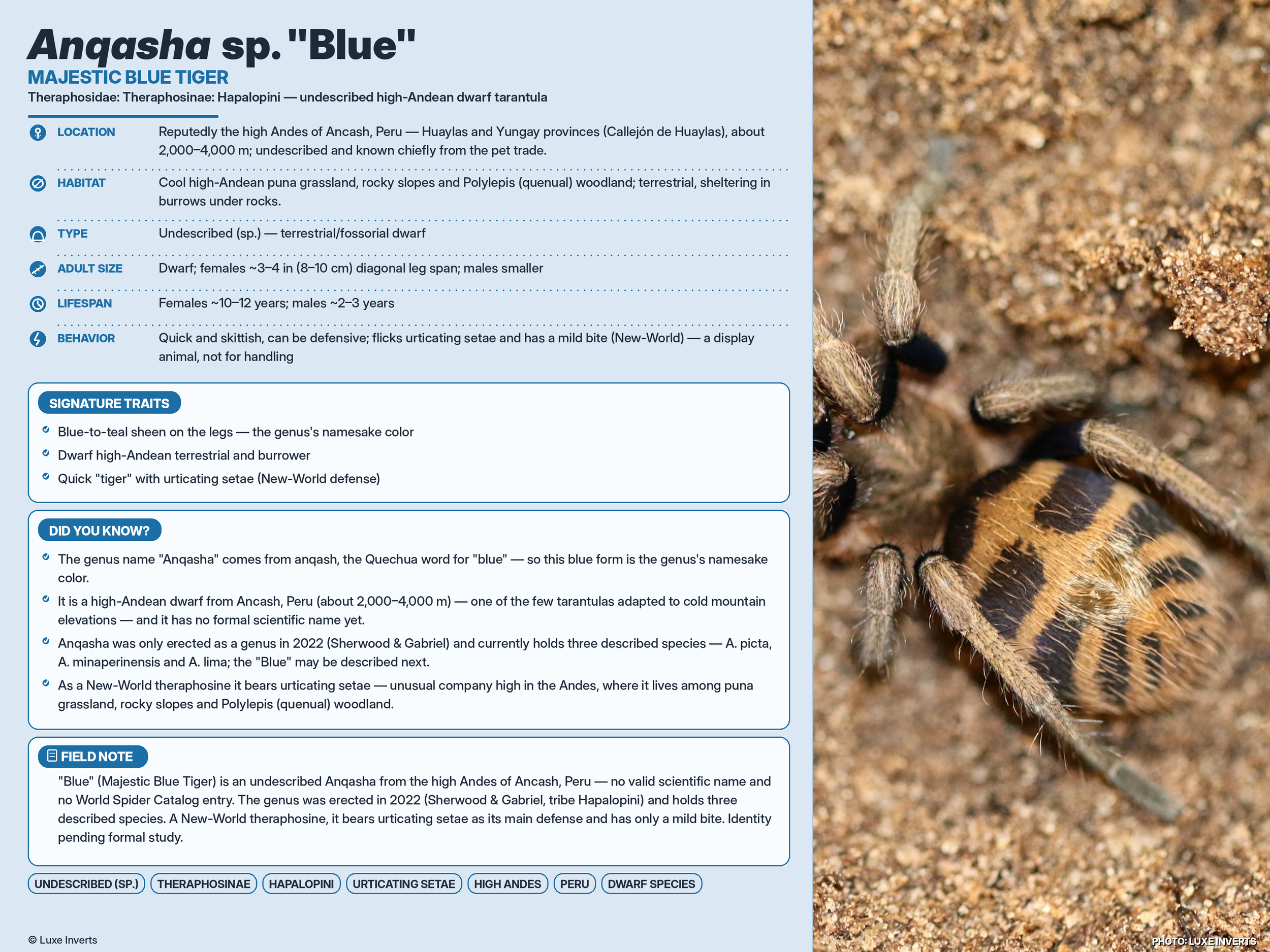
Anqasha sp. "Blue" — Peruvian Blue Dwarf tarantula

Anqasha sp. "Blue"

Peruvian Blue Dwarf

Photo: Luxe Inverts
Field Note

Anqasha is a recently erected Neotropical genus within subfamily Theraphosinae, circumscribed by Kaderka, Ortiz, and Peñaherrera-R. in 2021 from specimens collected in the Peruvian and Bolivian Andes. The genus name is Quechua for “blue,” a reference to the metallic coloration present in several described members. Anqasha sp. “Blue” is an undescribed trade form currently awaiting formal assignment; hobby material has been tentatively linked to Andean cloud-forest populations and may prove conspecific with, or sister to, one of the described species once morphological and molecular work is completed.

Range
Undescribed form; captive material originates from Andean Peru. Related described congeners occur in cloud-forest habitats of the eastern Andean slope.
Lifestyle
Opportunistic terrestrial with strong fossorial tendencies; constructs silk-lined burrows beneath rocks and rootmats in the wild. Small-bodied by theraphosid standards.
Adult Size
A small dwarf; females reach roughly 3–3.5 in diagonal leg span; males noticeably smaller. Sexual dimorphism is modest compared with large-bodied Theraphosinae.
Difficulty
Intermediate
Temperament
Flight-dominant and reclusive; threat displays are rare. Carries Type I urticating setae typical of Theraphosinae, though the small body size limits the practical defensive dose. Bites are undocumented to the author’s knowledge and venom is not considered medically significant.
Habitat
Cool, humid Andean cloud-forest and adjacent montane habitats. Expects moderate substrate moisture, stable temperatures in the mid-60s to low-70s °F, and good ventilation. Avoid the hot, dry conditions suitable for lowland Theraphosinae.
Theraphosinae Terrestrial burrower Andean endemic Dwarf Undescribed form