

Pamphobeteus
Family: Theraphosidae · Subfamily: Theraphosinae · Type species: Pamphobeteus nigricolor (Ausserer, 1875)
Pamphobeteus is a genus of very large terrestrial tarantulas from northwestern South America and adjacent Central America—among the bulkiest spiders in the Americas and a hobby favorite under names such as the "birdeaters" and "blooms." The genus is defined for many keepers by the spectacular sexual dimorphism of its males, which on maturity develop an intense iridescent purple, violet, or pink sheen ("bloom") across the carapace and legs that is absent in the cryptically colored females. Following an intensive wave of revisionary work between 2022 and 2025, the World Spider Catalog now recognizes 25 valid species, the great majority concentrated in the Andean foothills of Ecuador and Colombia.
Taxonomy and nomenclature
Pamphobeteus was erected by R. I. Pocock in 1901, with Lasiodora nigricolor Ausserer, 1875 as its type species. For much of the twentieth century the genus served as a catch-all for large theraphosines, accumulating numerous Brazilian and other species that have since been recognized as belonging elsewhere. Modern work has substantially purified the concept: many former Pamphobeteus have been transferred to Vitalius, Lasiodora, Megaphobema, Pterinopelma, Tekoapora, Lasiodorides, and Crypsidromus, leaving a genus restricted to a northwestern South American / lower Central American clade. A redescriptive revision of the type material held at the Natural History Museum, London (Sherwood, Gabriel et al., 2022), a large companion treatment of the Ecuadorian fauna (Sherwood, Cisneros-Heredia, Peñaherrera-R. et al., 2023), and further additions by Dupérré & Tapia (2025) together more than doubled the number of recognized species and stabilized the limits of the genus.
Morphology and biology
Pamphobeteus are massive, heavy-bodied theraphosines; mature individuals of the larger species are among the biggest tarantulas by leg span and mass, rivaling Theraphosa and Lasiodora. As members of the Theraphosinae they bear urticating setae (the abdominal Type III predominating) that are kicked defensively. The most conspicuous feature of the genus is its ontogenetic and sexual color change: juveniles and females are typically dark brown to black with a subtle starburst pattern on the carapace and faint leg markings, while mature males flush with metallic purple, magenta, or blue iridescence produced by the microstructure of the setae. The 2008 description of two Brazilian species by Bertani, Fukushima & Silva also documented a previously unknown type of stridulatory organ in the genus, adding to the morphological characters used in its diagnosis. Ecologically, Pamphobeteus are terrestrial, opportunistically burrowing ambush predators of humid Andean and Amazonian forests, sheltering in burrows, under logs and rocks, and among root buttresses.
Constituent species
The 25 currently recognized species, grouped by principal country of occurrence, are:
Ecuador (the most species-rich region): P. augusti (Simon, 1889), P. contramina Dupérré & Tapia, 2025, P. gangotenai Cisneros-Heredia et al., 2023, P. guacamayos Dupérré & Tapia, 2025, P. jamacoaque Peñaherrera-R. et al., 2023, P. lasjuntas Peñaherrera-R. et al., 2023, P. matildeae Sherwood et al., 2023, P. nellieblyae Sherwood et al., 2022, P. skis León-E. et al., 2023, P. ultramarinus Schmidt, 1995, P. urvinae Sherwood et al., 2022, P. vespertinus (Simon, 1889), P. zaruma Sherwood et al., 2022.
Colombia: P. ferox (Ausserer, 1875), P. fortis (Ausserer, 1875), P. insignis Pocock, 1903, P. lapola Sherwood et al., 2022, P. nigricolor (Ausserer, 1875) — the type species, P. ornatus Pocock, 1903, P. verdolaga Cifuentes, Perafán & Estrada-Gómez, 2016.
Brazil, Peru and Bolivia (Amazonian): P. amazonas Sherwood et al., 2023 (Brazil), P. antinous Pocock, 1903 (Peru, Bolivia), P. crassifemur Bertani, Fukushima & Silva, 2008 (Brazil), P. grandis Bertani, Fukushima & Silva, 2008 (Peru, Brazil).
Central America: P. sucreorum Gabriel & Sherwood, 2022 (Panama) — the northernmost species.
Distribution and conservation
The genus ranges across the northern Andes and western Amazon basin—Colombia, Ecuador, Peru, Bolivia and western Brazil—reaching its northern limit in Panama. Diversity is greatest along the humid eastern and western Andean slopes of Ecuador and Colombia, where many species are narrowly endemic to particular valleys or forest types. Pamphobeteus is not listed under CITES, and the principal conservation concern is habitat loss through Andean and Amazonian deforestation and land conversion, compounded for the most colorful species by collection for the international pet trade. Because several species were only formally described in the 2020s and are known from limited material, the true distributional and conservation picture for much of the genus remains incompletely documented.
Selected references
Pocock, R. I. (1901). Descriptions of some new species of spiders… (Establishment of Pamphobeteus.)
Bertani, R., Fukushima, C. S. & Silva, P. I., Jr. (2008). Two new species of Pamphobeteus Pocock 1901 (Araneae: Theraphosidae) from Brazil, with a new type of stridulatory organ. Zootaxa 1826: 45–58.
Sherwood, D., Gabriel, R. et al. (2022). On the species of Pamphobeteus deposited in the Natural History Museum, London… Arachnology 19(3): 650–673.
Sherwood, D., Cisneros-Heredia, D. F., Peñaherrera-R., P. et al. (2023). Revision of the Ecuadorian Pamphobeteus, with descriptions of new species.
World Spider Catalog (current version). Natural History Museum Bern. https://wsc.nmbe.ch
© Luxe Inverts — www.luxeinverts.com
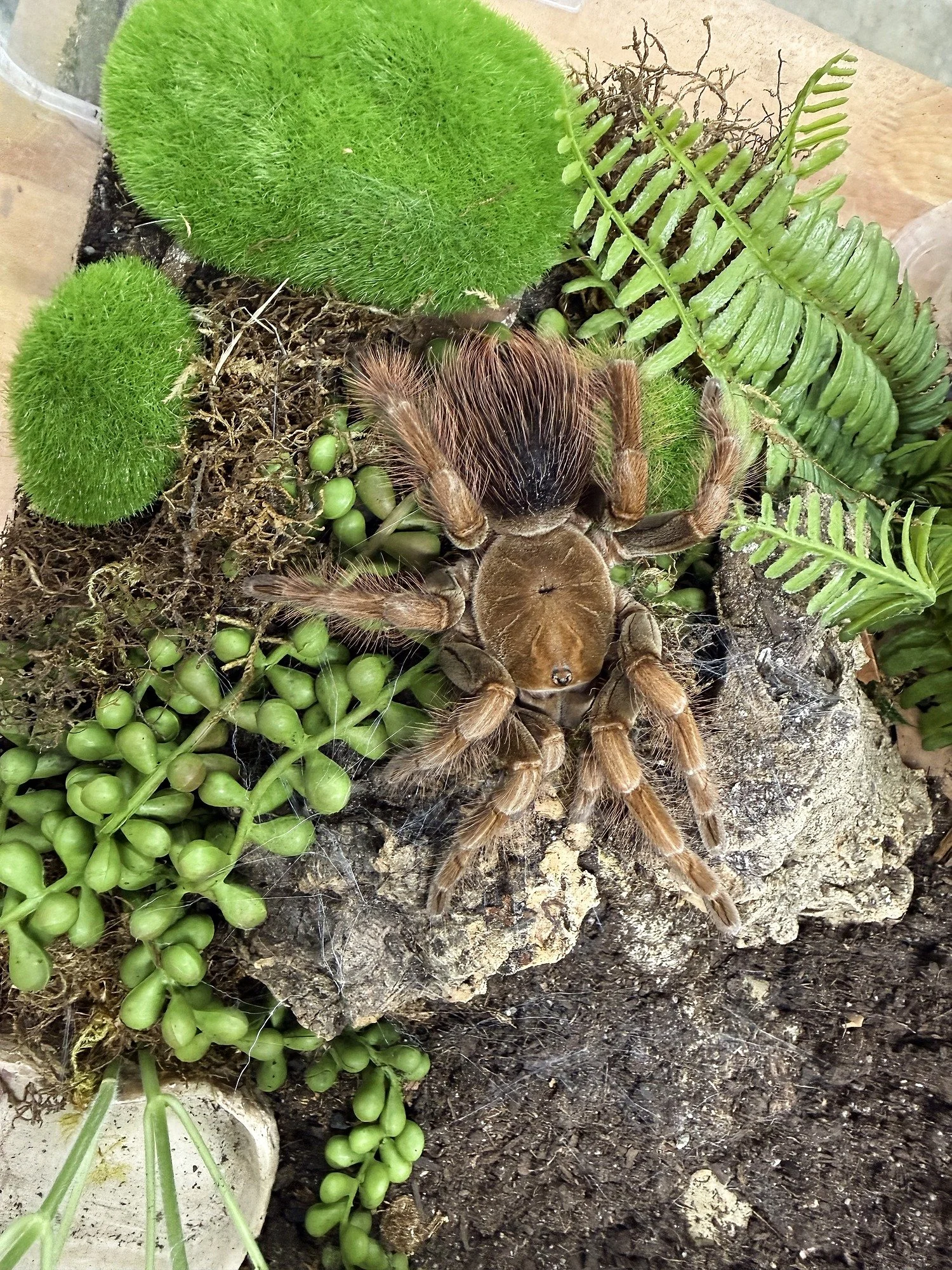
Pamphobeteus sp. ‘mascara’
Mascara Giant Birdeater
Pamphobeteus sp. ‘mascara’ is an undescribed Ecuadorian species in the genus Pamphobeteus Pocock, 1901, informally known in the hobby as the Mascara Giant Birdeater. The name refers to the diagnostic rose-to-carmine “mask” across the anterior carapace — a flush of warm pigment behind the ocular mound that is unusually pronounced in this species and contrasts with the dark femora and the bronze-gold setae of the opisthosoma. The species is known from the Pacific-slope cloud and premontane forests of western Ecuador and has been in the U.S. hobby only since approximately 2019. As with all Pamphobeteus, it bears type I urticating setae and uses them as a primary defense; the venom is mild by theraphosid standards but feeding response is dramatic and husbandry should account for the species' large adult size and powerful prey-handling behavior.
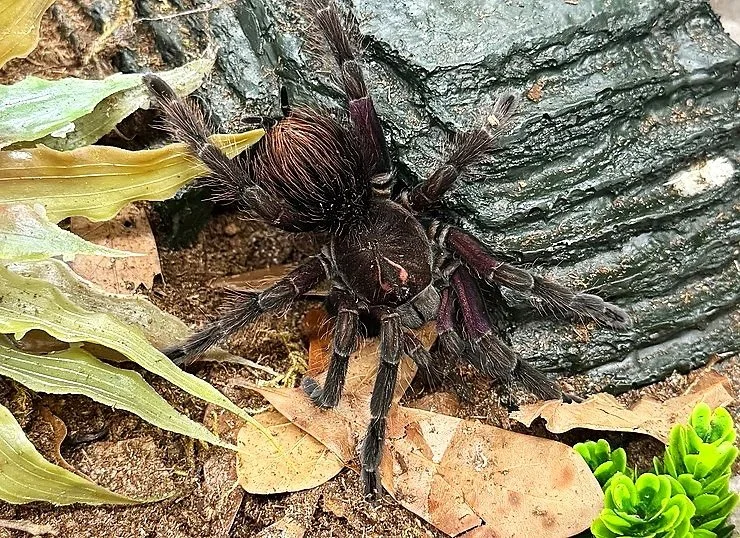
Pamphobeteus sp. ‘tigris’
Ecuadorian Black Birdeater
Pamphobeteus sp. ‘tigris’ is an undescribed Ecuadorian species in the genus Pamphobeteus Pocock, 1901, informally known in the hobby as the Ecuadorian Black Birdeater or Tiger Bloom. The trade name “tigris” references the bold tiger-stripe banding visible on the femora and patellae of juveniles and sub-adults — a pattern that fades with each molt until the adult emerges nearly uniform sable-black, with a subtle violet-to-magenta iridescence across the carapace and femoral segments under strong light. The species entered the U.S. hobby around 2019 and remains relatively uncommon. As with all Pamphobeteus, it bears type I urticating setae and is a large, muscular terrestrial with an explosive feeding response; husbandry should reflect the adult footprint and the animal's tendency to hold a single chosen retreat for months at a time.
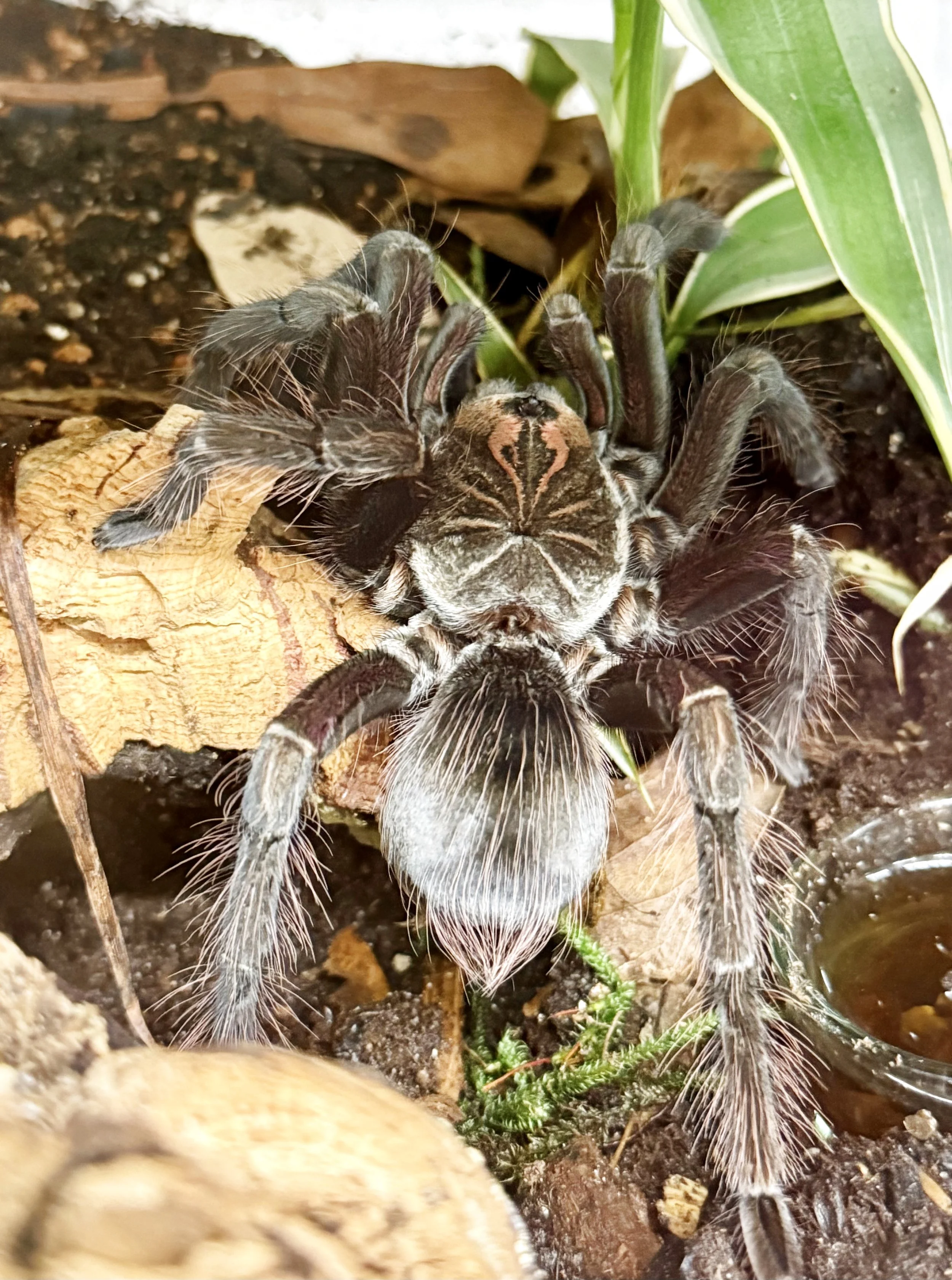
Pamphobeteus sp. ‘Machala’
Ecuador Purple Bloom (hobby form)
Pamphobeteus sp. ‘Machala’ is an undescribed hobby form named for its type-locality city, Machala, in El Oro Province on the Pacific slope of southwestern Ecuador. It is one of several regional Pamphobeteus colour forms that have circulated in the international pet trade for decades under informal Latinized names — ‘Machala’, ‘Mascara’, ‘Tigris’, ‘Platyomma’ — awaiting formal treatment. The genus was substantially revised by Sherwood, Gabriel, Peñaherrera-R., Cisneros-Heredia, León-E., Brescovit & Lucas in 2023 (Arachnology 19(6): 894), which redescribed the existing species, described six new species from Ecuador and Brazil (P. amazonas, P. gangotenai, P. jamacoaque, P. lasjuntas, P. matildeae, P. skis), and rearranged generic limits with Megaphobema Pocock, 1901. The ‘Machala’ form was not formally erected in that revision and its relationship to the newly described western-Ecuadorian congeners — particularly P. jamacoaque — remains to be worked out, but its Pacific-slope Ecuadorian origin places it firmly within the western radiation of the genus. The species shows the strong sexual dimorphism typical of Pamphobeteus: females remain dark brown through maturity, while males develop the bright violet-purple metallic sheen on the carapace and legs at the ultimate moult.