
Ewok
Ewok Peñaherrera-R., Sherwood, Gabriel, León-E., Rollard, Leguin, Brescovit & Lucas, 2025 is a recently erected genus of small-to-medium Andean theraphosids in the subfamily Theraphosinae, tribe Hapalopini, and one of four new Hapalopini genera (alongside Warmiru, Crypticarachne, and Devicarina) described in Peñaherrera-R. et al.'s 2025 revision of the tribe. The genus currently contains eight species: E. aycaramba Peñaherrera-R. et al., 2025 (new), E. aymara (Chamberlin, 1916), E. christineae (Sherwood & Gabriel, 2024) (type species), E. cyaneolus (Schmidt, Friebolin & Friebolin, 2005), E. eliseanneae (Sherwood & Gabriel, 2024), E. kainae Peñaherrera-R. et al., 2025 (new), E. kimraykawsaki (Signorotto et al., 2025), and E. pruriens (Schmidt, 1998). Six of the eight are former Thrixopelma transferred by the 2025 revision, and most pre-2025 hobby literature and captive-bred inventories still refer to these animals by the old combinations — particularly E. pruriens (as "Thrixopelma pruriens" or the trade name "Theraphosinae sp. Piura") and E. cyaneolus (as "Thrixopelma cyaneolum," the "Cobalt Blue" or "Cobalt Red Rump"). Under the revision, a reduced Thrixopelma Schmidt, 1994 is retained, with T. ockerti as the type species and the three Peruvian hobby forms sp. Golden Blue, sp. Loque, and sp. Sullana still standing in the old genus pending formal treatment.
Ewok is an Andean genus in the narrow sense: its known range spans the Peruvian Andes and their Pacific slope, from the dry northern foothills of Piura region (E. pruriens) south through the Andean valleys and highland scrub of central and southern Peru (E. aymara, E. cyaneolus), with the other species scattered across a comparable montane to sub-montane envelope. This places the genus in the same broad cool-climate theraphosid adaptive zone as Grammostola s.l. and Phrixotrichus, and sharply distinguishes the husbandry profile of Ewok species from that of the warm-lowland Neotropical Theraphosinae they often share pet-trade space with. Native habitat ranges from dry Pacific-slope foothills and xeric scrub through cloud-forest margins and cooler Andean valley floors; seasonality is pronounced, with cool dry winters and warmer wet summers, and captive animals respond well to a modest seasonal cycle. Sustained warmth above 80 F is poorly tolerated by most species in the genus, and cool-climate husbandry — high-60s to mid-70s F baseline with a tolerated winter dip, moderate humidity, and strong ventilation — is the appropriate template.
Members of the genus are terrestrial with a strong fossorial tendency. Wild animals excavate silk-lined burrows under rocks, tree roots, and bunchgrass on Andean slopes; in captivity they accept a cork retreat on 4–6 in of moderately moist substrate with a dry surface, and generally prefer a retreat-oriented setup to an open surface. Adult female sizes across the genus are modest by New World standards — typically 4–5 in diagonal leg span in the better-known species, with E. pruriens and E. cyaneolus at the upper end of that range — and growth is slow, a consistent trait of cool-climate theraphosids. Males are smaller and more gracile, and short-lived post-ultimate. Ewok species bear type I urticating setae as their principal active defense and are in the main skittish rather than defensive: retreat is strongly preferred to threat display, bites are uncommon, and venom is mild by theraphosid standards with documented envenomations in the ex-Thrixopelma species producing only transient localized effects. Coloration varies considerably across the genus, from the marine-blue-and-red-rump phenotype of E. cyaneolus to deep velvet browns and warm coppers in most other species; E. pruriens is the velvet-green "Peruvian Green Velvet" of the pet trade, and the two newly described species are, on current information, in the same muted-brown to velvet-dark colour range.
No Ewok species is currently listed on CITES and none has a published IUCN Red List assessment, but the genus's Andean range is under sustained pressure from road expansion, mining, and agricultural conversion, and the cloud-forest and dry-foothill habitats of the Pacific slope are particularly vulnerable. Captive-bred stock has largely displaced wild-sourced animals for the two best-established species in the international hobby (E. pruriens and E. cyaneolus), though the two newly described species are not in circulation under their new names as of 2026 and the other four remain peripheral in the hobby. In captivity, the genus expects 4–6 in of moderately moist substrate with a dry surface, a cork retreat or pre-started burrow, high-60s to mid-70s F with a tolerated seasonal cool dip, and moderate humidity with generous cross-ventilation. Alongside Warmiru, Crypticarachne, and Devicarina, Ewok represents the 2025 rationalization of what had long been a morphologically and ecologically heterogeneous Thrixopelma, and its composition is likely to grow as the three Peruvian undescribed hobby forms currently parked in the reduced Thrixopelma are examined against the new generic diagnoses.
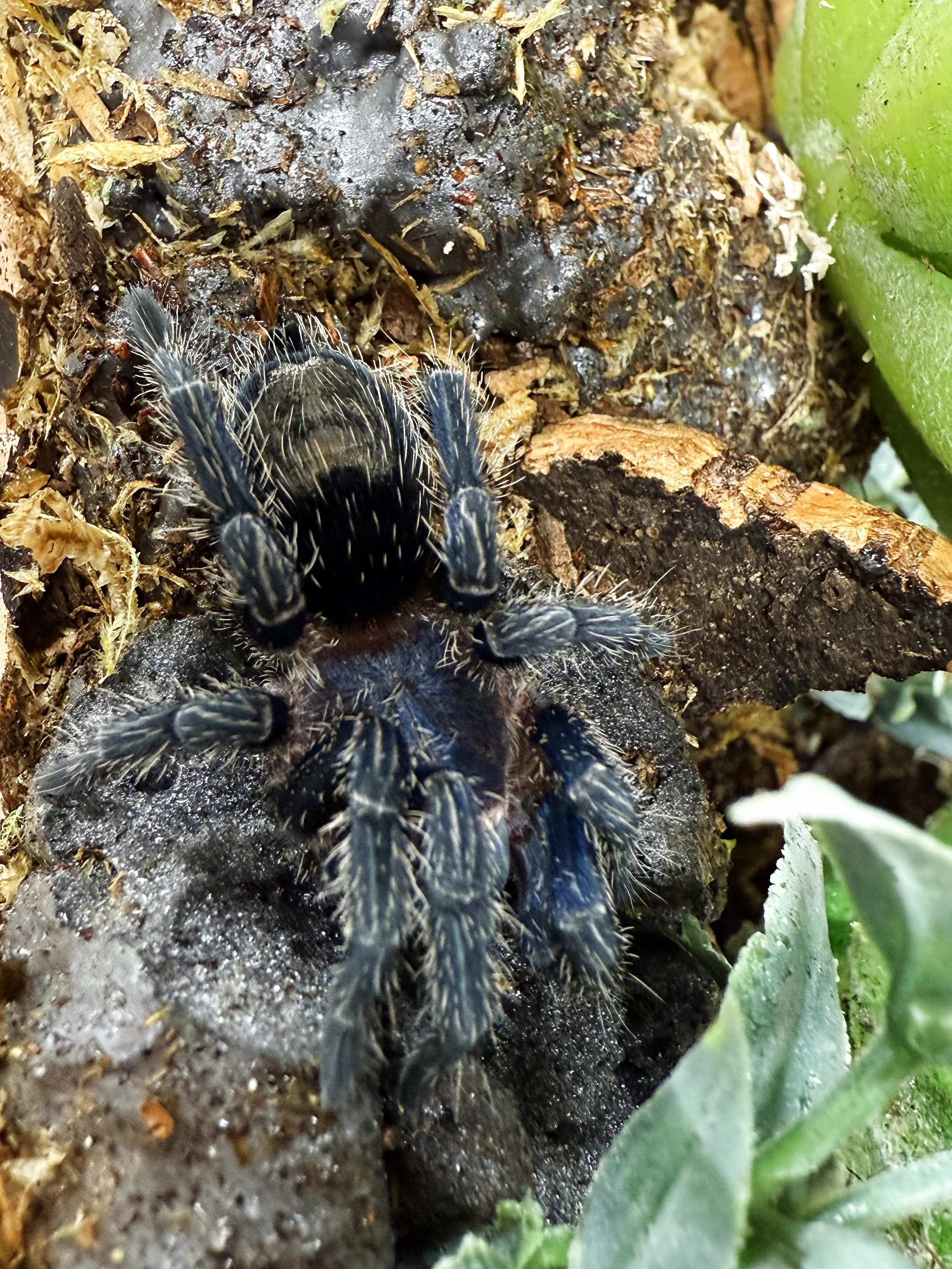
Ewok cyaneolus
Cobalt Blue (ex. Thrixopelma cyaneolum)
Ewok cyaneolus (Schmidt, Friebolin & Friebolin, 2005) is the Cobalt Blue or “Cobalt Red Rump,” described from the Pacific-slope highlands of Peru and long known in the hobby as Thrixopelma cyaneolum. The species was transferred to Ewok Peñaherrera-R., Sherwood, Gabriel, León-E., Rollard, Leguin, Brescovit & Lucas, 2025 in the recent revision of the tribe Hapalopini, which erected four new genera (Ewok, Warmiru, Crypticarachne, and one additional) and transferred a majority of the species previously in Thrixopelma; current congeners in Ewok include E. pruriens, E. kimraykawsaki, E. aymara, E. christineae, E. eliseanneae, and E. zaratensis. Pre-2025 hobby literature and captive-bred inventories (including the name under which this animal is almost always sold) use the old combination Thrixopelma cyaneolum. The species is cool-adapted, slow-growing, and strikingly coloured at maturity: marine-blue metallic body with dense silver-tipped setae and warm red-brown opisthosomal pubescence.