
Haplocosmia
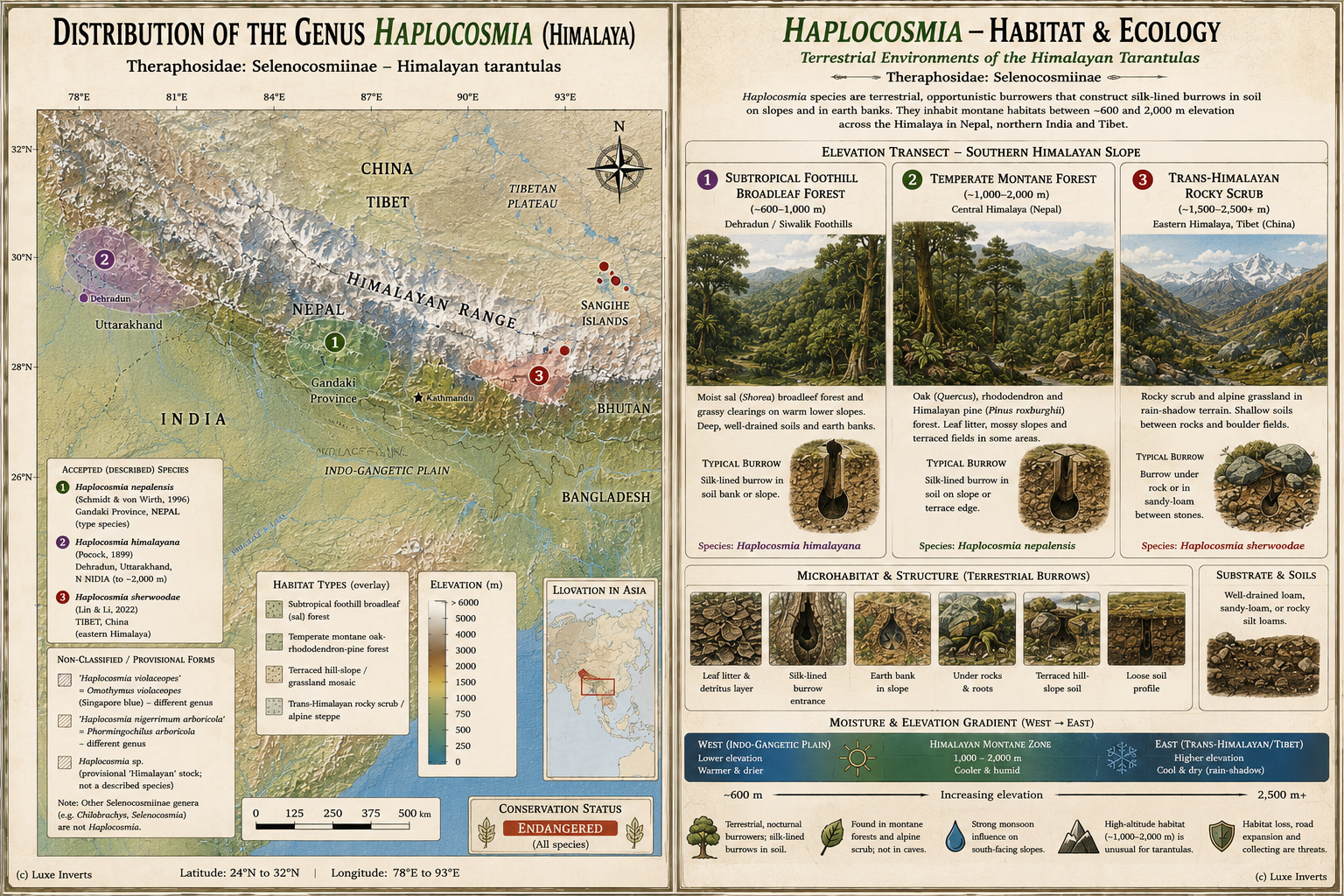
Haplocosmia Schmidt & von Wirth, 2005 is a small genus of terrestrial theraphosids in the subfamily Selenocosmiinae, erected to accommodate high-altitude Himalayan spiders that had historically been placed in Chilobrachys. The type species, Haplocosmia himalayana, was originally described by Pocock in 1899 from Nepal and reassigned to the new genus on the basis of spermathecal and tibial-spur morphology. The genus is restricted to montane forest and forest-edge habitat in Nepal and immediately adjacent regions of the eastern Himalaya, at elevations where nights are consistently cool and seasonal temperature swings are pronounced. Beyond the type species, a small number of additional forms — including the undescribed "sp. Black Femur" circulating in private collections from the Nepalese lowland-to-montane transition — almost certainly represent further Haplocosmia awaiting formal treatment.
Members of the genus are semi-fossorial. Juveniles and sub-adults excavate short, silk-lined retreats under leaf litter, rocks, and fallen wood along forest slopes; adults often expand these into shallow burrows with a silk apron at the entrance. They are nocturnal ambush predators, taking invertebrate prey from the retreat opening. Compared to the tropical Selenocosmiinae of Southeast Asia, Haplocosmia are notably cool-tolerant — wild-caught adults routinely experience night temperatures in the 50s °F — and this is reflected in captive husbandry: the genus does not require the sustained warmth typical for the subfamily, and animals fare poorly when kept at the upper end of the Selenocosmia / Cyriopagopus range.
Morphologically, Haplocosmia are medium-bodied by Asian standards, with adult females reaching roughly 4.5–5 in diagonal leg span. Coloration is muted — adults are typically a drab grey-brown with fine cream banding across the patellae and tibiae — and sexual dimorphism is modest. Like all Selenocosmiinae, the genus lacks urticating setae and possesses a prominent stridulating organ (lyra) between the chelicerae and pedipalp coxae, which is used to produce an audible hiss when threatened. Venom has not been characterized in detail in the primary literature, but bites from congeners in Selenocosmiinae are painful and can produce substantial local and systemic effects; the genus should be treated as medically significant, and handling is not advised.
No Haplocosmia species is currently listed on CITES or has a published IUCN Red List assessment, but the genus's range coincides with regions experiencing rapid deforestation, road development, and agricultural expansion, and with known commercial collection pressure for the international pet trade. In captivity, the genus expects a deep substrate layer (commonly 6–8 in), a cork bark or half-log retreat, cool-temperate temperatures in the high-60s to mid-70s °F, and moderate humidity with steady ventilation; prolonged exposure above 80 °F is poorly tolerated. Haplocosmia is an uncommon genus in the hobby, studied very little in the laboratory, and a useful case study in how montane Asian theraphosid systematics continues to be clarified.