

Poecilotheria
Family: Theraphosidae · Subfamily: Poecilotheriinae (sole genus) · Type species: Poecilotheria fasciata (Latreille, 1804) — inherited from the replaced genus Scurria
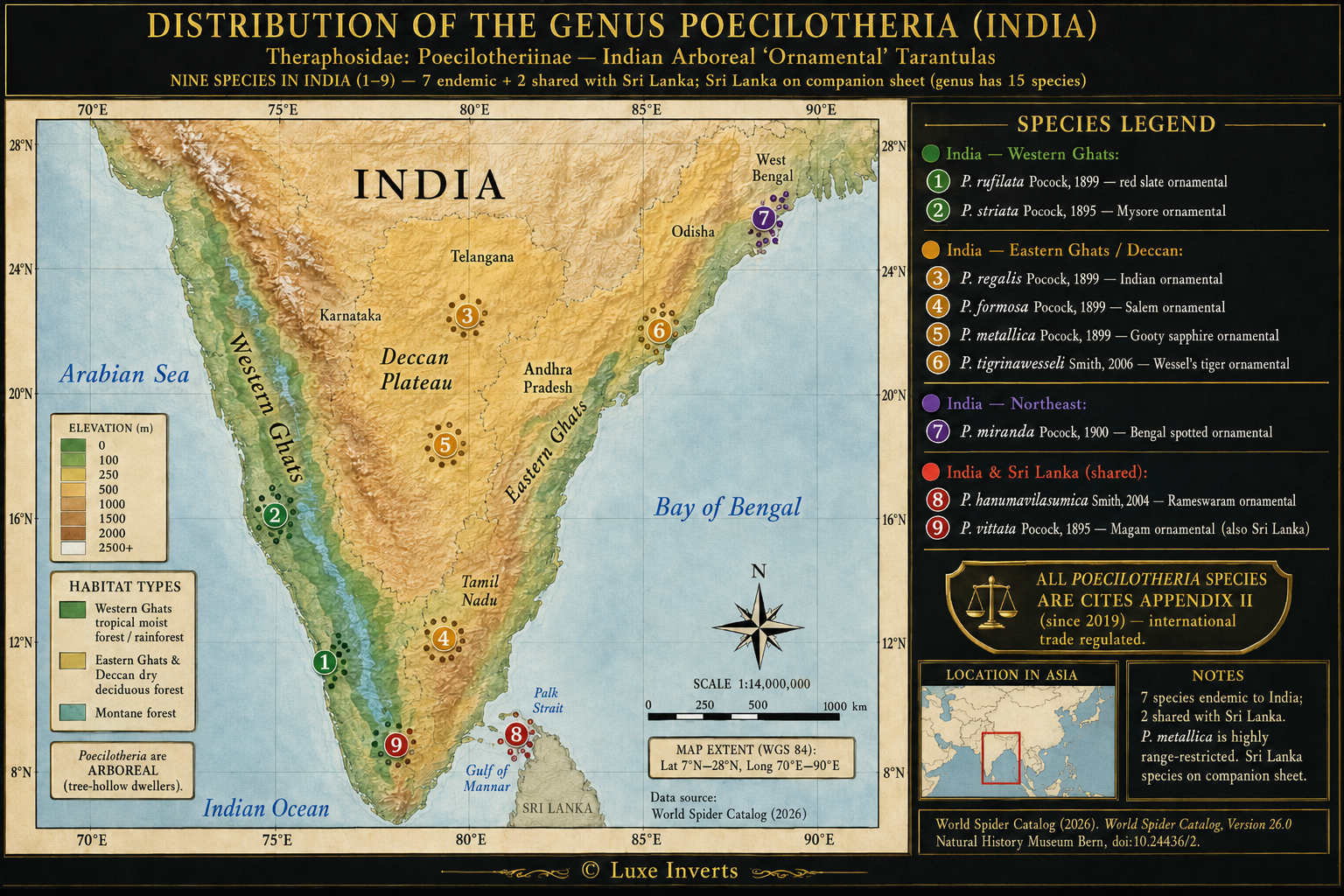
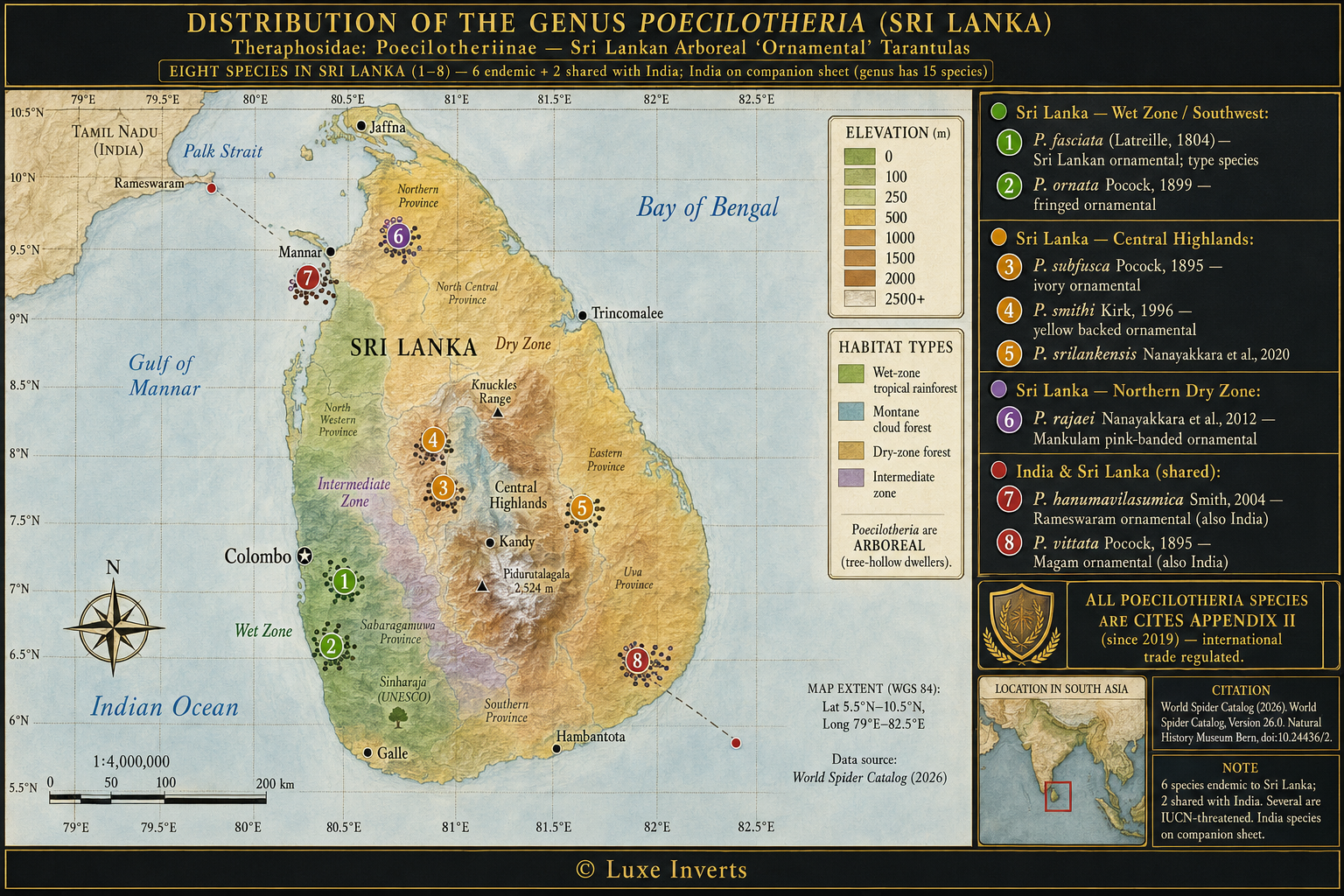
Poecilotheria is a genus of large, arboreal Old World tarantulas endemic to the Indian subcontinent and Sri Lanka—the celebrated "ornamental" or "tiger" spiders of the hobby. They are immediately recognizable for their cryptic, bark-mimicking dorsal patterning combined with vivid aposematic markings on the ventral legs, their speed and arboreal agility, and a medically significant venom. The genus currently comprises 15 valid species: seven restricted to India, six to Sri Lanka, and two occurring in both countries. The entire genus is listed on CITES Appendix II, and several species are of serious conservation concern.
Taxonomy and nomenclature
Poecilotheria was erected by Eugène Simon in 1885 as a replacement name for Scurria C. L. Koch, 1850, which was preoccupied in the Mollusca (Gastropoda). The type species, Mygale fasciata Latreille, 1804, is one of the earliest-described tarantulas from the region. The genus is traditionally placed in its own subfamily, Poecilotheriinae, of which it is the only member—an arrangement reflecting its distinctive morphology and its molecular position within Theraphosidae.
The genus has a long history of synonymy and revision, with numerous names erected and later sunk. Among the more notable: P. nallamalaiensis is a synonym of P. formosa; P. pederseni of P. vittata; P. pococki of P. smithi; P. uniformis and P. bara of P. subfusca; P. gadgili of P. regalis; and P. chaojii (described 2014) of P. tigrinawesseli. This instability reflects both the subtle morphological differences among species and the commercial value that has driven repeated descriptions.
Morphology and biology
Poecilotheria are among the largest arboreal tarantulas, with leg spans commonly reaching 15–20 cm. As Old World theraphosids, they lack urticating setae; their defenses are instead speed, crypsis, and a potent venom delivered by a defensive bite. Coloration combines intricate grey, brown, black, white and cream reticulation that renders them nearly invisible against lichen-covered bark, with contrasting bright yellow, orange, or (in P. metallica) brilliant blue on the ventral and prolateral leg surfaces—flashed in threat displays. They are obligate tree-dwellers, sheltering by day in tree hollows, bark crevices, and cavities, and ambushing flying and climbing insects at night. Several species show notable tolerance of conspecifics and have been maintained communally in captivity, an unusual trait among tarantulas.
The venom is medically significant: bites in humans typically cause intense localized pain, prolonged and severe muscle cramping that may persist for days, and systemic effects; no specific antivenom exists. This—together with their speed—makes them a genus for experienced keepers rather than beginners.
Constituent species
The 15 currently recognized species, with country of occurrence, are:
India: P. formosa Pocock, 1899; P. metallica Pocock, 1899 (the Gooty sapphire ornamental, the only blue species); P. miranda Pocock, 1900; P. regalis Pocock, 1899 (the Indian ornamental); P. rufilata Pocock, 1899; P. striata Pocock, 1895; P. tigrinawesseli Smith, 2006.
Sri Lanka: P. fasciata (Latreille, 1804) — the type species; P. ornata Pocock, 1899; P. rajaei Nanayakkara et al., 2012; P. smithi Kirk, 1996; P. srilankensis Nanayakkara et al., 2020; P. subfusca Pocock, 1895.
India and Sri Lanka: P. hanumavilasumica Smith, 2004; P. vittata Pocock, 1895.
Distribution and conservation
The genus is confined to the forests of peninsular and northeastern India and Sri Lanka, where most species are narrowly distributed and tied to specific forest types—including, for several, plantation and human-modified landscapes. Habitat loss through deforestation and forest fragmentation, compounded by collection for the international pet trade, has placed many species under threat. Poecilotheria metallica, known from a single highly fragmented forest patch in Andhra Pradesh, is among the most range-restricted and is widely regarded as critically imperiled.
In recognition of these pressures, the entire genus Poecilotheria was added to CITES Appendix II at the 18th Conference of the Parties (2019), regulating its international trade. Several Sri Lankan species have additionally been the subject of national and international protective listings. Captive breeding is well established for the most popular species (notably P. regalis and P. metallica), which has reduced—though not removed—pressure on wild populations.
Selected references
Simon, E. (1885). Matériaux pour servir à la faune arachnologique de l'Asie méridionale. (Establishment of Poecilotheria as a replacement name for Scurria.)
Gabriel, R., Gallon, R. C. & Smith, A. M. (2013). Revisionary notes on Poecilotheria and species-level synonymies. British Tarantula Society Journal.
Nanayakkara, R. P. et al. (2012, 2020). Descriptions of Poecilotheria rajaei and P. srilankensis (Sri Lanka).
World Spider Catalog (current version). Natural History Museum Bern. https://wsc.nmbe.ch
© Luxe Inverts — www.luxeinverts.com
Poecilotheria regalis
Indian Ornamental
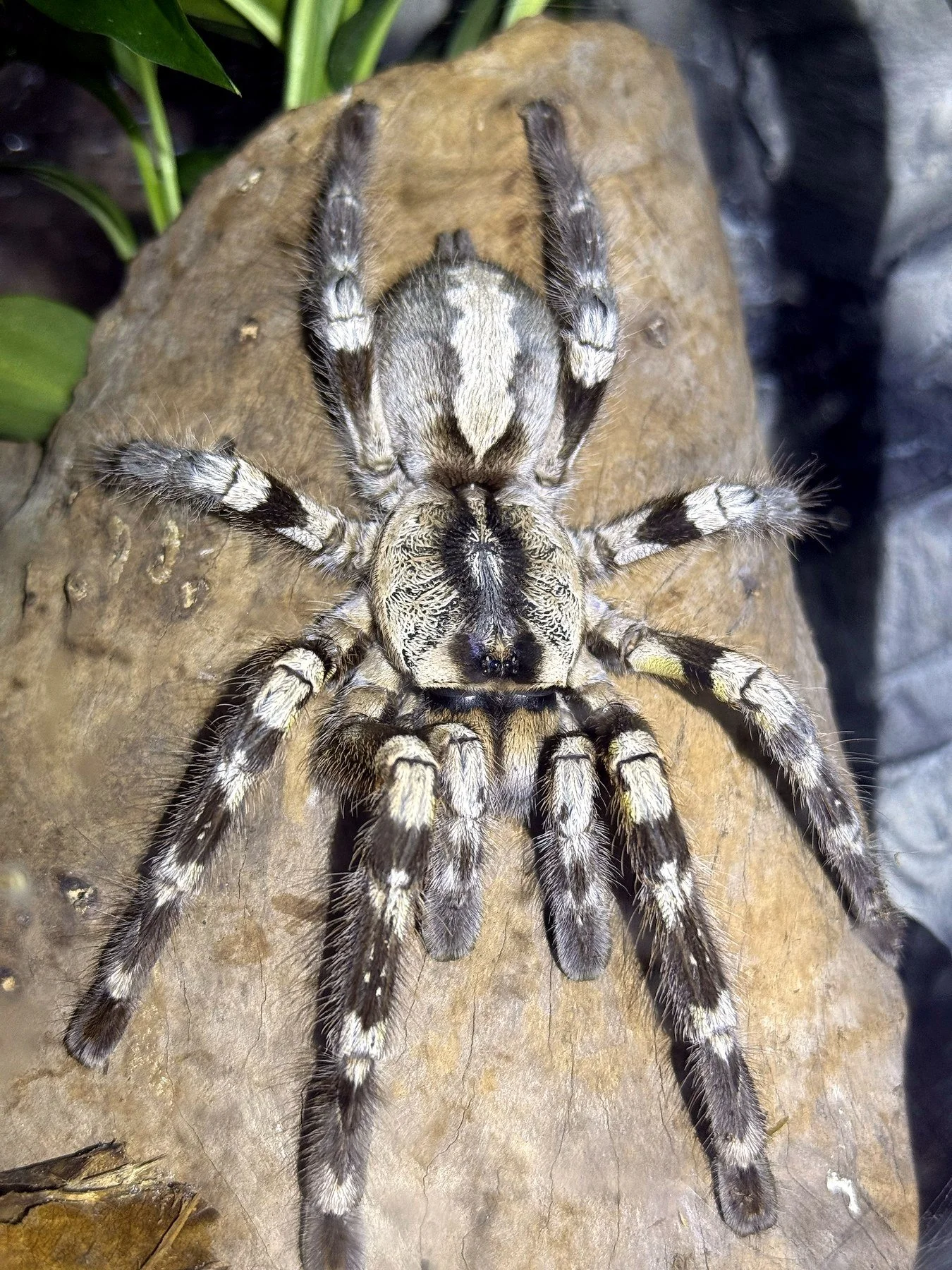
Poecilotheria regalis Pocock, 1899 is the most widely kept of the ornamental tarantulas and the species responsible for fixing the English-language name “Indian Ornamental” in the hobby. Described from material collected in central and eastern India, the species is an arboreal sit-and-wait predator tied to large-diameter tree hollows in deciduous and mixed forest. Like all Poecilotheria, it lacks urticating setae — defense is speed, threat display, and bite — and carries venom considered medically meaningful. The genus is listed on CITES Appendix II.
Poecilotheria metallica
Gooty Sapphire Ornamental
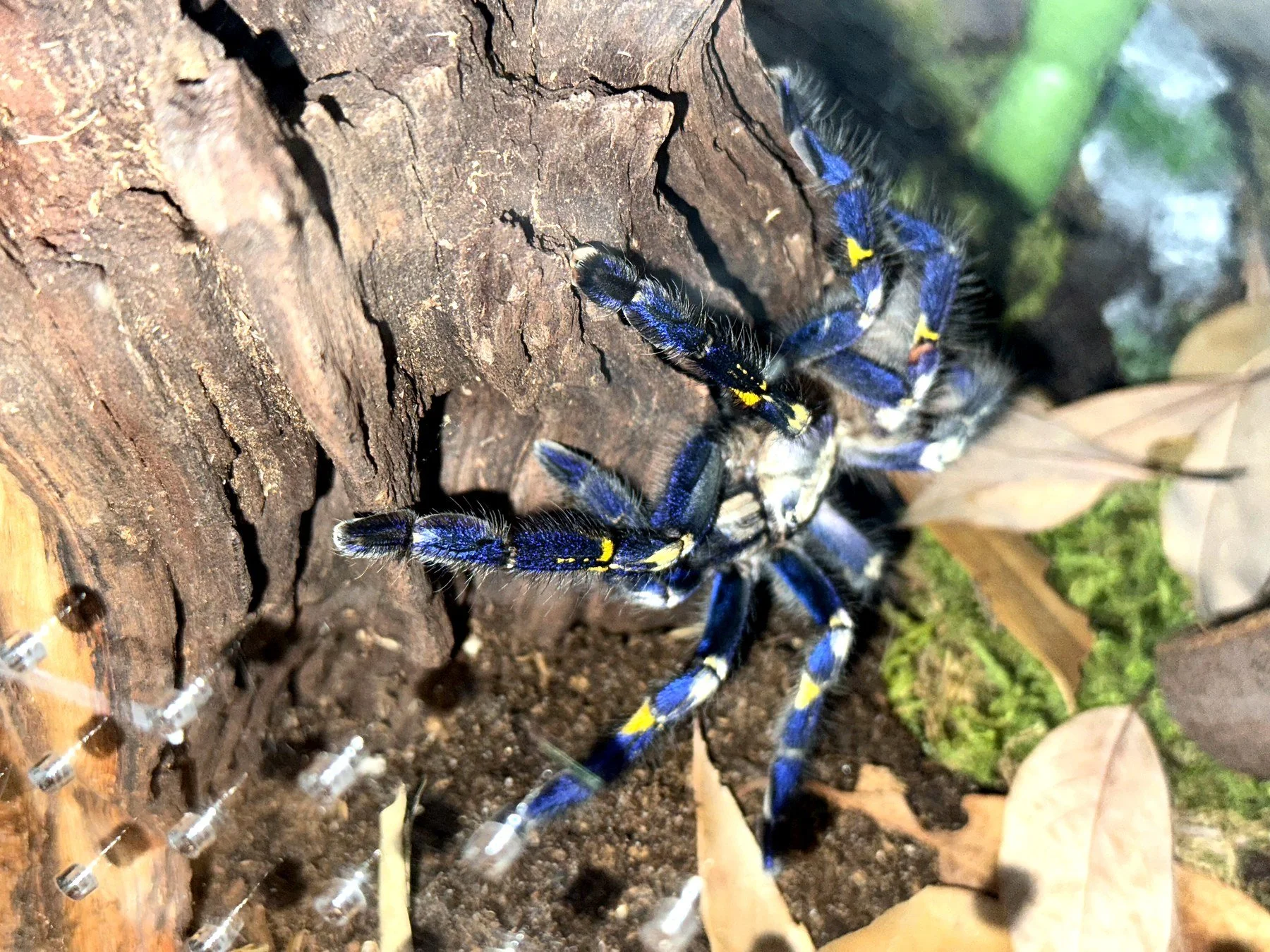
Poecilotheria metallica Pocock, 1899 is the most visually distinctive member of the genus and one of the most iconic tarantulas in the hobby. Described from a single specimen collected near Gooty in Andhra Pradesh, India, the species was not encountered again in the wild for close to a century, and its known distribution remains an extremely restricted fragment of deciduous forest in the Nallamala Hills and Andhra Pradesh–Telangana border region. It is listed as Critically Endangered by the IUCN on the basis of habitat loss and range fragmentation. Mature animals display a structural cobalt-blue sheen unique within Poecilotheria. Like all congeners, P. metallica lacks urticating setae and carries medically meaningful venom; the genus is listed on CITES Appendix II.
Poecilotheria ornata
Fringed Ornamental
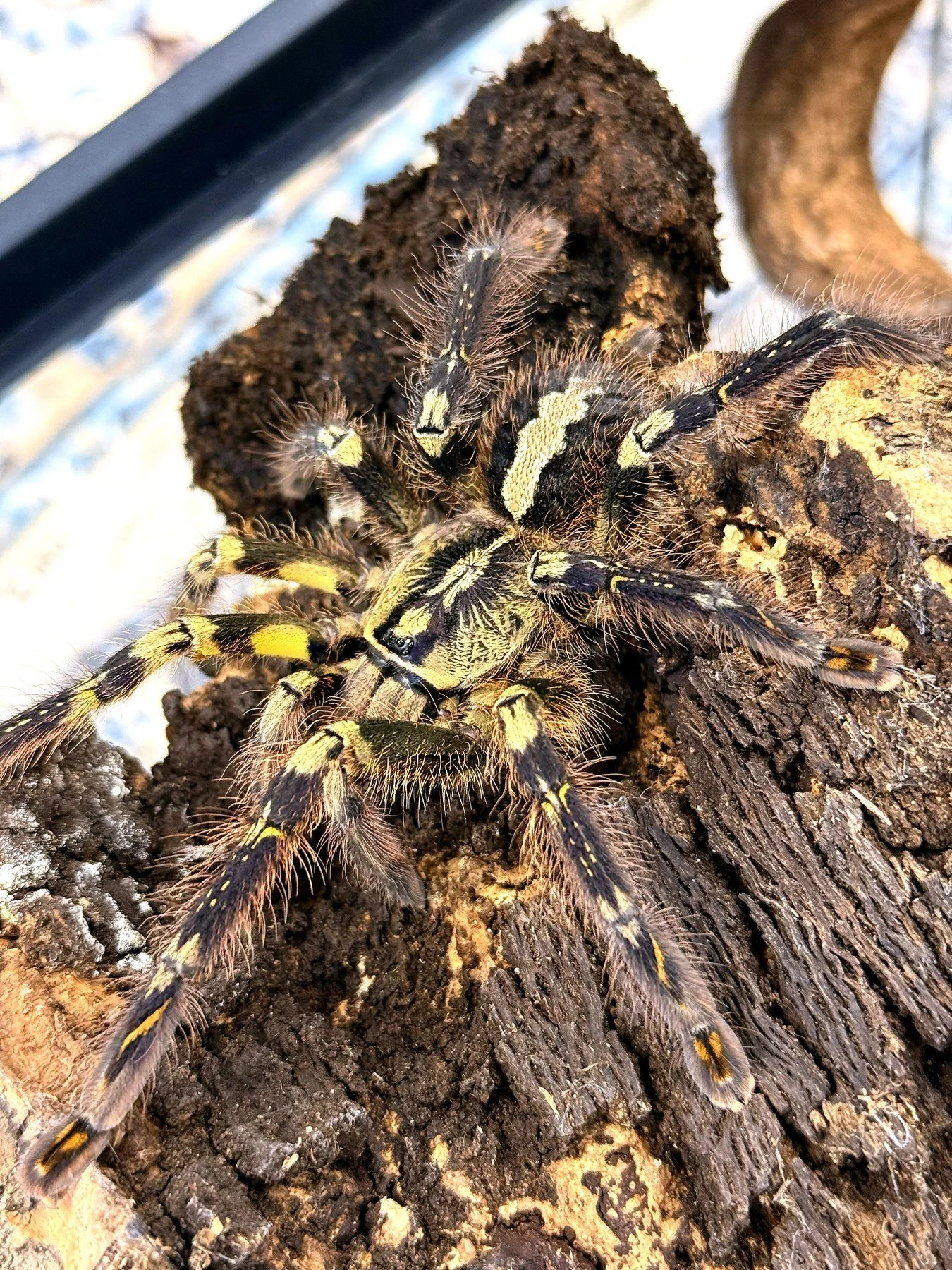
Poecilotheria ornata Pocock, 1899 is the largest of the described Poecilotheria and one of two Sri Lankan species in the genus. Distinguished from Indian congeners by vivid lemon-yellow banding on the ventral femora and a sooty-brown dorsal pattern that contrasts more strongly with the cream folium than in the Indian species. Like all Poecilotheria, P. ornata is arboreal, lacks urticating setae, and carries medically meaningful venom. The genus is listed on CITES Appendix II and the species is considered vulnerable to habitat pressures in its native range.
Poecilotheria subfusca "Lowlands"
Ivory Ornamental (Lowland form)
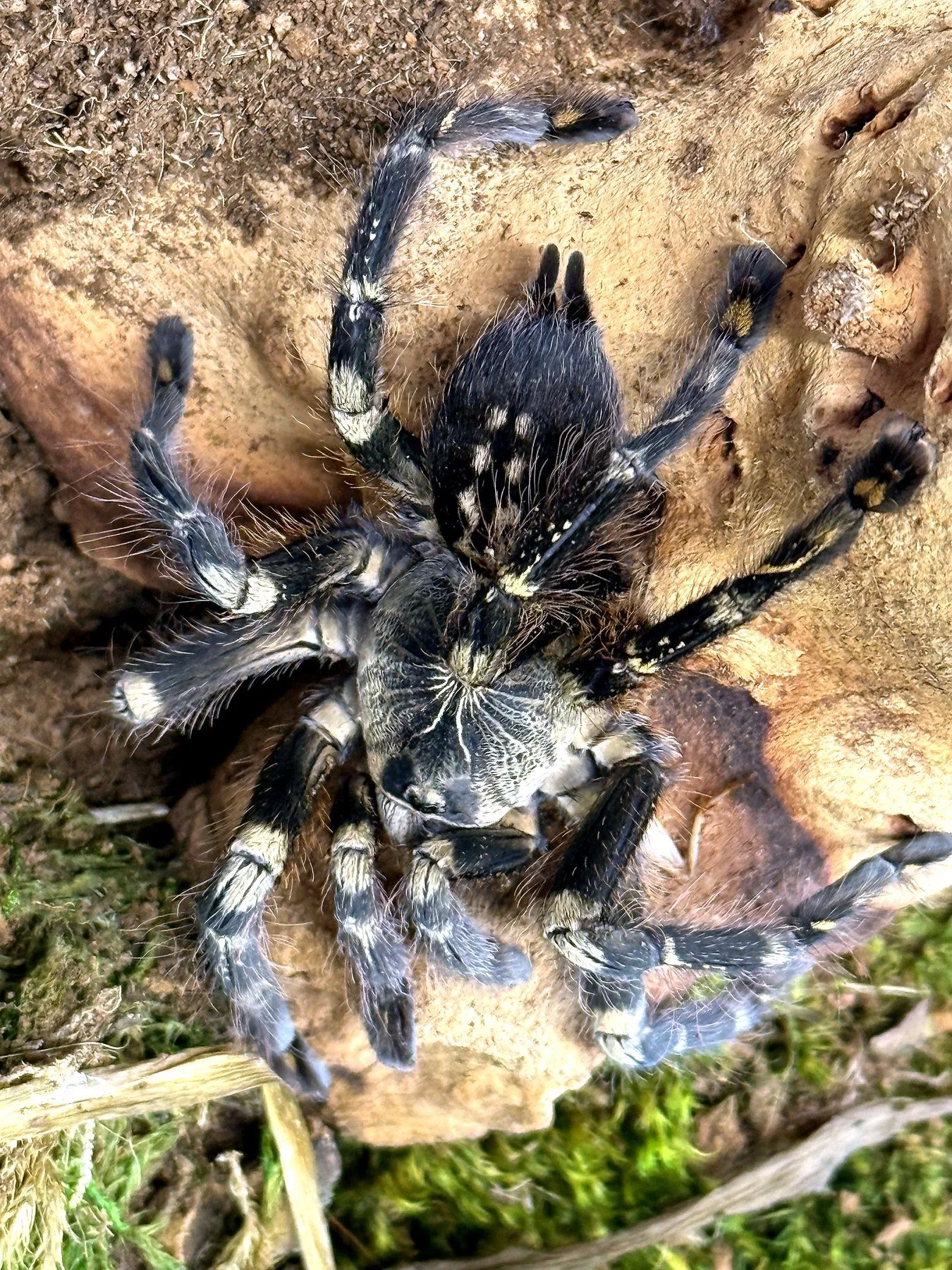
Poecilotheria subfusca Pocock, 1895 is a Sri Lankan ornamental tarantula distinguished in the hobby by the recognition of two distinct forms — “Highlands” and “Lowlands” — corresponding to populations from different elevation bands of the central highlands and the lowland forest. Smith (2004) and subsequent workers proposed elevating the lowland form to species rank as P. bara, though hobby-grade material is most often traded under the original subfusca epithet with the locality tag. The lowland form is smaller, darker, and slower-growing than highland material. Like all Poecilotheria, it lacks urticating setae and carries medically meaningful venom; the genus is listed on CITES Appendix II.