

Omothymus
Family: Theraphosidae · Subfamily: Ornithoctoninae · Type species: Omothymus schioedtei Thorell, 1891
Omothymus is a small genus of large, arboreal Southeast Asian tarantulas—members of the "earth tiger" assemblage of the subfamily Ornithoctoninae—distributed across peninsular Thailand and Malaysia, Singapore, and Sumatra. The genus is best known for Omothymus violaceopes, the Singapore blue, one of the largest and most striking arboreal tarantulas in the region, in which mature specimens develop an iridescent steel-blue sheen. As currently recognized by the World Spider Catalog, the genus contains four valid species. Like all Old World theraphosids it lacks urticating setae and is defended instead by speed, an arboreal lifestyle, and a potent venomous bite.
Taxonomy and nomenclature
Omothymus was erected by Tamerlan Thorell in 1891 for O. schioedtei, an arboreal tarantula from the Malay Peninsula. Its subsequent history is a textbook case of the taxonomic instability that has long affected Southeast Asian arboreal theraphosids. Simon (1903) synonymized Omothymus with Cyriopagopus, where its species languished for over a century. Smith & Jacobi (2015) removed Omothymus from that synonymy and revalidated the genus, reassigning the type species and the Singapore blue to it. Gabriel & Sherwood (2019) then refined its composition further—transferring O. fuchsi from Phormingochilus, formally confirming O. violaceopes (originally described in Lampropelma), describing the new species O. rafni, and synonymizing the old name O. thorelli under O. schioedtei. The genus is diagnosed primarily on male and female genitalic morphology, and is distinguished from the closely allied Phormingochilus by the pointed apex of the male embolus.
Morphology and biology
Omothymus are large, long-legged arboreal tarantulas with body proportions typical of the Ornithoctoninae: an elongate, lightly built habitus suited to life in vertical retreats. Coloration ranges from the dark, banded "tiger" patterning of O. schioedtei to the diffuse blue iridescence of mature O. violaceopes, which is sexually and ontogenetically variable. Being Old World spiders, they possess no urticating setae; when threatened they rely on rapid retreat into the retreat tube, threat posturing, and a defensive bite delivering a medically significant (though not lethal) venom. They are tube-web builders, constructing heavily silked retreats in tree hollows, under bark, in arboreal cavities, and sometimes in ground-level crevices, from which they ambush insect prey. As with most arboreal Asian theraphosids, they are fast-moving and skittish, and are considered advanced-level animals in captivity.
Constituent species
The four currently recognized species are:
Omothymus schioedtei Thorell, 1891 — the type species; the Malaysian earth-tiger tarantula, ranging across peninsular Thailand and Malaysia.
Omothymus violaceopes (Abraham, 1924) — the Singapore blue; peninsular Malaysia and Singapore. Originally described in Lampropelma; among the largest arboreal tarantulas of the region.
Omothymus fuchsi (Strand, 1906) — Sumatra, Indonesia; transferred from Phormingochilus by Gabriel & Sherwood (2019).
Omothymus rafni Gabriel & Sherwood, 2019 — Sumatra, Indonesia; the most recently described member of the genus.
Distribution and conservation
The genus is confined to the Sundaic region of Southeast Asia—peninsular Thailand and Malaysia, Singapore, and Sumatra—where its species occupy lowland and hill forest as arboreal specialists. Omothymus is not listed under CITES, and its species are not currently subject to international trade regulation. As with most Southeast Asian arboreal tarantulas, the principal long-term concern is habitat loss driven by deforestation and land conversion across the Sundaland biodiversity hotspot, while localized collection for the pet trade affects the most desirable species, particularly the Singapore blue.
Selected references
Thorell, T. (1891). Spindlar från Nikobarerna och andra delar af södra Asien. (Original description of Omothymus.)
Smith, A. M. & Jacobi, M. (2015). Revalidation of Omothymus and reassignment of species (removal from synonymy with Cyriopagopus). British Tarantula Society Journal.
Gabriel, R. & Sherwood, D. (2019). Revisionary notes on Omothymus, with the description of O. rafni and new combinations.
World Spider Catalog (current version). Natural History Museum Bern. https://wsc.nmbe.ch
© Luxe Inverts — www.luxeinverts.com
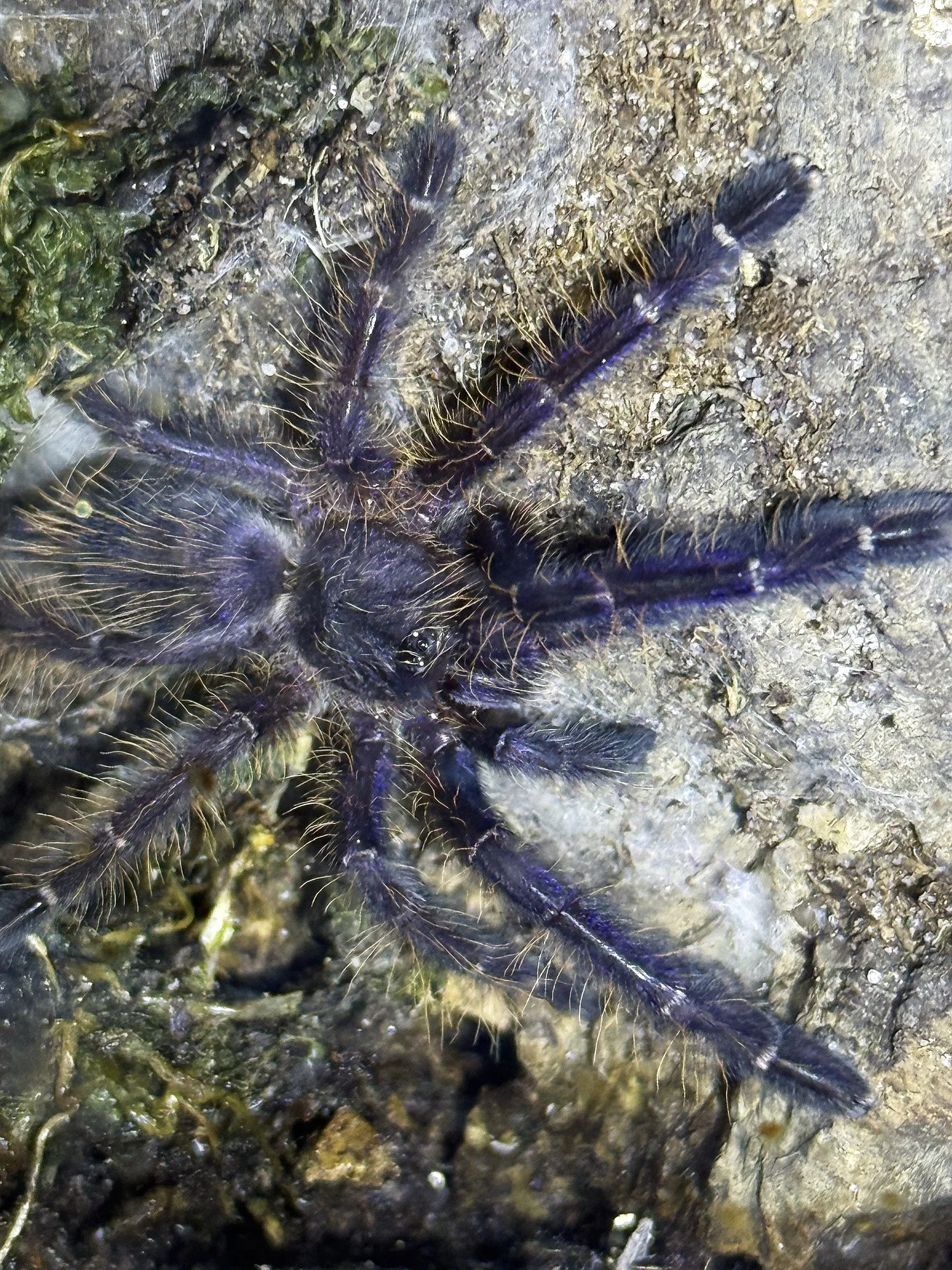
Omothymus violaceopes
Singapore Blue
Omothymus violaceopes (Abraham, 1924) is the Singapore Blue, a large arboreal ornithoctonine native to the Malay Peninsula and Singapore. The genus Omothymus Thorell, 1891 (type species O. schioedtei Thorell, 1891, by monotypy) was long synonymized under Cyriopagopus Simon, 1887 following Simon (1903), then revalidated by Smith & Jacobi (2015). This species was originally described as Lampropelma violaceopes Abraham, 1924 from Penang Hill, Malaysia; Gabriel & Sherwood (2019, Arachnology 18(2): 137–147) transferred it to Omothymus on the basis of leg morphometrics and geography, along with two congeners, bringing the genus to four currently valid species: O. schioedtei, O. fuchsi, O. rafni, and O. violaceopes (World Spider Catalog, 2026). As with all Ornithoctoninae, the species lacks urticating setae; defense is behavioral (retreat, threat posture, speed) and chemical (bite). Mature specimens — particularly males — develop a striking metallic violet-blue sheen across the legs and body.