
Acanthoscurria

Acanthoscurria Ausserer, 1871 is a genus of large, heavy-bodied terrestrial theraphosids in the subfamily Theraphosinae and one of the most conspicuous New World tarantula lineages. The type species is Acanthoscurria geniculata (C. L. Koch, 1841) — the Brazilian Giant White-Knee, originally described as Mygale geniculata — designated by monotypy, and the genus is now known from Argentina, Bolivia, Brazil, Colombia, Ecuador, French Guiana, Guyana, Paraguay, Peru, Suriname, and Venezuela, with a documented presence in the Windward Islands of the West Indies. After a long period of taxonomic sprawl — the genus at one point accommodated well over thirty nominal species — a sustained wave of revisionary work has pulled the count down to roughly nineteen valid species (World Spider Catalog, 2026). The most consequential recent papers are Fukushima and Bertani's 2023 cladistic revision of Lasiodora (Zootaxa 5390), which resolved a tangle of shared species between Acanthoscurria, Lasiodora, Crypsidromus, and Proshapalopus and transferred L. sternalis into Acanthoscurria as A. melloleitaoi (to avoid homonymy with A. sternalis Pocock, 1903), and Sherwood, Gabriel, Peñaherrera-R., and García's 2025 treatment (Zootaxa 5563) proposing the theraphosoides species-group and describing A. armasi sp. nov. as the first published record of the genus from Colombia.

The genus occupies an unusually broad slice of the Neotropics. Northern Amazonian species (A. geniculata, A. theraphosoides, A. juruenicola, A. armasi) are animals of primary and secondary lowland rainforest on the Guiana Shield and the Brazilian Amazon; central-Brazilian species (A. gomesiana, A. natalensis) extend across Cerrado savanna and the Caatinga xeric scrub of the Northeast; southern species (A. insubtilis, A. chacoana, A. cursor, A. suina) occur through the Chaco and the subtropical Atlantic Forest as far south as Argentina and Uruguay; and the West Indian records extend the genus onto the Windward Islands. This habitat breadth is reflected in captive husbandry, where the A. geniculata profile that dominates the hobby (warm, moderately humid, Amazonian) is a poor template for the drier Cerrado and Chaco species.

Members of the genus are terrestrial with opportunistic, rather than obligate, burrowing. Juveniles excavate shallow silk-lined retreats under cover; sub-adults often expand these into a proper burrow; mature females tenant a cork retreat or a wall-backed scrape and are visible on the surface far more frequently than the reclusive Neotropical burrowers (Theraphosa, Xenesthis, Pamphobeteus). Acanthoscurria sits in Group A of the Theraphosinae defined by Perafán et al. (2016, updated in Foelix, Erb, Rast, and Peretti, 2019, PLOS One 14(11)) and bears type I urticating setae as its principal defensive armament; the genus is notorious in the hobby for how readily it deploys them, and A. geniculata in particular is among the most enthusiastic hair-kickers in the family. Venom is mild — documented bites have produced only transient localized effects — and defensive behavior combines the urticating-hair kick, a rapid retreat into the burrow, and, if pressed, a high threat display with bite attempted only when cornered. Coloration is variable across the genus: the iconic black-and-white tarsal-and-metatarsal banding of A. geniculata is shared by several congeners, while other species (A. chacoana, A. juruenicola) are uniformly dark or olive, and yet others (A. natalensis) carry pale carapace pubescence over a darker ground. Females across the genus reach 6–8 in diagonal leg span at maturity — A. geniculata and A. juruenicola sit at the upper end — with stout, heavily-built opisthosomas that reflect the genus's general habit of growing quickly, moulting often, and eating prodigiously.

No Acanthoscurria species is currently listed on CITES, and none has a published IUCN Red List assessment at the species level, though several species — particularly A. geniculata and A. insubtilis — have been subject to sustained collection pressure for the international pet trade, and ongoing loss of Cerrado and Atlantic Forest habitat is the meaningful conservation concern across much of the genus's range. In captivity, the genus expects 4–6 in of moderately moist substrate with a dry surface, a cork retreat at ground level, mid-70s to low-80s °F for Amazonian species and a few degrees cooler with lower humidity for Cerrado and Chaco species, and generous cross-ventilation in all cases. Acanthoscurria is not a beginner genus despite its ubiquity in the hobby — the size, speed, and particularly the urticating-setae output of mature females are substantial — but it is among the most rewarding terrestrial genera for keepers ready for a large, active, hard-eating theraphosid and one of the more active areas of current systematic work in the subfamily.
Mature Acanthoscurria geniculata photographed laterally, showing the diagnostic black ground with bold cream-white tarsal and patellar banding and long pale setae along the legs.

Acanthoscurria geniculata

Brazilian Giant White-Knee

Photo: Luxe Inverts
Field Note

Acanthoscurria geniculata (C. L. Koch, 1841) is the Brazilian Giant White-Knee and the type species of Acanthoscurria Ausserer, 1871 (Theraphosidae: Theraphosinae). It was originally described as Mygale geniculata from Brazilian Amazonian material and remains the most familiar and widely-kept species in a genus whose current valid species count stands at roughly nineteen following sustained recent revisionary work (World Spider Catalog, 2026). The species is a northern Amazonian lowland rainforest inhabitant and, along with congeners such as A. juruenicola, sits at the upper end of the genus in size. Acanthoscurria belongs to Group A of the Theraphosinae (Foelix, Erb, Rast & Peretti, 2019, PLOS One 14(11)) and bears type I urticating setae as its principal defensive armament; A. geniculata in particular is notorious for the readiness with which it deploys them.

Range
Northern Amazon basin of Brazil (Pará, Amapá) extending into the Guianas. No published IUCN assessment; sustained international collection pressure on wild stock.
Lifestyle
Terrestrial with opportunistic burrowing. Juveniles dig shallow silk-lined retreats; adults typically accept a cork hide at ground level and spend long periods visible on the substrate surface.
Adult Size
Large; adult females typically reach 7–8 in diagonal leg span, occasionally more, with a stoutly built opisthosoma. Males markedly smaller and shorter-lived.
Difficulty
Intermediate
Temperament
Bold and defensive. Rather than retreating, adults more often stand ground, raising the forelegs into a threat posture and kicking urticating setae freely—A. geniculata is among the most enthusiastic hair-kickers in the family. Venom is mild and documented bites produce only transient localized effects, but the setae output alone justifies the no-handling recommendation.
Habitat
Warm, humid Amazonian lowland rainforest. Captive setup expects 4–6 in of moderately moist substrate with a dry surface, a cork retreat at ground level, mid-70s to low-80s °F, and moderate-to-high humidity with steady cross-ventilation.
Theraphosinae Terrestrial Urticating setae (type I) Type species of genus Amazon basin
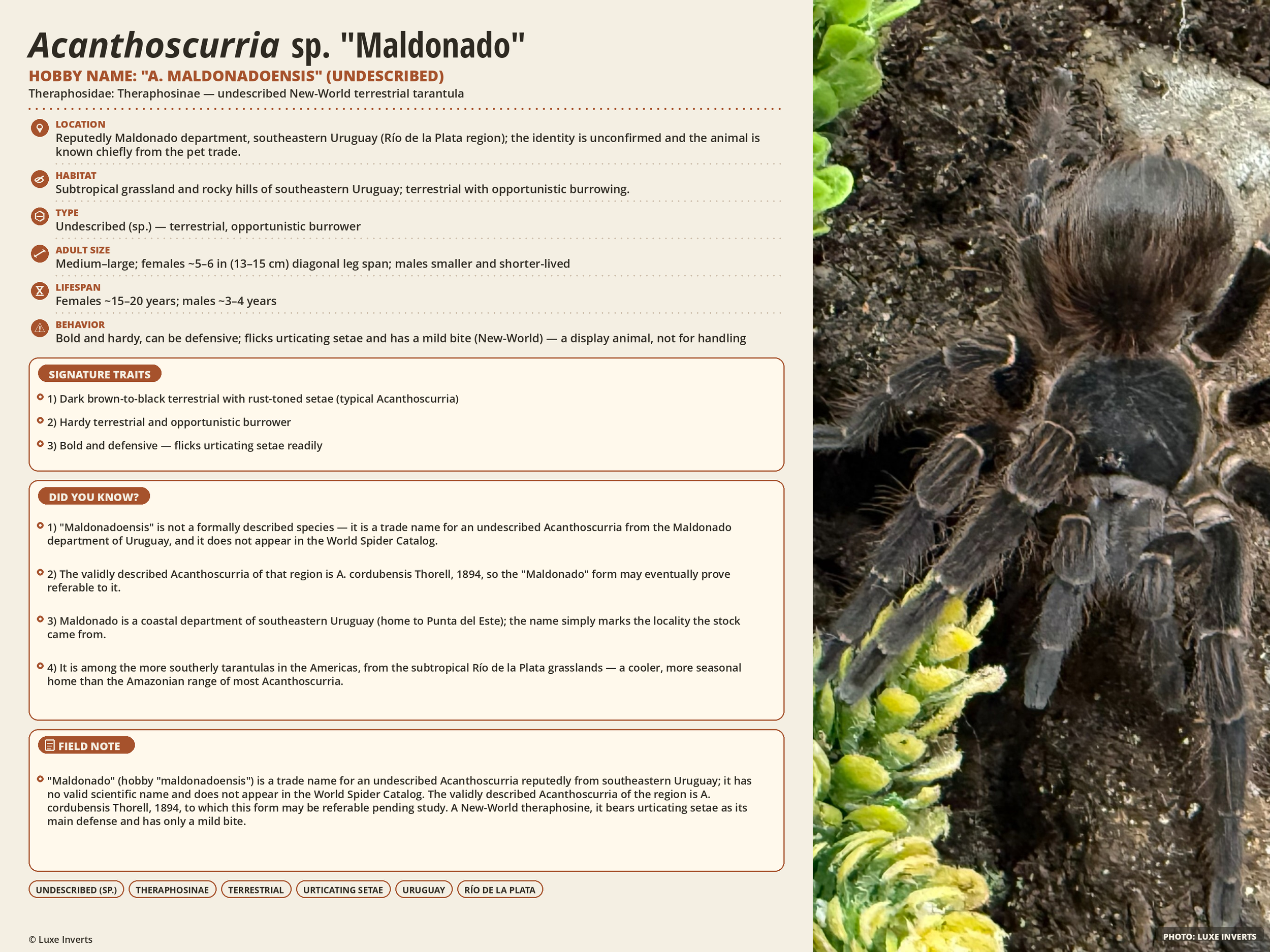
Sub-adult Acanthoscurria sp. 'Maldonadoensis' photographed laterally on a cork bark tube, showing the diagnostic rich coppery-russet setae across the legs and opisthosoma typical of the hobby form.

Acanthoscurria sp. ‘Maldonadoensis’

Maldonado Birdeater (hobby form)

Photo: Luxe Inverts
Field Note

Acanthoscurria sp. ‘Maldonadoensis’ is an undescribed hobby form sold under a Latinized manuscript-style name that evokes Maldonado Department in southeastern Uruguay; the epithet is, however, misleading. The animals circulating in the international pet trade under this name trace not to Uruguay but to commercial collection in the western Amazon — most reliably the Madre de Dios region of southeastern Peru — and their coloration, temperament, and size fit comfortably within the northern Amazonian Acanthoscurria radiation (A. theraphosoides, A. juruenicola, A. geniculata), not the smaller Southern Cone species known from Uruguay (A. suina, A. chacoana). The name is not recognized in the World Spider Catalog (2026) and has not been formally published; the form is not listed as nomen dubium or as a junior synonym, and it should be treated as awaiting formal description. The genus Acanthoscurria Ausserer, 1871 itself remains an active area of systematic work — Fukushima & Bertani, 2023 (Zootaxa 5390) and Sherwood et al., 2025 (Zootaxa 5563) have both moved material in and around the genus — and it is plausible this form will receive placement in a future revision.

Range
Uncertain but commercial stock most reliably traces to the western Amazon basin (Madre de Dios, southeastern Peru). Despite the manuscript-style name, the form is not known from Maldonado, Uruguay. No published IUCN assessment.
Lifestyle
Terrestrial with opportunistic burrowing. Juveniles and sub-adults excavate shallow silk-lined retreats under cover and readily accept a cork tube or half-log hide in captivity; adults are visible on the substrate surface more often than the reclusive Neotropical burrowers.
Adult Size
Large; adult females are expected to reach roughly 6–7 in diagonal leg span based on growth rates and build typical of northern Amazonian Acanthoscurria, with a stoutly built opisthosoma. Published measurements are not yet available pending formal description.
Difficulty
Intermediate
Temperament
Bold and defensive, consistent with the rest of the genus. Readily kicks type I urticating setae when disturbed and will adopt a threat posture rather than retreat when cornered. Venom is expected to be mild by theraphosid standards — documented bites across Acanthoscurria produce only transient localized effects — but the setae output alone justifies the no-handling recommendation.
Habitat
Warm, humid lowland Amazonian rainforest floor, based on the most likely geographic origin. Captive setup expects 4–6 in of moderately moist substrate with a dry surface, a cork retreat at ground level, mid-70s to low-80s °F, and moderate-to-high humidity with steady cross-ventilation. Poorly suited to dry Cerrado or Chaco husbandry protocols.
Theraphosinae Terrestrial Urticating setae (type I) Undescribed hobby form Likely western Amazon (Peru)
Acanthoscurria sternalis

Acanthoscurria sternalis

Argentine Giant Black Rump

Photo: Luxe Inverts
Field Note

Acanthoscurria sternalis Pocock, 1903 is the principal Argentine Acanthoscurria, distributed widely through the Chaco and Pampa biomes from northern Argentina north into Paraguay, Bolivia, and the Brazilian state of Mato Grosso do Sul. The species is diagnosed in part by an unusually dark, almost glossy black opisthosoma in adult females — the basis for the “Black Rump” trade name — contrasting with the chocolate-brown carapace and the reddish-orange opisthosomal setae characteristic of the genus. The taxonomy of southern Acanthoscurria has seen substantial recent attention (Ferretti et al., 2011, Zootaxa 2828), and several pre-1990 nominal taxa have been rearranged under or near A. sternalis in the resulting synonymies.

Range
Northern Argentina (Salta, Tucumán, Chaco) north through Paraguay, eastern Bolivia, and southwestern Brazilian Mato Grosso do Sul.
Lifestyle
Terrestrial, opportunistically fossorial. Excavates silk-lined burrows under cover in dry scrub and gallery-forest substrate.
Adult Size
Large; females reach 6–7 in diagonal leg span. Glossy black opisthosoma, chocolate-brown carapace, reddish-orange opisthosomal setae and pale leg-banding.
Difficulty
Intermediate
Temperament
Defensive by genus standard — readily threat-displays and kicks Type I/III urticating setae. Venom mild; the setae output is the practical no-handling justification.
Habitat
Chaco dry forest and Pampa subtropical scrub. Captive setup expects 4–6 in of compactable substrate with a clear dig-start, cork retreat, mid-70s to low-80s °F with cool winter dips tolerated, low-to-moderate humidity with good cross-ventilation.
Theraphosinae Terrestrial / opportunistic fossorial Urticating setae (types I & III) Argentine Chaco / Pampa Glossy black opisthosoma diagnostic
Genus Spotlight · Theraphosidae

Acanthoscurria

The White-Knee Tarantulas of South America

Acanthoscurria is a robust, primarily Brazilian genus of large terrestrial tarantulas — flagship species of the South American Theraphosinae alongside Lasiodora, Theraphosa, and Pamphobeteus. The famous "Brazilian Whiteknee" (A. geniculata) is among the most popular tarantulas in the world. Twelve of the genus's nineteen valid species are featured below — covering the Amazon basin, the Atlantic Forest, the Cerrado and Caatinga of NE Brazil, and the Gran Chaco of Argentina, Paraguay, and Bolivia.

12Featured species
19Valid species
20–25yFemale lifespan
10Countries (range)
Habitat Range

Where Acanthoscurria lives

Acanthoscurria is centred on Brazil — every Brazilian biome harbours at least one species, from the Amazon and the Cerrado of the central plateau to the Caatinga of the NE and the Atlantic Forest of the SE. Beyond Brazil, the genus extends into the Gran Chaco of Argentina, Paraguay, and Bolivia, west to Peru, north into the Guianas, and across the sea to Trinidad and the Windward Islands. Brazilian state-level boundaries are shown for the species' main range; surrounding countries are shown at country level.

Argentina — Acanthoscurria musculosa, Acanthoscurria chacoana, Acanthoscurria suina, Acanthoscurria cordubensisBolivia — Acanthoscurria theraphosoides, Acanthoscurria musculosa, Acanthoscurria suinaChile — No populationsColombia — No populationsEcuador — No populationsFrench Guiana — Acanthoscurria theraphosoidesGuyana — No populationsPeru — Acanthoscurria theraphosoidesParaguay — Acanthoscurria musculosa, Acanthoscurria chacoanaSuriname — No populationsTrinidad and Tobago — No populationsUruguay — No populationsVenezuela — No populations Acre — Acanthoscurria juruenicola, Acanthoscurria theraphosoidesAlagoas — Acanthoscurria natalensisAmapá — Acanthoscurria geniculataAmazonas — Acanthoscurria geniculata, Acanthoscurria juruenicola, Acanthoscurria theraphosoidesBahia — Acanthoscurria natalensis, Acanthoscurria atroxCeará — Acanthoscurria natalensisDistrito Federal — No populationsEspírito Santo — Acanthoscurria atroxGoiás — Acanthoscurria brocklehursti, Acanthoscurria gomesianaMaranhão — Acanthoscurria geniculataMato Grosso — Acanthoscurria brocklehursti, Acanthoscurria juruenicola, Acanthoscurria gomesianaMato Grosso do Sul — Acanthoscurria brocklehursti, Acanthoscurria gomesiana, Acanthoscurria musculosaMinas Gerais — Acanthoscurria atrox, Acanthoscurria paulensis, Acanthoscurria gomesianaPará — Acanthoscurria geniculata, Acanthoscurria juruenicola, Acanthoscurria theraphosoidesParaíba — Acanthoscurria natalensisParaná — Acanthoscurria paulensisPernambuco — Acanthoscurria natalensisPiauí — Acanthoscurria natalensisRio de Janeiro — Acanthoscurria atrox, Acanthoscurria paulensis, Acanthoscurria gomesianaRio Grande do Norte — Acanthoscurria natalensisRio Grande do Sul — No populationsRondônia — Acanthoscurria juruenicola, Acanthoscurria theraphosoidesRoraima — Acanthoscurria geniculataSanta Catarina — No populationsSão Paulo — Acanthoscurria paulensis, Acanthoscurria gomesianaSergipe — Acanthoscurria natalensisTocantins — No populations Pacific Ocean Atlantic Ocean Caribbean SeaAMAZON BASIN CAATINGA CERRADO ATLANTIC FOREST GRAN CHACO PAMPAS
The Featured Twelve

Genus members

Twelve of the nineteen currently-valid Acanthoscurria, chosen to span the genus's Amazonian, Atlantic-Forest, Cerrado/Caatinga, and Chaco diversity. Brazilian species are mapped at state level; non-Brazilian species at country level.

photo placeholder

Acanthoscurria geniculata

Brazilian Whiteknee

Iconic jet-black body with bold cream-white banding at every leg joint. Among the most popular pet tarantulas worldwide.

Leg span
18–22 cm
Lifespan
♀ 20–25 yrs · ♂ 4–5 yrs

Habitat — Lowland and lower-montane Amazon rainforest. Constructs deep burrows under buttress roots and in clay banks.

Range — Type locality: Rio Branco, Roraima. Range covers Brazilian Amazonia north of the Amazon — Roraima, Pará, Amazonas, Amapá, and adjacent Maranhão. Possibly extends marginally into Suriname and French Guiana.

Locations: br-rr br-pa br-am br-ap br-ma
photo placeholder

Acanthoscurria brocklehursti

Brazilian Black & White

Glossy black with subtle cream leg banding (less vivid than geniculata). Recent revisions place this under A. theraphosoides; many sources still treat it as a distinct species.

Leg span
15–18 cm
Lifespan
♀ 20–25 yrs · ♂ 4–5 yrs

Habitat — Cerrado savanna and gallery forest of central-western Brazil, 200–800 m.

Range — Mato Grosso (type), Goiás, and northern Mato Grosso do Sul. Often sympatric with A. juruenicola in the Pantanal margins.

Locations: br-mt br-go br-ms
photo placeholder

Acanthoscurria natalensis

Natal Tarantula

Warm chocolate-brown overall with reddish abdominal flush; subtler leg banding than the Amazonian species.

Leg span
14–17 cm
Lifespan
♀ 20–25 yrs · ♂ 4–5 yrs

Habitat — Caatinga thornscrub and Atlantic Forest edge of NE Brazil, sea level to 800 m.

Range — Most of the NE: Rio Grande do Norte, Paraíba, Pernambuco, Alagoas, Sergipe, Bahia, Ceará, and southern Piauí.

Locations: br-rn br-pb br-pe br-ba br-ce br-pi br-se br-al
photo placeholder

Acanthoscurria juruenicola

Juruena Tarantula

Tan-brown body with distinct cream femoral bands. Named for the Juruena River basin.

Leg span
15–18 cm
Lifespan
♀ 20–25 yrs · ♂ 4–5 yrs

Habitat — Southern Amazon basin transitional forest and gallery forest, 100–500 m.

Range — Mato Grosso (Juruena basin), western Amazonas, Pará, Rondônia, and Acre.

Locations: br-mt br-am br-pa br-ro br-ac
photo placeholder

Acanthoscurria theraphosoides

Pink-Edge Tarantula

Brown body with diagnostic pink-orange leg edges and pink abdominal setae. The most widely distributed Acanthoscurria.

Leg span
15–18 cm
Lifespan
♀ 20–25 yrs · ♂ 4–5 yrs

Habitat — Lowland Amazon terra firme and varzea forest, 50–600 m.

Range — Throughout the western and northern Amazon — Brazilian Amazonas, Pará, Acre, Rondônia; eastern Peru; northern Bolivia; French Guiana.

Locations: br-am br-pa br-ac br-ro Peru Bolivia French Guiana
photo placeholder

Acanthoscurria atrox

Atrox Tarantula

Almost solid black with subtle reddish overtones on the abdomen.

Leg span
14–17 cm
Lifespan
♀ 20–25 yrs · ♂ 4–5 yrs

Habitat — Atlantic Forest lowlands and montane forest of southeastern Brazil, sea level to 1,500 m.

Range — Espírito Santo, southern Bahia, eastern Minas Gerais, and Rio de Janeiro — Atlantic Forest endemic.

Locations: br-es br-ba br-mg br-rj
photo placeholder

Acanthoscurria paulensis

São Paulo Tarantula

Mid-brown with subtle leg banding; smaller and more compact than its northern relatives.

Leg span
14–16 cm
Lifespan
♀ 20–25 yrs · ♂ 4–5 yrs

Habitat — Atlantic Forest and adjacent Cerrado fringe of southeastern Brazil, 300–1,200 m.

Range — São Paulo (type), Paraná, southern Minas Gerais, and Rio de Janeiro.

Locations: br-sp br-pr br-mg br-rj
photo placeholder

Acanthoscurria gomesiana

Gomes' Tarantula

Tan-brown overall with reddish leg setae. A widely distributed Cerrado-Atlantic Forest species.

Leg span
13–16 cm
Lifespan
♀ 20–25 yrs · ♂ 4–5 yrs

Habitat — Cerrado, Atlantic Forest, and adjacent montane scrub, 200–1,400 m.

Range — São Paulo, Minas Gerais, Rio de Janeiro, Goiás, southern Mato Grosso, and Mato Grosso do Sul.

Locations: br-sp br-mg br-rj br-go br-mt br-ms
photo placeholder

Acanthoscurria musculosa

Bolivian Chaco Tarantula

Warm tan-gold with darker leg banding. Robust and heavily-built.

Leg span
14–17 cm
Lifespan
♀ 20–25 yrs · ♂ 4–5 yrs

Habitat — Gran Chaco thornscrub and dry savanna, 100–800 m.

Range — Bolivian Chaco (Santa Cruz, Tarija, Chuquisaca), western Paraguay, northern Argentina (Salta, Formosa, Chaco), and adjacent Mato Grosso do Sul.

Locations: Bolivia Paraguay Argentina br-ms
photo placeholder

Acanthoscurria chacoana

Argentine Chaco Tarantula

Mid-brown with reddish abdominal setae; closely related to A. musculosa but more easterly-distributed.

Leg span
13–16 cm
Lifespan
♀ 20–25 yrs · ♂ 4–5 yrs

Habitat — Gran Chaco quebracho and palo santo thornscrub, 80–500 m.

Range — Northern Argentina (Chaco, Formosa, Santiago del Estero) and eastern Paraguay.

Locations: Argentina Paraguay
photo placeholder

Acanthoscurria suina

Suina

Compact dark-brown species with subtle copper highlights on the femora.

Leg span
13–15 cm
Lifespan
♀ 20–25 yrs · ♂ 4–5 yrs

Habitat — Andean foothill scrub and Yungas transition forest, 600–1,800 m.

Range — Northwestern Argentina (Salta, Jujuy, Tucumán) and adjacent Bolivian Yungas.

Locations: Argentina Bolivia
photo placeholder

Acanthoscurria cordubensis

Córdoba Tarantula

Sandy-tan body with subtle dorsal banding — well camouflaged on Sierra Pampeana scree.

Leg span
13–15 cm
Lifespan
♀ 20–25 yrs · ♂ 4–5 yrs

Habitat — Sierras Pampeanas and Monte Desert scrub, 600–2,000 m.

Range — Argentine sierras: Córdoba, San Luis, Catamarca, La Rioja, San Juan, Mendoza.

Locations: Argentina

Genus notes & recent synonymies

Acanthoscurria Ausserer 1871 currently contains 19 valid species. Recent revisions have synonymized several historical names: A. ferina = A. theraphosoides; A. fracta = A. natalensis; some authors also synonymize A. brocklehursti under A. theraphosoides, though this remains debated and most pet-trade material is still labelled as brocklehursti.

Bertani & da Silva (2002) revised the Brazilian Amazonian species; further work continues, and undescribed forms from the Atlantic Forest and Chaco are likely.

Featured (12 of 19 species)

  • A. geniculata
  • A. brocklehursti
  • A. natalensis
  • A. juruenicola
  • A. theraphosoides
  • A. atrox
  • A. paulensis
  • A. gomesiana
  • A. musculosa
  • A. chacoana
  • A. suina
  • A. cordubensis

Other valid species

  • A. insubtilis
  • A. minor
  • A. tigrina
  • A. proxima
  • A. simoensi
  • A. urens
  • A. juniperdolens
Natural History

Conservation, biology & burrow ecology

Conservation

Status & Threats

Acanthoscurria are not CITES-listed. Habitat loss is the genus's primary threat, especially for Atlantic Forest and Cerrado endemics. Brazilian export is regulated by IBAMA.

  • Habitat conversion: deforestation in the southern Amazon "arc-of-deforestation," Cerrado conversion to soy and cattle, and Atlantic Forest fragmentation are the leading threats.
  • Wild collection: historically heavy collection of A. geniculata from Pará for the European pet trade; the species is now widely captive-bred.
  • Brazilian regulations: IBAMA prohibits export of native theraphosids without CITES-equivalent permits — most legal hobby stock outside Brazil descends from older founder lines.
  • Protected areas: several large Brazilian and Bolivian national parks contain core populations (Pico da Neblina, Jaú, Madidi, Noel Kempff Mercado).
Quick Facts

Biology at a glance

  • Size: 13–22 cm leg span; bodies 5–7 cm. A. geniculata reaches the genus maximum.
  • Lifespan: females 20–25 years; males 4–5 years post-maturity.
  • Temperament: defensive and quick to kick urticating hairs; bites are uncommon but the genus has a reputation for being "cup-rattlers" in captivity.
  • Venom: medically insignificant despite the size; bites are mechanically painful.
  • Diet: opportunistic ambush predators of insects, frogs, lizards, and occasionally small rodents.
  • Reproduction: egg sacs of 500–1,500 eggs — among the most fecund Theraphosidae. Spiderlings disperse rapidly.
Habitat

Burrow & ecology

Acanthoscurria are obligate burrowers of tropical and subtropical forest, savanna, and dry-scrub floors — they tolerate a remarkable range of habitats, from the saturated Amazon to the seasonally arid Caatinga and Chaco.

  • Burrow architecture: a single oblique entrance often plugged with silk during molts; a curving tunnel 30–60 cm deep; a humid terminal chamber.
  • Substrate: firm clay-loam, alluvial silt, and rocky alluvium; A. cordubensis uses sandy decomposed-granite soils.
  • Climate: activity tracks the warm-wet season (Oct–Apr in Brazil); Caatinga and Chaco species tolerate prolonged dry spells.
  • Biome breadth: the genus's wide tolerance of habitats — from the Amazon to the Pampas — distinguishes it from more habitat-specialised giants like Theraphosa and Pamphobeteus.