
Chilobrachys
Chilobrachys Karsch, 1891 is an Asian genus of medium-bodied terrestrial-to-semi-arboreal theraphosids in the subfamily Selenocosmiinae, distributed across South Asia and Southeast Asia from the Indian Western Ghats and adjacent Sri Lanka through Myanmar, Thailand, southern China, peninsular Malaysia, and into the islands of the Greater Sunda Shelf. The genus has had an unusually active recent descriptive history: long stable at roughly a dozen valid species through the 20th century, the Thai fauna alone has produced multiple high-profile new descriptions in the 2020s — most prominently C. natanicharum Songsangchote, Sippawat & Khaikaew, 2023 (the "Electric Blue Tarantula," described from Thai mangroves and the subject of substantial international press coverage in the year of description) — and the body of undescribed Thai trade forms entering the European and US hobby continues to outpace formal description by a wide margin.
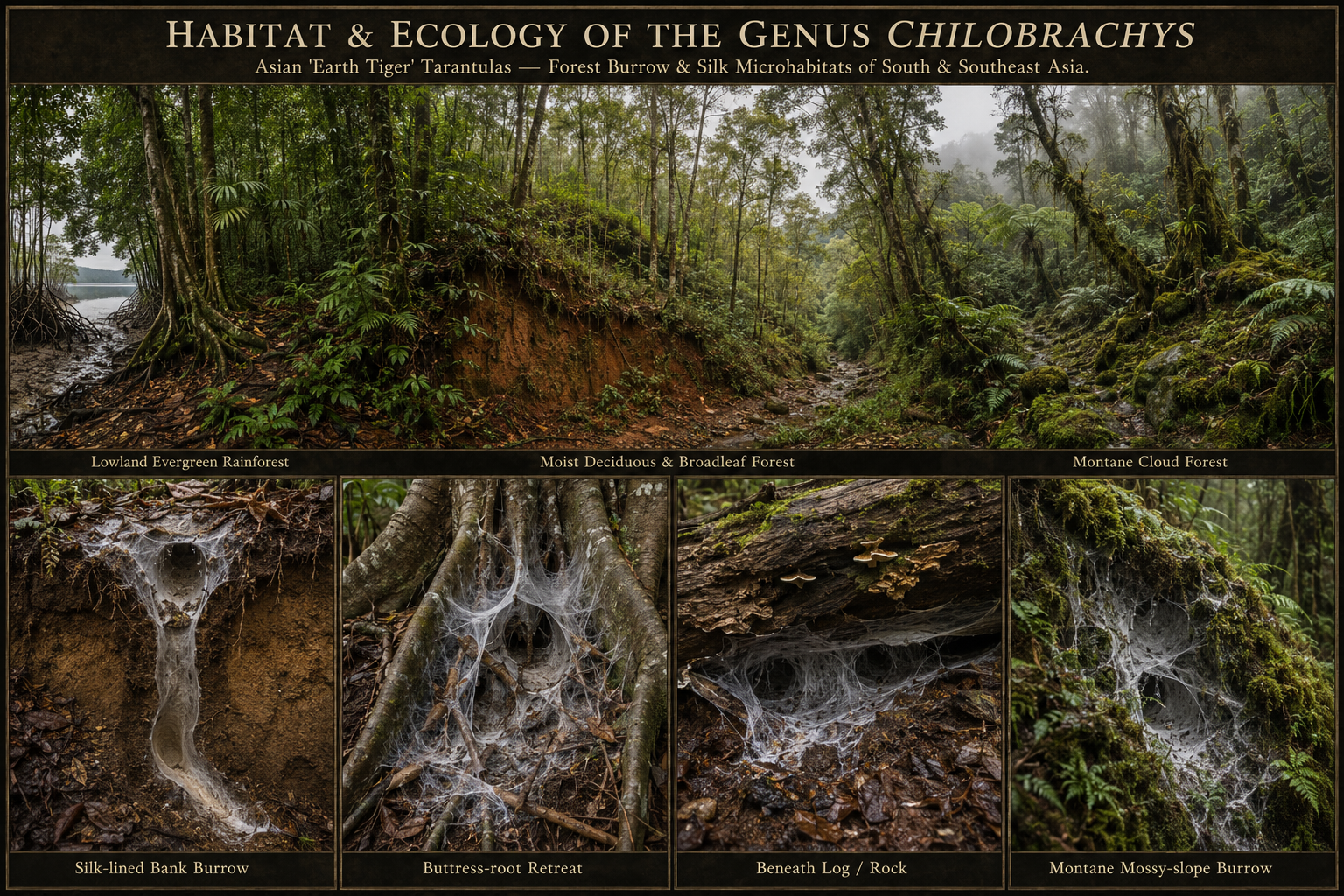
Members of the genus are obligately fossorial in most species, with the subset of arboreal-and-mangrove specialists (most notably C. natanicharum) being the diagnostic exception rather than the rule. The standard Chilobrachys habit is a deep silk-lined burrow combined with extensive surface webbing extending well above the substrate — the genus is among the heaviest webbers in the Asian Selenocosmiinae and constructs more visible surface silk than the comparable Cyriopagopus and Selenocosmia. Adult coloration ranges across the genus from the muted fawns and chocolates of the Burmese and Indian fauna (C. dyscolus, C. fimbriatus) through bronze-to-violet sheens on Western Ghats material to the saturated electric-blue iridescence of C. natanicharum and the orange-saturated Thai trade phenotypes that may ultimately resolve into one or several formally described species. As with all Old World theraphosids, no urticating setae are produced; defense is purely flight-and-bite, with a fast retreat into the surface webbing or burrow as the dominant first response and a willing defensive bite as the secondary response when cornered.
Behaviorally Chilobrachys are markedly defensive even by Asian Selenocosmiinae standards. Threat displays are common and brief, retreat speed is high, and bite-readiness when persistently cornered is among the highest in the international hobby — the genus is routinely categorized as advanced and is not appropriate for keepers without substantial Old World terrestrial-fossorial experience. Venom is moderate-to-strong by Asian standards across documented species, with localized pain, swelling, and occasional muscle cramping reported in bite literature; no medically significant systemic envenomation is reliably documented but the upper-end Chilobrachys bite is materially more uncomfortable than the comparable Pterinochilus or Heteroscodra envenomation. Captive husbandry expects 6–8 in of compactable substrate to support deep burrowing, multiple anchor points and substrate-surface architecture (cork bark, slabs, low branches) to accommodate the heavy surface webbing the genus expects, mid-70s to low-80s °F across most of the genus's range, and moderate-to-higher humidity (~70–80%) maintained primarily through a moist substrate base with adequate cross-ventilation. Sustained low humidity in undersized enclosures is the most consistent cause of failed long-term keeping. No Chilobrachys species is currently CITES-listed; conservation pressure is meaningful through habitat loss to agricultural conversion and (in the Thai mangrove specialist C. natanicharum) coastal development.