
Heterothele
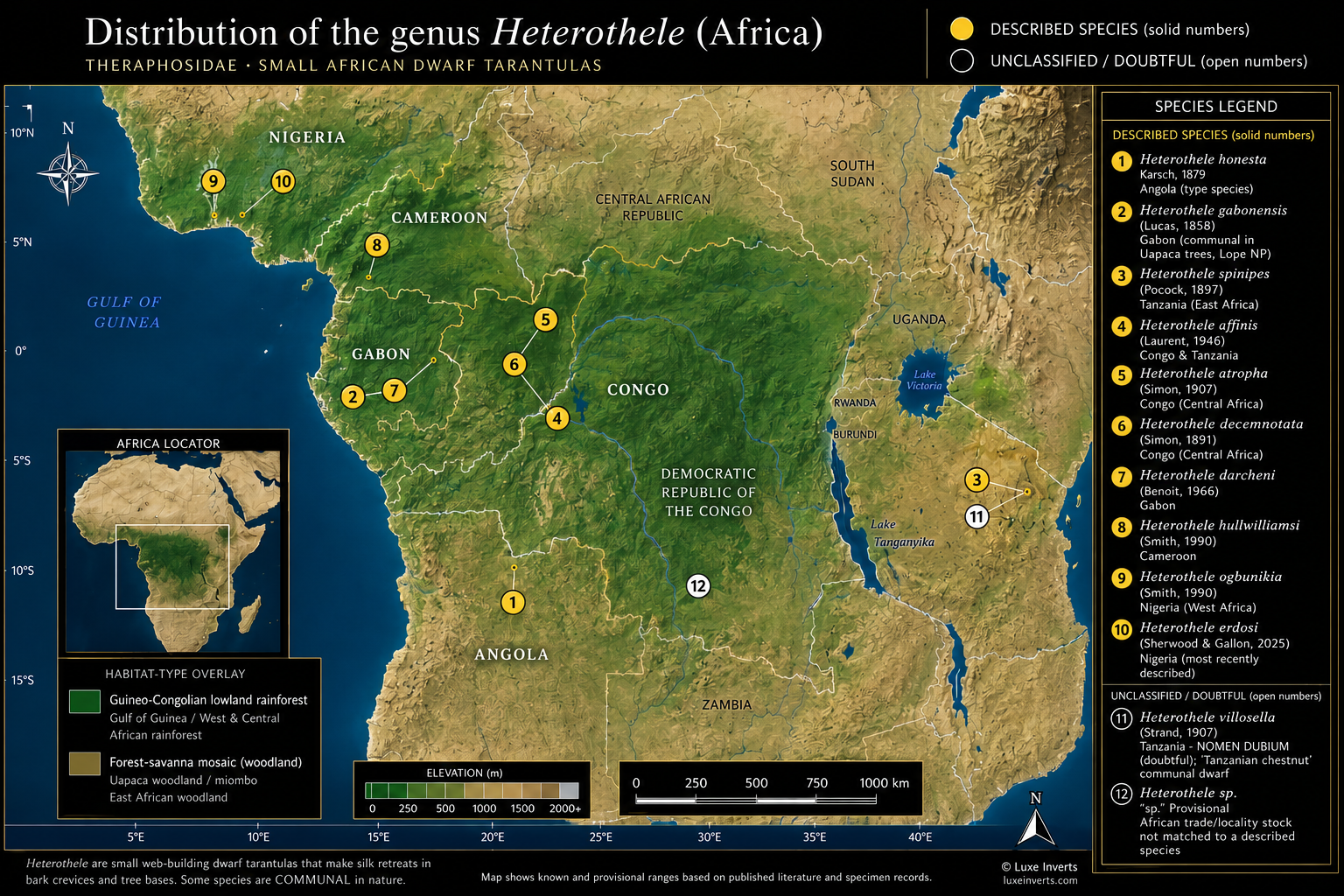
Heterothele Karsch, 1879 is a genus of small, communal to sub-communal African theraphosids historically placed in several different subfamilies and now generally associated with the Harpactirinae following recent systematic revisions. The genus is distributed across sub-Saharan Africa, with described species known from Tanzania, Kenya, Uganda, the Democratic Republic of the Congo, Gabon, Cameroon, and adjacent countries. The type species is H. affinis Karsch, 1879; among the most familiar species in the hobby are H. villosella (Tanzanian Chestnut Baboon) and H. gabonensis (Gabon Blue Dwarf Baboon), alongside H. honesta, H. gabonensis, H. odysseus, and a small scatter of less commonly kept forms. The genus sits at the taxonomic boundary between the harpactirines and other small African theraphosids, and its generic limits continue to be refined by ongoing revisionary work.
Members of the genus are small, heavily webbing, semi-fossorial to fossorial spiders of savanna, rainforest, and the transitional habitats between them. Wild animals build extensive, multi-chambered silk retreats under rocks, logs, and root mats, often extending the retreat with substantial tubular webbing across the substrate surface — an uncommon phenotype among Old World dwarf theraphosids and one of the genus's diagnostic field signatures. Several species are reported to tolerate conspecifics as juveniles and sub-adults, and communal or sub-communal arrangements have been maintained successfully in captivity, though cannibalism remains a risk and long-term communal husbandry requires careful management of prey density and population structure.
Morphologically, Heterothele are dwarf to small, with adult females typically reaching 1.75–2.75 in diagonal leg span. Coloration is species-specific: H. villosella is a warm chestnut-brown with fine golden setae; H. gabonensis carries a subtle blue-to-slate structural sheen; H. honesta and several West African forms trend toward dark charcoal with reddish or copper highlights. Like all Old World theraphosids, Heterothele lack urticating setae and rely on speed, prodigious webbing, and defensive biting. Venom has not been characterized in detail in the primary literature, but bites from congeneric harpactirines can produce significant localized pain and, in some cases, systemic effects; the genus should be treated as medically meaningful, and handling is not advised despite the animals' small size.
No Heterothele species is listed on CITES, and no species has a published IUCN Red List assessment. In captivity, the genus expects a modest enclosure with a deep webbing substrate (commonly 3–5 in of peat or coir blends), a cork retreat or rock crevice, temperatures in the mid-70s to low-80s °F, and moderate humidity with strong ventilation. Heterothele is a practical introduction to the Old World fauna for experienced small-species keepers: manageable in scale, striking in their web architecture, resilient in husbandry, and increasingly appreciated as a group in which genuinely communal theraphosid behavior can be studied at close range.