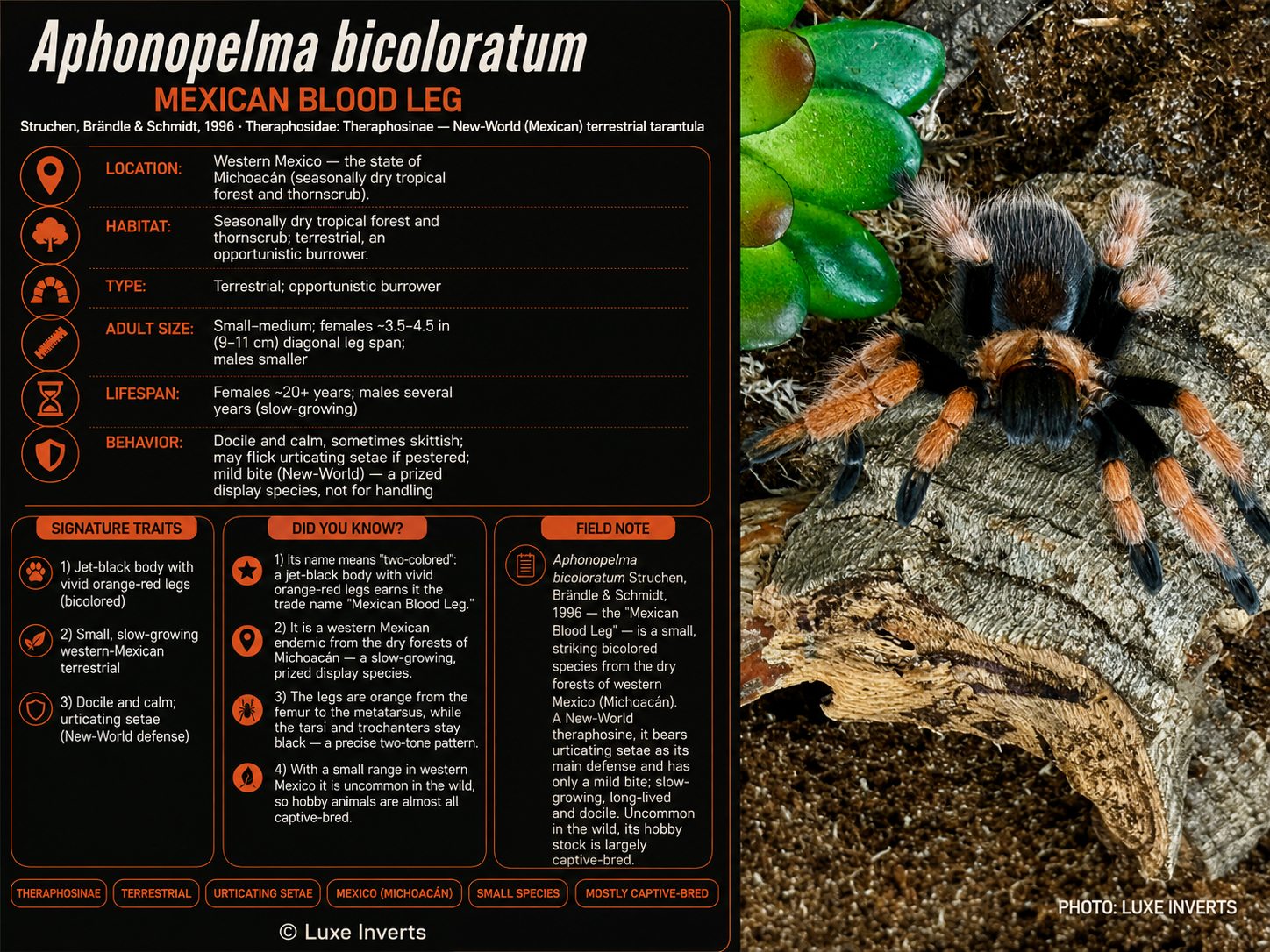

Aphonopelma
Aphonopelma Pocock, 1901 is a genus of medium to large terrestrial theraphosids in the subfamily Theraphosinae and the dominant tarantula lineage of temperate and subtropical North America. The genus was erected by Pocock when he split the old catch-all Eurypelma, and he designated Eurypelma seemanni F. O. Pickard-Cambridge, 1897 — the Costa Rican Zebra, originally described from a female holotype collected at Puerto Culebra, Guanacaste, Costa Rica — as the type species; it is now Aphonopelma seemanni. The genus currently contains roughly fifty-four valid species (World Spider Catalog, 2026), distributed from the southern and western United States through Mexico and Central America as far south as Costa Rica and Panama, with the bulk of described species concentrated in the US Southwest and the Mexican Plateau. The taxonomic history of the group was, until very recently, a mess: at one point, well over eighty nominal North American species had been described, many on trivial or environmentally variable characters, and the genus served as a holding pen for almost every New World mygalomorph that did not obviously belong elsewhere. The consequential recent work is Hamilton, Hendrixson, and Bond's 2016 integrative revision of the United States fauna (ZooKeys 560:1-340), which combined morphology, mitochondrial and nuclear sequence data, and geospatial distribution modeling to reduce fifty-five nominal US species to twenty-nine valid species, synonymizing thirty-three, assigning seven to nomina dubia, and describing fourteen new species (including A. johnnycashi, A. chiricahua, A. madera, A. prenticei, and A. peloncillo). The Mexican and Central American fauna remain comparatively under-revised, and the 2016 paper's own concluding remarks flag this as the next substantial body of work needed in the genus.
The genus occupies an exceptionally broad climatic envelope for a tarantula lineage. United States species range from the Sonoran Desert floor (A. chalcodes) and the Chihuahuan Desert and sky-island complex of southeastern Arizona and southwestern New Mexico (A. chiricahua, A. madera, A. peloncillo) through Mojave and Great Basin scrub (A. iodius), California chaparral and oak woodland (A. eutylenum), and the southern Great Plains into central and southern Texas and Oklahoma (A. anax, A. hentzi, A. armada, A. moderatum). Mexican species extend across the Mexican Plateau and the Sierra Madre into the Balsas depression, and Central American species reach the Pacific dry forest (A. seemanni) and the southern limit of the genus in Costa Rica and western Panama. This range covers a remarkable temperature and moisture breadth — from sustained summer ground temperatures above 100 F in desert lowlands to winter snowfall at higher elevations in the Four Corners region — and the husbandry profiles of the genus vary accordingly: the dry, cool-winter-tolerant profile of A. chalcodes, A. iodius, and A. hentzi is a poor template for the warmer, moderately humid A. seemanni or for the Mexican lowland species.
Members of the genus are terrestrial with an opportunistic fossorial habit. Wild animals excavate silk-lined burrows in compactable desert or prairie soils — often at the base of shrubs, rocks, or cactus — and in the US Southwest, these burrows are reliable microhabitats through the seasonal extremes of the Sonoran and Chihuahuan Deserts. Surface activity is largely nocturnal outside of the midsummer male wandering phenomenon: in late July and August, particularly after the first monsoon rains in Arizona and New Mexico, mature males leave their burrows en masse in search of females, and the resulting evening roadside activity is one of the most visible tarantula events in North America and the source of most of the genus's public profile. Aphonopelma sits in Group A of the Theraphosinae, and bears type I urticating setae as its principal active defense; the genus is, on the whole, strikingly reluctant to use them, and is famously among the most placid of theraphosids — most species prefer retreat over threat, and bites in wild and captive contexts are uncommon. Venom is mild by theraphosid standards, with documented envenomations producing only transient localized effects. Females reach 4.5-6 in diagonal leg span in most species, with the larger A. anax and A. eutylenum reaching the upper end of that range; males are smaller and more gracile. Coloration across the genus is generally muted — browns, blacks, and coppers dominate — with a handful of striking exceptions: the metallic-gold carapace pubescence of A. chalcodes, the crisp black-and-cream tibial banding of A. seemanni, and the black body with red abdominal setae of A. johnnycashi.
Longevity in the genus is exceptional. Documented female lifespans in A. chalcodes exceed twenty-five years in captivity, with credible records of several captive females reaching or exceeding thirty years, and similar longevity is reported for A. hentzi and A. iodius; males, as across the family, are short-lived at roughly 5-10 years post-ultimate molt. No Aphonopelma species is currently listed on CITES, and none has a published IUCN Red List assessment at the species level, though localized collection pressure on visible US populations (particularly A. chalcodes during the summer male-wandering season) and sustained habitat loss to development and agricultural conversion in both the US Southwest and the Mexican Plateau are the meaningful conservation concerns in the genus. In captivity, the genus expects 4-6 in of moderately dry substrate with a deeper, compactable section for burrow retention, a cork retreat or pre-started burrow at ground level, temperatures in the mid-70s to low-80s F with a cool winter dip tolerated and, for the desert species, actively beneficial, and low-to-moderate humidity with generous cross-ventilation; sustained high humidity is poorly handled. Aphonopelma is one of the few theraphosid genera for which a "beginner-friendly" label is genuinely defensible, and one of the most scientifically active areas in current New World tarantula systematics, with the Mexican and Central American fauna all but certain to see substantial taxonomic work in the next decade.