

Brachypelma
Family: Theraphosidae · Subfamily: Theraphosinae · Type species: Brachypelma emilia (White, 1856), by monotypy
Brachypelma is a genus of large, terrestrial New World tarantulas endemic to Mexico, comprising the iconic "red-kneed" and "red-legged" species that are among the most recognizable—and most heavily regulated—tarantulas in the world. Erected by Eugène Simon in 1891, the genus today contains eight valid species following a series of molecular and morphological revisions that substantially narrowed its scope. Every member of the genus is listed under CITES Appendix II, reflecting decades of pressure from the international pet trade on slow-growing, range-restricted populations.
Diagnosis and morphology
Brachypelma are robust, heavy-bodied theraphosines with adult leg spans typically ranging from roughly 12 to 16 cm. As members of the subfamily Theraphosinae, they possess urticating setae on the dorsal and posterior abdomen—primarily Type I and Type III setae—which are kicked off as a defensive barrier against vertebrate predators and represent the genus's first line of defense in lieu of a potent venom. The genus is characterized within Theraphosinae by a combination of palpal bulb and spermathecal morphology, the configuration of the male tibial apophysis on leg I, and—diagnostically for the modern concept of the genus—a distinctive carapace and leg coloration in which black or dark backgrounds are offset by vivid orange, red, pink, or cream markings concentrated on the patellae ("knees") and leg articulations. This bright aposematic patterning distinguishes Brachypelma sensu stricto from its largely uniformly dark sister genus Tliltocatl (see below). Like other theraphosines, they are long-lived, with mature females persisting for 20–30 years while males die within roughly a year of their ultimate molt.
Taxonomic history
The genus has undergone significant reorganization. Historically, Brachypelma was applied broadly to a heterogeneous assemblage of Mexican and Central American species that included both the brightly marked "red-leg/red-knee" forms and a group of darker-bodied "red-rump" species. A systematic revision by Mendoza & Francke (2017), which combined morphology with DNA barcoding to aid identification of these CITES-listed animals, concluded that the genus as then circumscribed was not monophyletic. In 2020, the same authors formally split the genus: the dark, red-rumped species were transferred to the newly erected genus Tliltocatl Mendoza & Francke, 2020 (from the Nahuatl tlil, "black," and tocatl, "spider"), among them the well-known curly-hair tarantula T. albopilosus and T. vagans, T. kahlenbergi, T. sabulosus, and others. Brachypelma in its current sense is restricted to the eight brightly colored, Pacific-versant Mexican endemics.
Constituent species
The eight currently recognized species, all endemic to Mexico, are:
Brachypelma emilia (White, 1856) — the Mexican red-leg or painted red-leg; the type species of the genus, distributed along the Pacific slope in the northwestern states (Nayarit, Sinaloa, Durango).
Brachypelma smithi (F. O. Pickard-Cambridge, 1897) — the Mexican red-knee in the strict sense; native to the Pacific coast of Guerrero. Long confused in the hobby and literature with B. hamorii.
Brachypelma hamorii Tesmoingt, Cléton & Verdez, 1997 — the species most commonly sold as the "Mexican red-knee," ranging across the western Sierra Madre Occidental and Sierra Madre del Sur in Colima, Jalisco, and Michoacán.
Brachypelma boehmei Schmidt & Klaas, 1993 — the Mexican fire-leg, with intense orange-red leg banding; endemic to Guerrero.
Brachypelma auratum Schmidt, 1992 — the Mexican flame-knee; found in Guerrero and Michoacán.
Brachypelma baumgarteni Smith, 1993 — restricted to Michoacán.
Brachypelma klaasi (Schmidt & Krause, 1994) — the Mexican pink, among the rarest in the genus; Jalisco and Nayarit.
Brachypelma albiceps Pocock, 1903 — the Mexican golden red-rump (despite the common name, retained in Brachypelma rather than Tliltocatl); endemic to the central highlands, especially Guerrero and Morelos.
Distribution and ecology
The genus is confined to the Pacific drainage of Mexico, occupying tropical dry forest, thorn scrub, and seasonally dry deciduous habitats along and west of the Sierra Madre del Sur and Sierra Madre Occidental, from sea level to mid-elevation. Brachypelma are fossorial-to-opportunistic burrowers, excavating or appropriating burrows beneath rocks, root systems, and embankments, which they line with silk and use as ambush retreats. They are sit-and-wait predators of insects and other arthropods, occasionally taking small vertebrates. Activity is strongly seasonal, with mating typically occurring in the warmer, wetter months; females construct silken egg sacs guarded within the burrow. Slow growth, delayed female maturity, and strong site fidelity make local populations highly sensitive to habitat loss and over-collection.
Conservation
Conservation concern has shaped the taxonomy and study of Brachypelma more than almost any other tarantula genus. B. smithi (then encompassing B. hamorii) was the first tarantula placed on CITES Appendix II in 1985; the remaining species were added in 1994, so that the entire genus is now CITES-regulated. The principal threats are illegal wild collection for the international pet trade and ongoing destruction of dry-forest habitat. Because adults of several species are superficially similar and difficult to identify—complicating enforcement—DNA barcoding has been advanced as a practical tool for distinguishing legally traded captive-bred animals from wild-caught specimens. Captive breeding is now well established for the most popular species, which has reduced but not eliminated collection pressure on wild populations.
Selected references
Mendoza, J. & Francke, O. (2017). Systematic revision of Brachypelma red-kneed tarantulas (Araneae: Theraphosidae), and the use of DNA barcodes to assist in the identification and conservation of CITES-listed species. Zoological Journal of the Linnean Society.
Mendoza, J. & Francke, O. (2020). Systematic revision of Mexican threatened tarantulas Brachypelma (Araneae: Theraphosidae: Theraphosinae), with a description of a new genus, and implications on the conservation. Zoological Journal of the Linnean Society 188(1): 82–147.
World Spider Catalog (current version). Natural History Museum Bern. https://wsc.nmbe.ch
© Luxe Inverts — www.luxeinverts.com
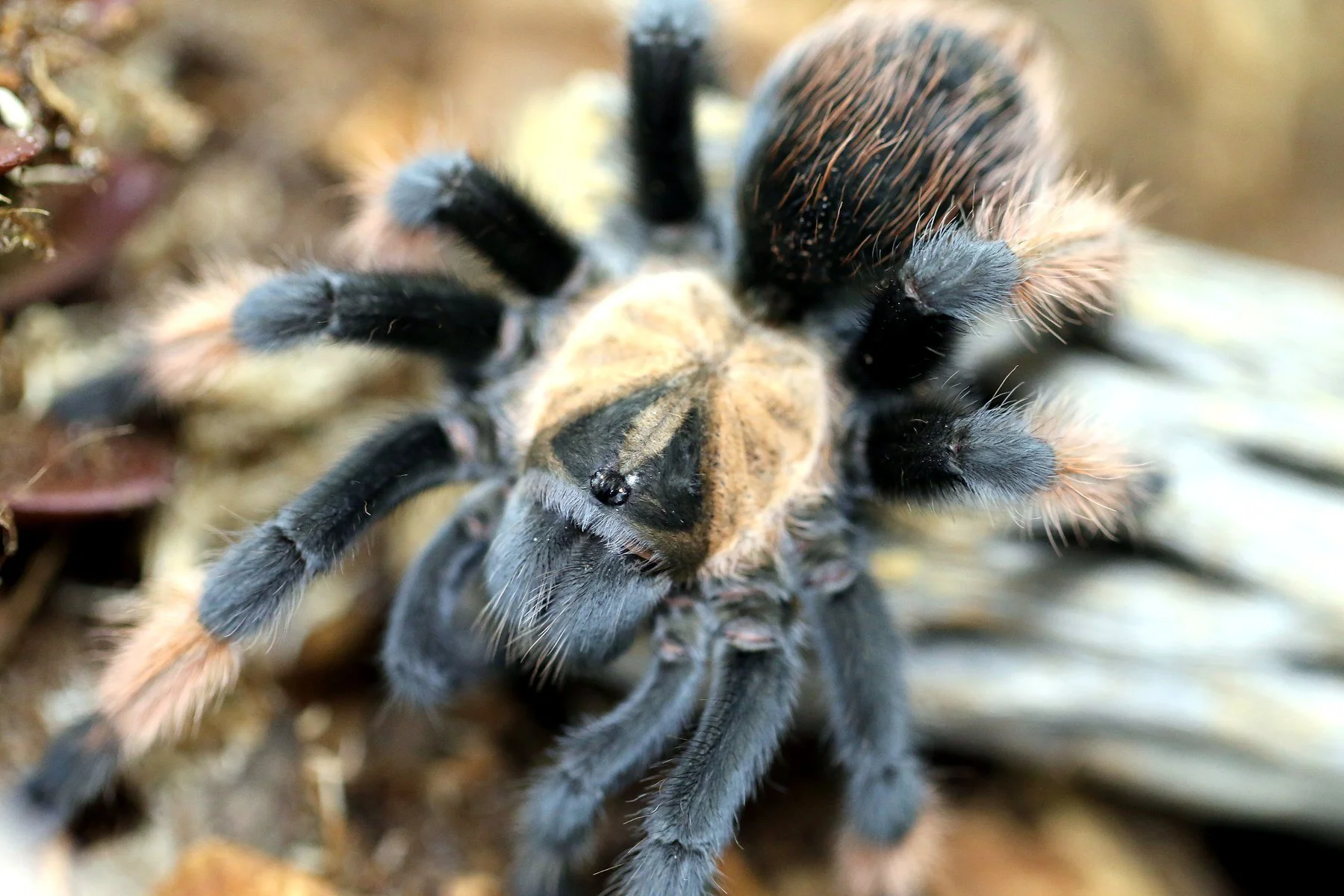
Brachypelma emilia
Mexican Red-Leg Tarantula
Brachypelma emilia (White, 1856) is a medium-bodied Neotropical theraphosid endemic to the Pacific slope of Mexico. Originally described as Eurypelma emilia and transferred to Brachypelma by Simon in 1891, the species is instantly diagnosed by the sharply defined black triangle on the beige carapace — the “emilia mark” — which remains the single most reliable field character across age classes. Long-lived, slow-moving, and handling-tolerant by theraphosid standards, B. emilia was among the Mexican redknee/redleg complex that drove the commercial tarantula trade in the latter half of the twentieth century. All Brachypelma have been listed on CITES Appendix II since 1985, and captive-bred specimens dominate the modern legal market.
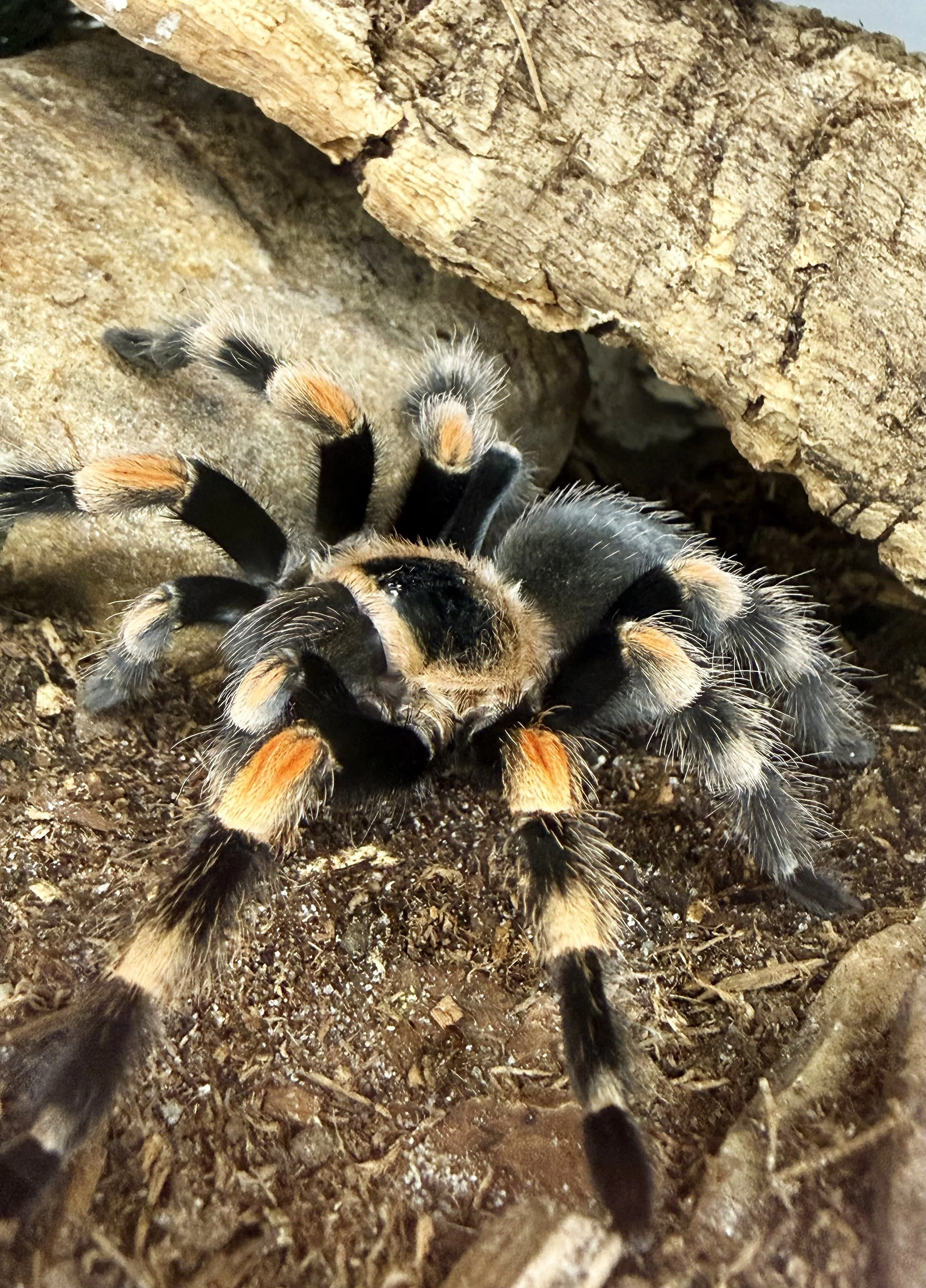
Brachypelma hamorii
Mexican Red Knee
Brachypelma hamorii Tesmoingt, Cleton & Verdez, 1997 is the Mexican Red Knee and the species that, for most of the late 20th century, was circulating in the pet trade and figuring in wildlife documentaries as Brachypelma smithi. The two species were formally disentangled by Mendoza & Francke in 2017 using mitochondrial COI barcoding alongside morphological characters, confirming that the familiar orange-kneed hobby animal is B. hamorii and restricting B. smithi to a separate, more southerly Mexican range. The subsequent Mendoza & Francke revision (2020, Zoological Journal of the Linnean Society 188: 82–147) further split the genus, erecting Tliltocatl for the dark-bodied species (T. albopilosum, T. vagans and allies) and restricting Brachypelma to eight Mexican species with brilliant red, orange, or rose highlights — B. hamorii among them. All Brachypelma species are listed under CITES Appendix II, reflecting sustained illegal collection and the genus's emblematic status in the Mexican tarantula conservation story.
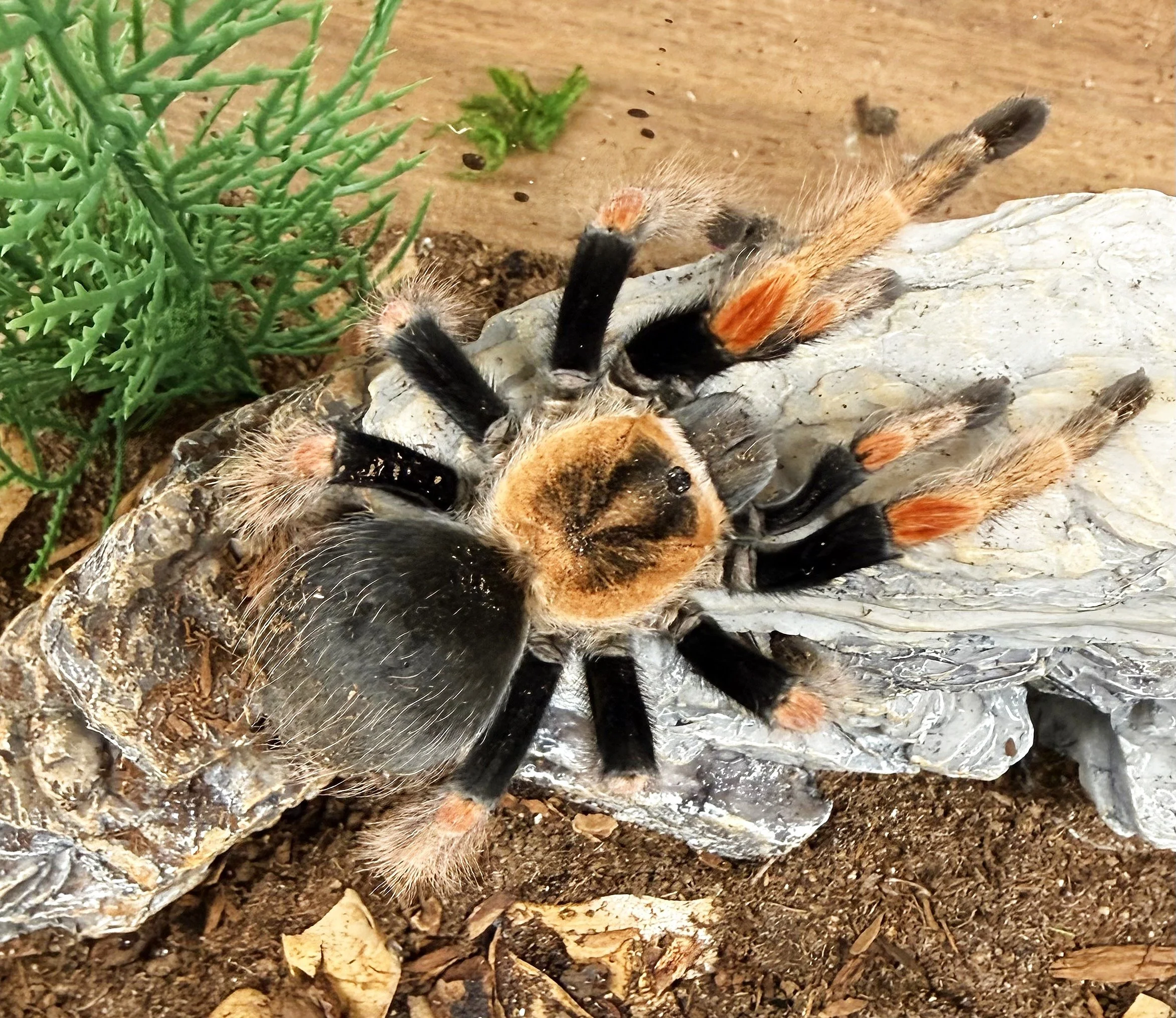
Brachypelma baumgarteni
Mexican Orange Beauty
Brachypelma baumgarteni Smith, 1993 is the Mexican Orange Beauty, described in the British Tarantula Society Journal 8(4): 14–19 from a male holotype collected by Marc Baumgarten (for whom the species is named) in the Sierra Madre del Sur foothills of Michoacán, Mexico; the holotype is deposited at the Natural History Museum, London (BMNH-1999-122). Among the red- and orange-kneed Mexican Brachypelma, it is readily distinguished by the deep flame-orange patellar bands bordered by distinct yellowish zones on the tibia and metatarsus — a warmer, more cream-toned palette than the harder red of B. hamorii or the near-uniform red legs of B. boehmei. B. baumgarteni was retained in Brachypelma s.s. following Mendoza & Francke's 2020 revision (Zoological Journal of the Linnean Society 188: 82–147), which split the genus and moved the dark-bodied species to Tliltocatl. All Brachypelma are listed under CITES Appendix II.
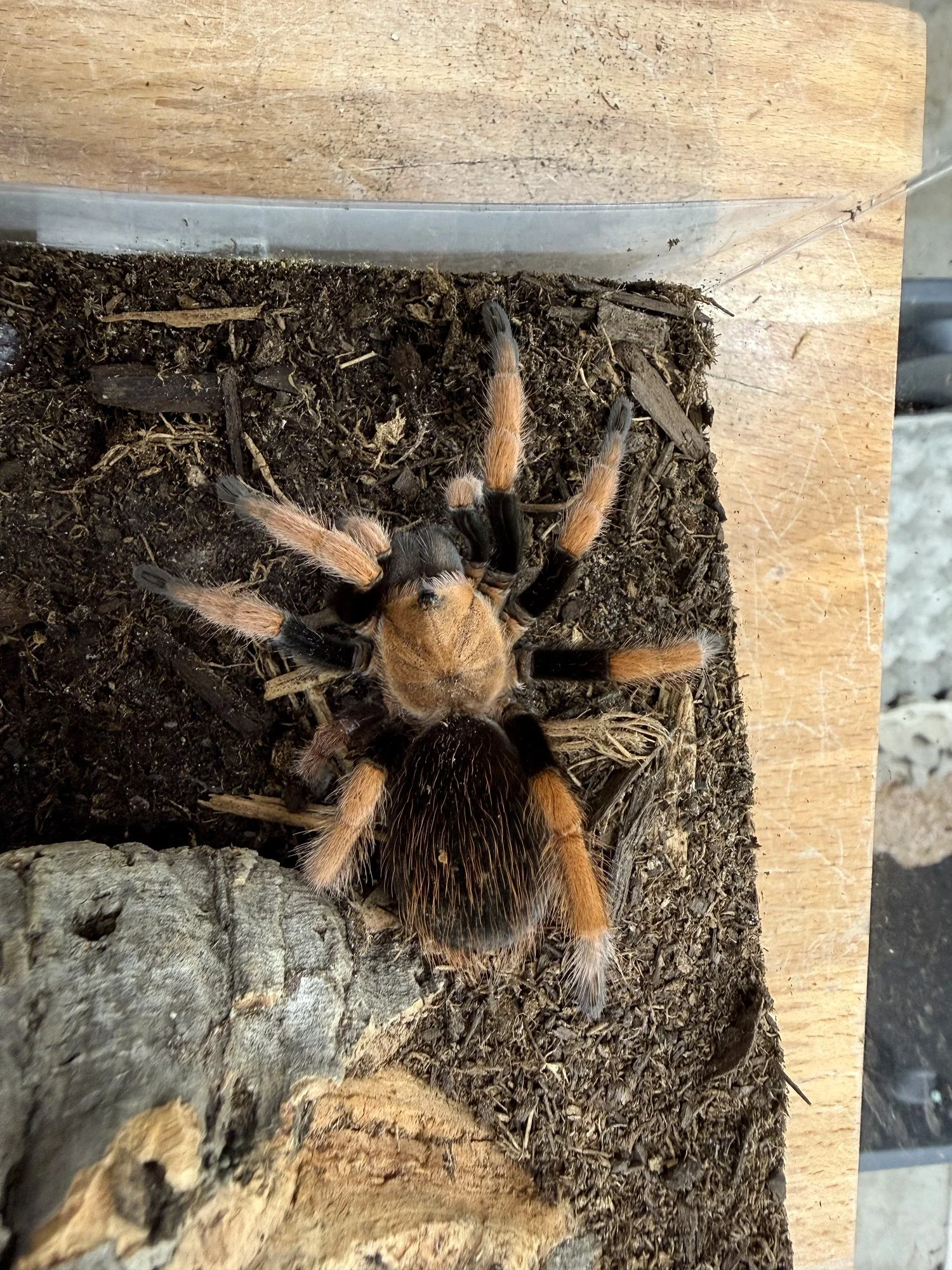
Brachypelma boehmei
Mexican Fire Leg
Brachypelma boehmei Schmidt & Klaas, 1993 is the Mexican Fire Leg, distinguished by the most saturated red-orange leg coloration in the genus — the femora and metatarsi flash a brilliant fire orange against the dark velvet body, brighter and more uniformly red than in B. hamorii or B. emilia. The species was retained in the redefined Brachypelma following Mendoza & Francke's revision (2020, Zoological Journal of the Linnean Society 188), which restricted the genus to eight Mexican species with brilliant red, orange, or rose highlights and erected Tliltocatl for the dark-bodied former congeners. Like all Brachypelma, B. boehmei is listed under CITES Appendix II.
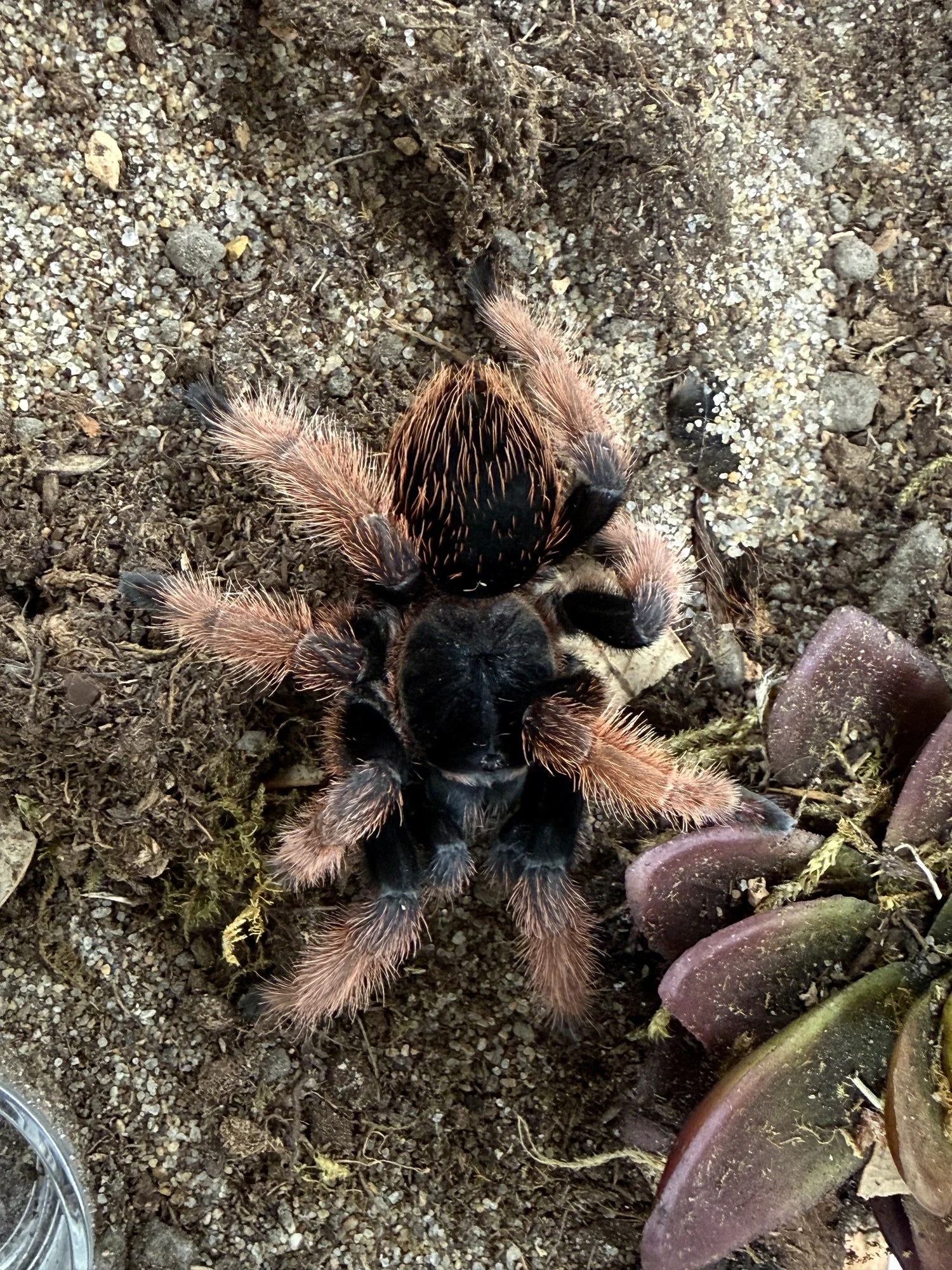
Brachypelma klaasi
Mexican Pink
Brachypelma klaasi Schmidt & Krause, 1994 is the Mexican Pink, the rosiest and least red of the redefined Brachypelma. The species is distinguished by a uniformly soft-pink-to-salmon overall coloration of the carapace, opisthosoma, and legs — the legs lack the saturated banded red of B. boehmei or B. hamorii and instead carry a more diffuse rose flush throughout. B. klaasi was retained in the redefined Brachypelma by Mendoza & Francke (2020) and is CITES Appendix II listed; the species has historically been the rarest of the Mexican Brachypelma in the legal trade and remains comparatively expensive even in captive-bred slings.