

Scolopendra
Scolopendra Linnaeus, 1758 is the type genus of the family Scolopendridae and the tribe Scolopendrini, and is one of the original genera erected in the 10th edition of Systema Naturae — among the oldest continuously valid names in any arthropod group. Scolopendra morsitans Linnaeus, 1758 is the type species by subsequent designation, and the genus as currently circumscribed contains on the order of thirty valid species, though well over a hundred nominal names have been applied to Scolopendra taxa since the Linnaean erection, and modern integrative revisions continue to rearrange the list. The consequential 21st-century reference point for the genus is Siriwut, Edgecombe, Sutcharit, Tongkerd and Panha's 2016 taxonomic review of mainland Southeast Asian Scolopendra (ZooKeys 590:1-124), which used mitochondrial (COI, 16S rRNA) and nuclear (28S rRNA) sequence data to redescribe eight nominal species (S. morsitans, S. subspinipes Leach, 1816, S. dehaani Brandt, 1840, S. multidens Newport, 1844, S. calcarata Porat, 1876, S. japonica Koch, 1878, S. pinguis Pocock, 1891, S. dawydoffi Kronmüller, 2012) and described the remarkable amphibious S. cataracta Siriwut, Edgecombe & Panha, 2016 from Laos — the first centipede known to actively enter and hunt in running water. That work recovered three main mainland-Asian clades — S. calcarata + S. pinguis, S. morsitans, and an S. subspinipes group uniting six of the other species — and established that the long-treated-as-polytypic S. subspinipes Leach, 1816 in fact comprises several valid biological species. The pattern has held up in subsequent work: Tsukamoto, Shimano, Murakami and Hiruta's 2021 description of S. alcyona from the Ryukyu Archipelago and Taiwan (Zootaxa 4952: 495-512) added a second amphibious lineage, and the S. gigantea / S. galapagoensis Neotropical complex has been progressively clarified since Shelley and Kiser's 2000 neotype designation for S. gigantea.
Scolopendra is a fully pantropical and warm-subtropical genus, effectively absent only from polar and cold-temperate latitudes. African, Mediterranean, Arabian, Central and South Asian, Southeast Asian, Australasian, North American (the US Southwest and Mexico), Central American, Caribbean, South American, and oceanic-island faunas all carry their own characteristic Scolopendra species, and the distribution of the genus tracks warm-continental and warm-island climates more closely than any particular habitat: members are recorded from desert scrub (S. heros across the US Southwest and northern Mexico, S. morsitans across its broad Old World range), tropical rainforest (S. dehaani, S. subspinipes, S. hainanum in the East Asian moist forests), oceanic island endemic habitats (S. galapagoensis, endemic to the Galápagos and coastal Ecuador and Peru; the Caribbean S. alternans), Mediterranean-type shrubland (the European S. cingulata, S. canidens, and allies), and in the amphibious S. cataracta and S. alcyona from the splash zones of mountain streams and coastal intertidal. Within habitat the genus is cryptic and surface-hunting: wild animals shelter under rocks, loose bark, logs, in rock-pile crevices, and in shallow burrows either self-excavated in compactable soil or occupied opportunistically, with activity concentrated in the hours after dusk and through the night. Seasonality in native populations is pronounced in the drier and cooler parts of the range — Mediterranean, desert-southwest US, and inland Australian species in particular — and some species undergo extended dry-season dormancy in sealed burrows.
Members of Scolopendra are typical scolopendrids in body plan — 21 leg-bearing trunk segments, 21 pairs of walking legs, a pair of modified first-leg forcipules carrying the venom gland and delivering the defensive and prey-capture bite, a heavy cephalic plate bearing four pairs of simple ocelli (retained clustered eyes, absent in the cryptopid and scolopocryptopid outgroups), and a sexually undimorphic pair of caudal terminal legs (ultimate pedes) used chiefly in sensory contact and defense rather than locomotion. Body size is the genus's most publicly recognizable feature: Scolopendra contains the largest centipedes ever described, with S. gigantea L., 1758 (the Peruvian Giant Yellowleg) and S. galapagoensis Bollman, 1889 (Darwin's Goliath) both exceeding 30 cm in documented wild specimens, S. dehaani and S. subspinipes reaching 20-25 cm, and the large-bodied Nearctic S. heros reaching 20 cm or more. At the small end the genus holds on at 4-6 cm in several of the European Mediterranean species. Coloration is broadly diagnostic at the species level: the ringed tergites of S. morsitans, the uniform orange-to-red body of S. heros and several of the subspinipes-group members, the dark blue-black body and bright red or yellow legs of S. dehaani "Malaysian Jewel" stock, and the paler orange S. hainanum are among the most visually distinctive. Scolopendra are active nocturnal predators of insects, other arthropods, spiders, and vertebrates up to and including small mammals, reptiles, amphibians, and (in the documented Galápagos case) snakes; predation on bats at cave roosts has been reported for S. gigantea in Venezuela. Venom across the genus is a biochemically rich peptide cocktail of which only a subset is well-characterized — the heat-activating RhTx from S. subspinipes mutilans (Yang et al., 2012, PNAS) and the cardiovascular-active SsTx were the first structurally resolved centipede-venom toxins — and bites from the large-bodied species routinely produce severe localized pain, lymphangitic spread, and in rare cases (documented in the Philippines and Venezuela) lethal systemic effects in susceptible humans. Defensive temperament is uniformly high: Scolopendra do not tolerate handling, strike readily and quickly when disturbed, and are among the arthropods most reliably cited as medically significant to keepers.
No Scolopendra species is listed on CITES and the genus has no published IUCN Red List assessments at the species level, though several narrow-range island and mountain endemics (S. galapagoensis, S. alcyona, and the smaller European taxa) are clearly of localized conservation interest. Captive breeding of Scolopendra remains difficult and inconsistently reproducible compared with theraphosid spiders, and wild-sourced animals still dominate the international hobby supply — a fact that has contributed to the persistent commercial use of hobby-trade locality names ("sp. Malaysian Cherry," "sp. Toraja," "sp. White Beard" among them) for regional colour forms whose formal placement within species like S. dehaani, S. subspinipes, or S. hainanum is still being worked out. In captivity the genus expects 5-8 in of moist, compactable substrate with real burrowing depth, broken surface cover (cork, flat stones, bark), temperatures tuned to the native range of the species (high-70s to low-80s F for the tropical SE Asian and American species, modestly cooler for the Mediterranean and Nearctic desert taxa), moderate-to-high humidity with genuine cross-ventilation for the tropical species, and dry-substrate/dry-surface setups with a small moisture corner for the desert species. Scolopendra is the reference genus of the centipede hobby — the group most keepers begin with, the group most field guides figure, and, by weight of both biomass and medical significance, the most ecologically consequential centipede genus in the world's tropical and subtropical ecosystems.
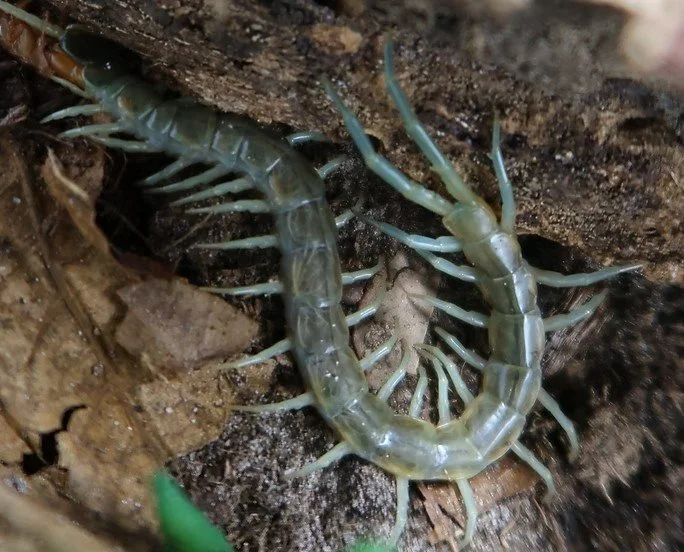
Scolopendra hainanum
Common name: Chinese Giant Tiger Leg Centipede / Chinese Tiger Centipede
Origin: Native to Hainan Island and parts of southern China, in warm tropical and subtropical forests.
Lifestyle: Nocturnal, ground-dwelling predator. Spends the day hidden under bark, leaf litter and in burrows, emerging at night to hunt insects and other invertebrates.
Adult Size: Typically around 8–9 in (21–23 cm) in length, placing it among the larger Scolopendra species.
Growth Rate: Moderate to fast. Given regular feeding and warm temperatures, juveniles can reach adult size in a few years, comparable to other large Asian Scolopendra (inferred from care information and reported sizes in the hobby).
Temperament: Very defensive, fast and high-strung. This species is not handleable; it will readily threat-posture and may strike if disturbed. Bites are considered medically significant and should be avoided.
Color & Appearance: A heavy-bodied, high-contrast centipede with a dark, almost black body and striking yellow-orange to red legs often showing “tiger” banding, plus a reddish to orange head and terminal legs. A darker color form of this species can be found, referred to by hobbyists as Scolopendra hainanum 'Black'.
Species history
Scolopendra hainanum is a relatively recently described giant centipede from Hainan Island in southern China. It was formally named in 2012 by Christian Kronmüller, who separated it from the complex of animals long lumped under S. subspinipes after reviewing that species group in detail.
In the hobby, this centipede was widely traded for years as S. subspinipes “tiger leg” or “Chinese tiger” before its true status was clarified. Kronmüller’s work showed that the distinctive South Chinese form—with its heavy build, dark body and bold orange-to-yellow legs—represented a separate species now known as S. hainanum (also listed under the spelling S. hainana in some taxonomic databases).
Since its description, S. hainanum—commonly called the Chinese Giant Tiger Leg Centipede—has become one of the most sought-after Asian Scolopendra in the trade, appreciated for its size, high-contrast coloration and “tiger” banding along the legs. Wild populations are centered on Hainan and nearby parts of southern China, where it lives as a fast, powerful nocturnal predator.
Natural habitat
Scolopendra hainanum is native to Hainan Island and nearby parts of southern China, where it lives in warm, humid, subtropical forests. It is most often found in and under rotting wood, leaf litter and loose soil, using deep cover, mossy ground and bark crevices as daytime retreats. Field records and climate data from Hainan indicate consistently high humidity, heavy seasonal rainfall and mild winters, creating a permanently damp forest floor with plenty of hiding spots and invertebrate prey.
In nature this “Chinese Giant Tiger Leg” centipede behaves as a nocturnal, ground-hunting predator, emerging at night to roam through cluttered forest microhabitats while spending the day hidden in secure, shaded cavities.
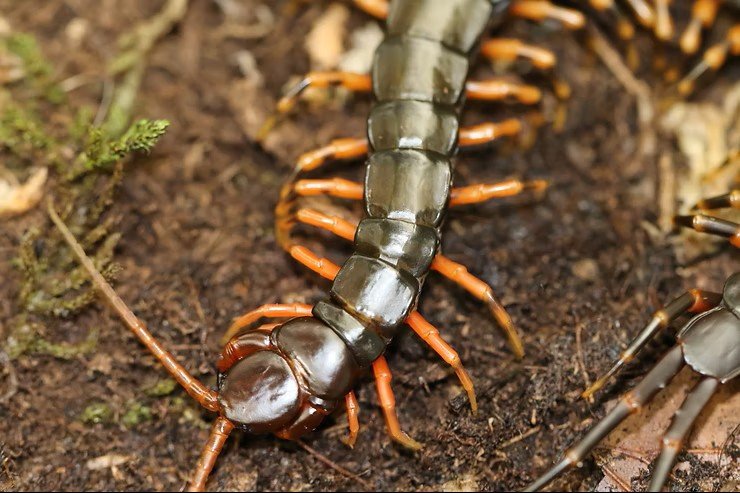
Scolopendra subspinipes ‘Piceoflava’ / ‘Sulawesi’
Common name: Sulawesi white-leg / Sulawesi tiger centipede
Origin: Sulawesi, Indonesia, though some hobbyists claim to have obtained them from Thailand.
Lifestyle: Terrestrial, ground-dwelling centipede that shelters in substrate/cover and behaves like other scolopendromorphs as a nocturnal predator.
Adult size: Typically ~18–22 cm (7–9 in), with some sellers reporting ~20–30 cm (8–12 in) depending on specimen/locality.
Growth rate: Moderate to slow—in the S. subspinipes complex, juveniles may take ~3–4 years to reach full adult size (highly dependent on feeding and temps).
Temperament: Fast and defensive; may jump
Color & appearance: Known for high-contrast “banded” look (dark body with lighter/yellowish banding/tergite patterning) and hobby lines described as black-leg or white-leg forms; some taxonomic notes describe a distinctive yellowish coloration on posterior tergite areas.
Species history
The current consensus among myriapodologists is that Scolopendra subspinipes ‘Piceoflava’ is part of the S. subspinipes species complex. Many hobbyists list it as Scolopendra sp. ‘Piceoflava’, though there is no real basis for this distinction due to a lack of material and molecular data.
Natural habitat
This locality of S. subspinipes lives in of Sulawesi, Indonesia. The type locality is from Tomohon (North Sulawesi) which is characterized by volcanic highlands, tropical rainforests, and rainfall year-round. This is a ground-dwelling, nocturnal centipede that spends daylight hours under leaf litter, rocks, bark, and rotting wood, so a proper enclosure should include a hide and a few inches of substrate for burrowing.
Scolopendra heros
Common name: Giant desert centipede is typical though there are many others for specific localities (i.e. Texas redheaded centipede)
Origin: Southwestern United States and northern Mexico.
Lifestyle: A fast, ground-dwelling predator that shelters under stones/logs/leaf litter and hunts other arthropods (and sometimes small vertebrates). Often described as primarily nocturnal, though it may be encountered active in daytime.
Adult size: Typically 6-8” though individuals nearly 12” are not unheard of, especially in captivity. This is the largest Scolopendra in the continental United States.
Growth rate: Moderate/variable—like other centipedes it grows by molting through multiple instars, and maturity timing can vary with conditions and feeding.
Temperament: Fast, defensive, and can be aggressive; capable of a painful venomous bite and may also pinch/grab with rear legs when threatened.
Color & appearance: Varies greatly by locale but the most commonly observed has orange tergites with the rear tergites being black as well as the head capsule. Yellow or orange legs appears to be a universal trait across all localities.
Species summary
Scolopendra heros—commonly called the giant desert centipede or giant redheaded centipede—is a large North American scolopendrid centipede known for its bold “warning” coloration and powerful predatory lifestyle. It was described by Girard in 1853, and modern taxonomic catalogs list it as a valid species; several historical names and subspecies have been associated with it (synonyms and named variants exist in the literature).
Natural habitat
Scolopendra heros occurs across the south-central and southwestern United States and into Northern Mexico. Despite the common name, it is found in both arid/semi-arid and woodland habitats in parts of its range. While S. heros is nocturnal like other Scolopendra species, it is found foraging during the day quite often. When it is not hunting for prey, it can be found under rocks, logs, and any other hiding place that provides shelter from the hot desert sun.