
Ethmostigmus
Ethmostigmus is an accepted genus of scolopendrid centipedes established by Pocock in 1898. ChiloBase currently lists 25 valid species in the genus, and the type species is Scolopendra trigonopodus Leach, 1817, fixed by subsequent designation. The genus also has a substantial nomenclatural history, including older names such as Dacetum and Heterostoma, reflecting the broader instability that historically affected large Old World scolopendrids.
In modern systematic and biogeographic work, Ethmostigmus is treated as an Old World tropical lineage distributed across Africa, the Indian subcontinent, Southeast Asia, the East Indies, Australia, Melanesia, and Polynesia. A 2019 biogeographic study treated the genus as an informative model for reconstructing Gondwanan and post-Gondwanan patterns in tropical centipedes, concluding that diversification likely began in the Late Cretaceous and was shaped by a mixture of deep vicariance and later regional dispersal.
The genus is scientifically important not only because of its broad Old World distribution, but also because of its uneven taxonomic resolution. Some regional faunas, especially in India, have been revised with molecular and integrative methods in recent years, whereas other Ethmostigmus lineages remain known primarily from historical descriptions, museum material, or hobby circulation. Recent work from peninsular India explicitly used molecular phylogenetics to test monophyly and refine species limits within the genus, underscoring that Ethmostigmus remains an active subject of systematic revision rather than a fully settled taxonomic group.
Ecologically, Ethmostigmus species are best understood as large, ground-associated predatory scolopendrids rather than arboreal forms. Although habitat detail varies greatly by species and region, the genus as a whole is associated with terrestrial tropical and subtropical environments, and its members are generally interpreted as shelter-seeking centipedes using protected microhabitats such as soil crevices, litter, wood, stones, or other cover. That ecological generalization is stronger at the genus level than for many individual species, for which formal field syntheses are still sparse.
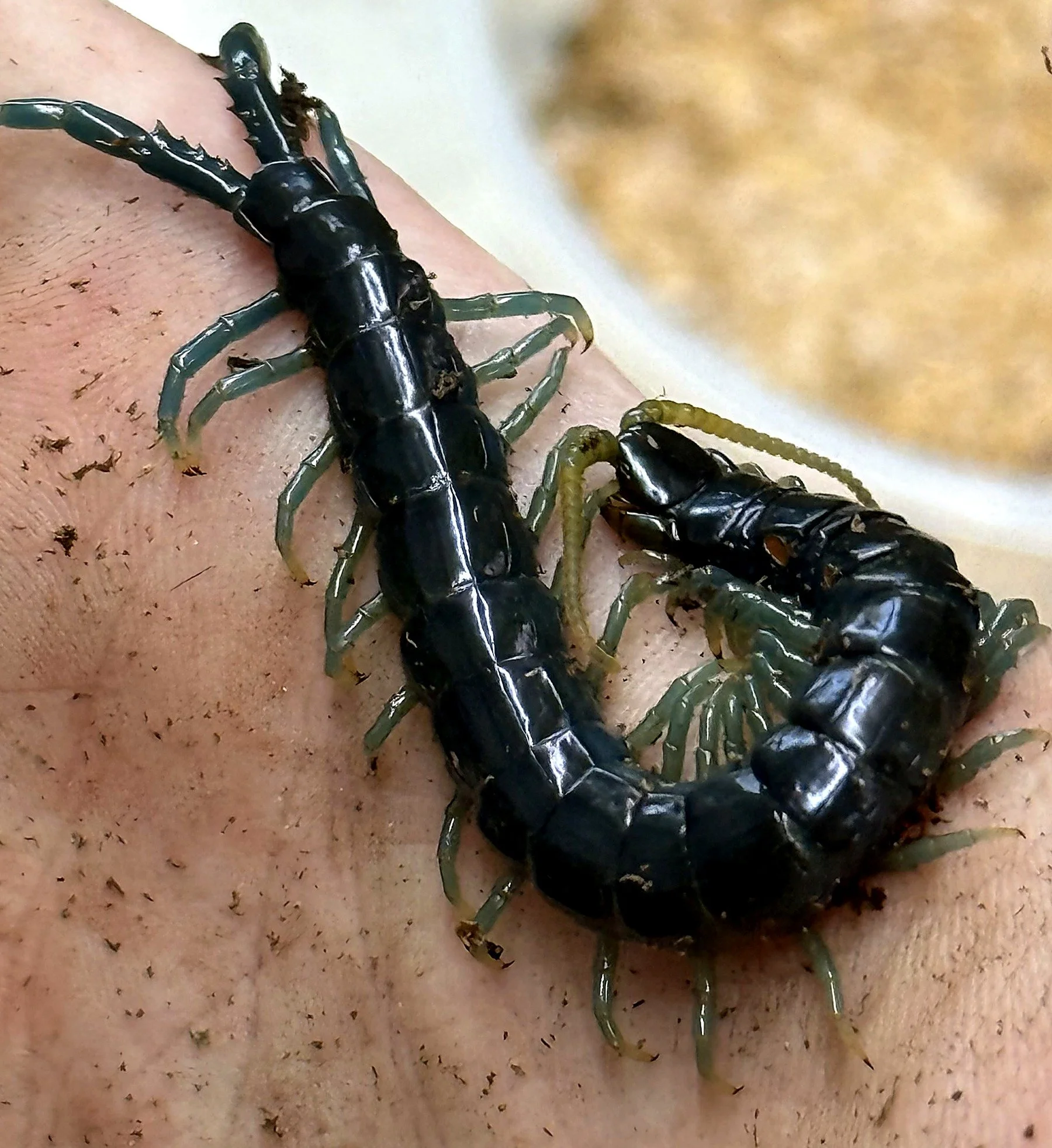
Ethmostigmus sp. “Borneo Blue”
Borneo Blue Leg
Ethmostigmus sp. “Borneo Blue” is an undescribed hobby form from the Bornean tropics, consistently offered as a close relative of — or provisional variant within — E. rubripes (Brandt, 1840), the most widely-distributed and morphologically variable species-group in the genus. It is distinguished in the trade by its uniformly blue legs over a dark olive-to-slate body and by its adult size, which sits at the upper end of Ethmostigmus. Its formal specific status will remain open until the rubripes complex is revisited with modern integrative methods.
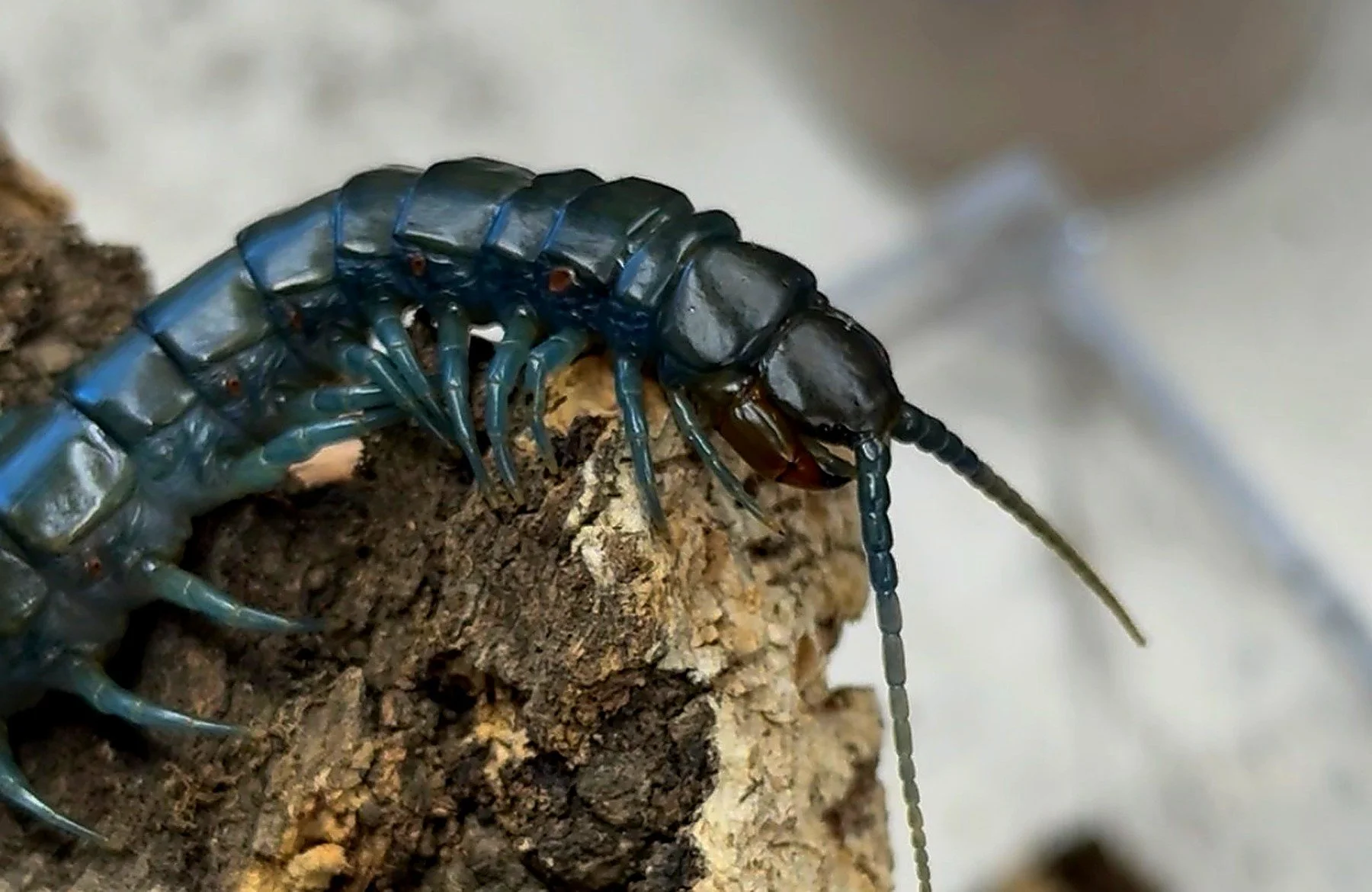
Ethmostigmus trigonopodus
Tanzanian Blue Ringleg
Ethmostigmus trigonopodus (Leach, 1817) is the type species of the genus, originally described as Scolopendra trigonopus from African material and transferred to Ethmostigmus by Pocock in his 1898 erection of the genus. It is the most widely encountered African ethmostigmid in the international hobby, traded as the “Tanzanian Blue Ringleg” for the contrasting banded blue rings on its otherwise olive-brown to green-black legs. Its venom was the source of the first active enzymes ever characterized from a centipede — the proteases, phosphatases, and esterases described at Ain Shams University in 1983 — and it remains one of the best-studied scolopendrid venoms on record.

Ethmostigmus sp. “Gigas”
Vietnamese Orange-Leg Giant
Ethmostigmus sp. “Gigas” is a Vietnamese locality-form that circulates in the international centipede trade under this specific label — not a formally described species or subspecies. “Gigas” (Latin for “giant”) has become the standard hobby identifier for this Vietnamese population, which presents the glossy chestnut-to-reddish-brown body and bright orange legs characteristic of the Ethmostigmus rubripes (Brandt, 1840) complex — the Latin epithet rubripes literally meaning “red-legged.” Vietnam falls within the documented ranges of both E. rubripes platycephalus (Newport, 1845) and E. rubripes spinosus (Newport, 1845), and until someone revisits the complex with modern integrative methods, the specific placement of “Gigas” animals will remain open between those two subspecies.