

Spinosatibiapalpus
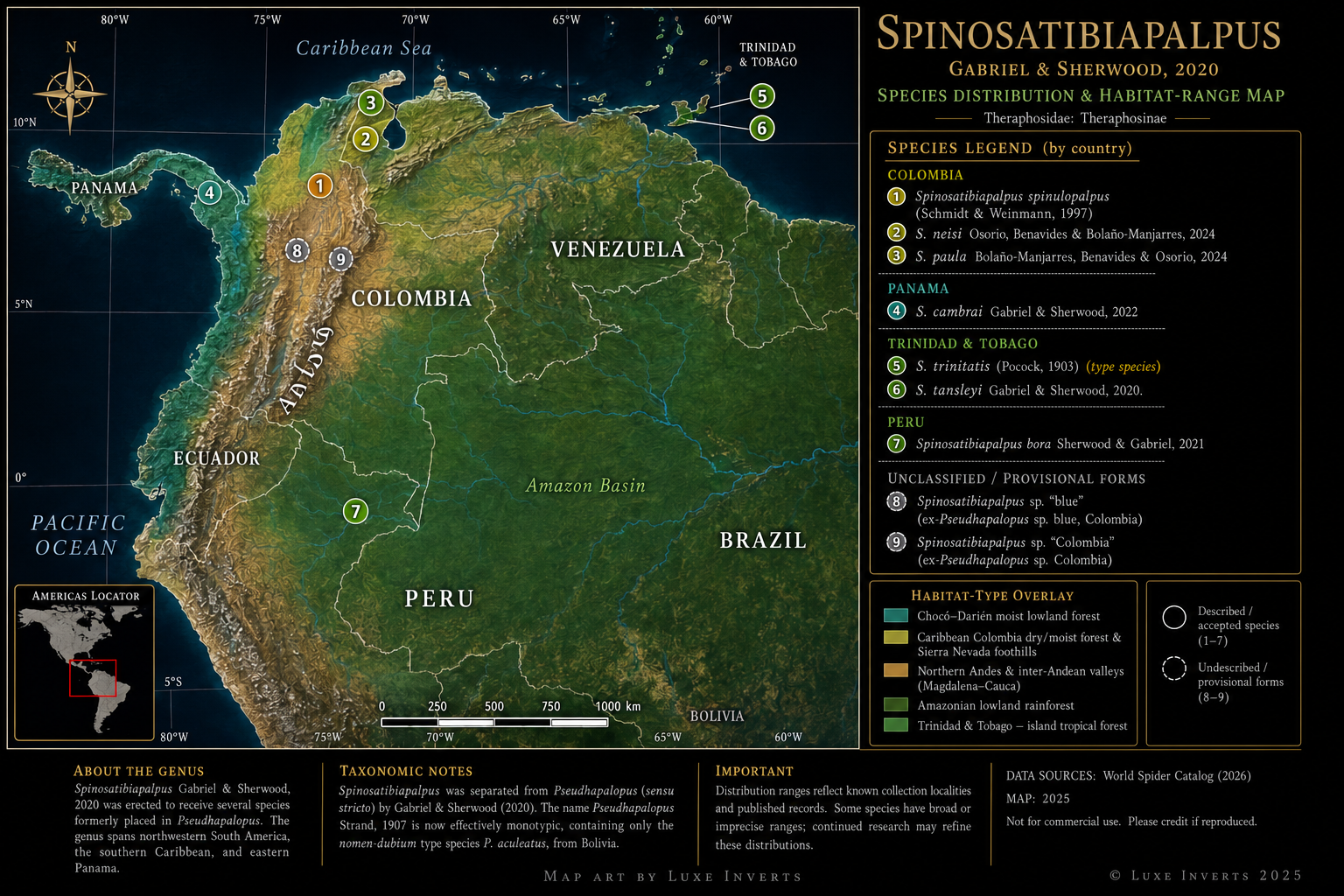
Spinosatibiapalpus Gabriel & Sherwood, 2020 is a genus of small, fossorial to opportunistically burrowing New World tarantulas in the subfamily Theraphosinae, distributed across the humid Neotropics from eastern Panama and the Colombian Andes to the southern Caribbean and western Amazonia — eastern Panama (the Darién), much of Colombia (Caribbean lowlands and the foothills of the Sierra Nevada de Santa Marta, and the inter-Andean Magdalena–Cauca system), Trinidad and Tobago, and Amazonian Peru (Loreto). The type species is S. trinitatis (Pocock, 1903), a Trinidadian theraphosine. The genus name refers to the diagnostic spiniform setae on the male palpal tibia, a character that, with the structure of the palpal bulb, separates the genus from its relatives.
The genus has a tangled taxonomic history that is recent and still settling. It was erected by Gabriel & Sherwood (2020) to receive species that had been placed in Pseudhapalopus Strand, 1907, but did not belong with that genus's type. The type species itself had previously been shuttled through Metriopelma, Crypsidromus, and Lasiodora before its stint in Pseudhapalopus; the Colombian S. spinulopalpus was likewise transferred out of Pseudhapalopus, while Pseudhapalopus velox was moved instead to Cymbiapophysa. The consequence is that Pseudhapalopus Strand, 1907 is today effectively monotypic, containing only its type species, P. aculeatus — a nomen dubium from Bolivia, whose holotype was destroyed and for which no usable type locality survives. Animals long circulated in the hobby under "Pseudhapalopus" locality tags are, in current usage, Spinosatibiapalpus or closely allied theraphosines; several almost certainly represent undescribed species awaiting formal treatment.
Members of the genus are terrestrial cryptic and fossorial spiders of humid lowland and lower-montane forest, sheltering in self-excavated burrows, in soil and leaf litter, and beneath rocks and fallen wood, from the moist forests of the Chocó–Darién and the Caribbean slope of Colombia to the Amazonian rainforest in Peru and the island forests of Trinidad. They are small to dwarf by theraphosid standards, with modest sexual dimorphism; described species tend to be cryptically brown, but the undescribed Colombian forms that drive the genus's popularity carry a structural blue-to-violet sheen across the legs and carapace set against contrasting gold, orange, or yellow markings on the opisthosoma — among the more vivid of the small New World tarantulas. As is typical of New World Theraphosinae, the genus bears urticating setae, the spiders' principal passive defense, and disturbance at the burrow generally prompts a rapid retreat underground rather than a sustained threat display.
No Spinosatibiapalpus species is listed on CITES, and none has a published IUCN Red List assessment, although much of the genus's range overlaps regions of intense and ongoing forest loss — particularly the Chocó–Darién corridor and the inter-Andean valleys of Colombia — and several of the undescribed locality forms are known from very restricted areas. In captivity the genus expects a terrestrial, burrow-oriented enclosure with deep, slightly moist substrate, a starter burrow or cork retreat, warm temperatures, and moderate to high humidity with good ventilation; the dwarf adult size, ready burrowing, and forgiving requirements make the Colombian forms accessible to keepers of beginner-to-intermediate experience, while the genus as a whole rewards anyone interested in the small, secretive theraphosine fauna of northwestern South America. As with all New World theraphosines, venom is not considered medically significant; the urticating setae, not the bite, are the relevant defensive consideration.
Species
The World Spider Catalog (2026) recognizes seven valid species. Several additional, undescribed forms circulate under hobby locality tags and are noted separately below.
Spinosatibiapalpus spinulopalpus (Schmidt & Weinmann, 1997) — Colombia (inter-Andean / Magdalena region); transferred from Pseudhapalopus.
Spinosatibiapalpus neisi Osorio, Benavides & Bolaño-Manjarres, 2024 — Colombia (Caribbean north; Magdalena).
Spinosatibiapalpus paula Bolaño-Manjarres, Benavides & Osorio, 2024 — Colombia (Caribbean north; Magdalena).
Spinosatibiapalpus cambrai Gabriel & Sherwood, 2022 — Panama (Darién lowlands).
Spinosatibiapalpus trinitatis (Pocock, 1903) — Trinidad and Tobago; type species of the genus.
Spinosatibiapalpus tansleyi Gabriel & Sherwood, 2020 — Trinidad.
Spinosatibiapalpus bora Sherwood & Gabriel, 2021 — Peru (Amazonian lowlands, Loreto).
Undescribed / provisional forms
The following are hobby trade names with no formal taxonomic standing; they are best regarded as undescribed Spinosatibiapalpus (or closely allied theraphosines) pending scientific description, and most originate in Colombia.
Spinosatibiapalpus sp. "blue" (ex-Pseudhapalopus sp. blue) — Colombia; the classic metallic-blue dwarf of the hobby.
Spinosatibiapalpus sp. "Colombia" (ex-Pseudhapalopus sp. Colombia) — Colombia; blue-and-gold form, closely related to the above.
Spinosatibiapalpus sp. "Yellow Blue" — Colombia; a variant with additional yellow leg striping.
Sources
Taxonomy and distribution follow the World Spider Catalog (2026), genus Spinosatibiapalpus; Gabriel & Sherwood (2020), Arachnology 18(4): 301–316 (revision of Pseudhapalopus); Sherwood & Gabriel (2021), Revista Ibérica de Aracnología 38: 87–91; Gabriel & Sherwood (2022), Revista Ibérica de Aracnología 40: 5–18; and Bolaño-Manjarres et al. (2024), Arachnology 19(9): 1205–1210. Provisional forms reflect hobby usage and are not recognized in the World Spider Catalog.
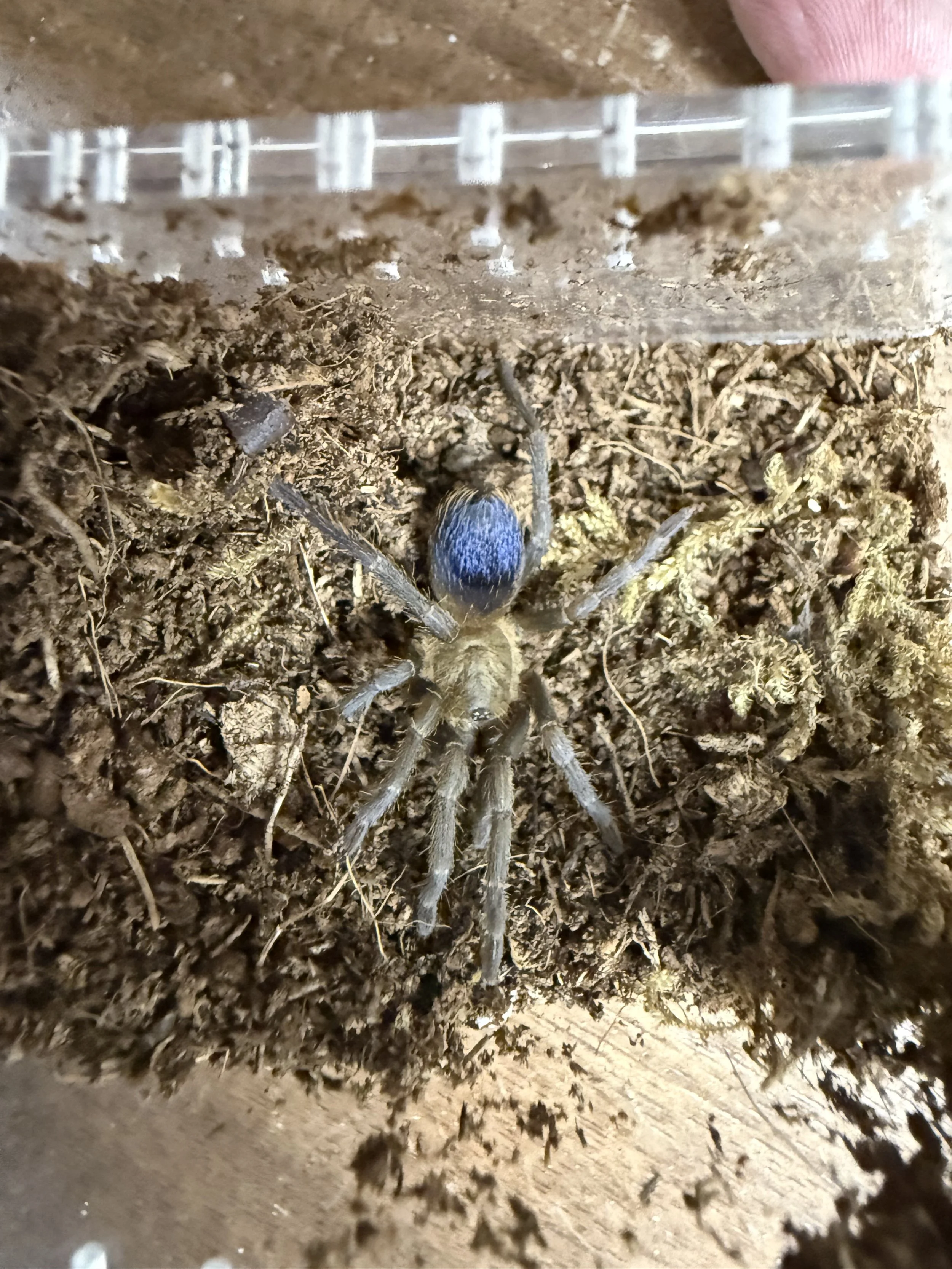
Pseudhapalopus sp. "Colombia"
Colombian Dwarf Beauty
Pseudhapalopus is a small-bodied Neotropical genus of uncertain subfamilial placement — historically assigned to Ischnocolinae, with more recent morphological work supporting affinities within Theraphosinae. Pseudhapalopus sp. “Colombia” is an undescribed Colombian trade form that has persisted in hobby culture for more than a decade without formal taxonomic resolution. Material is small-bodied, fast, and semi-fossorial.
Replace this block with an <img class="luxe-ag-photo" src="…" alt="…">
Pseudhapalopus sp. "Blue"
Blue Dwarf Beauty
Pseudhapalopus sp. “Blue” is an undescribed Neotropical dwarf theraphosid currently circulating in the trade without a formal specific epithet. Assigned to Pseudhapalopus on the basis of general morphology, with the same caveats around subfamilial placement that apply to the genus as a whole (historically Ischnocolinae; more recently regarded as Theraphosinae). Distinguished from Pseudhapalopus sp. “Colombia” by a subtle metallic blue sheen visible in good light.