Cyriopagopus
Cyriopagopus is a Southeast Asian tarantula genus first described by French arachnologist Eugène Simon in 1887, with Cyriopagopus paganus designated as the type species.
In the late 19th and early 20th centuries, closely related Asian tarantulas were split among several genera, including Selenocosmia, Haplopelma, Melopoeus, Lampropelma, and Omothymus. As more material was studied, it became clear that many of these taxa were very similar, and their boundaries were poorly defined.
A major turning point came when A.M. Smith and others re-examined the type material. They showed that the defining features of Haplopelma actually matched those of Cyriopagopus, making Cyriopagopus the senior synonym. As a result, Haplopelma (a name long used in the hobby) was formally sunk into Cyriopagopus, and many familiar “Haplopelma” species were transferred into Cyriopagopus. This arrangement is followed by the World Spider Catalog and other major taxonomic databases.
Despite this, the whole Ornithoctoninae group (which includes Cyriopagopus and several allied genera) is still considered taxonomically messy and “in urgent need of revision,” with ongoing debate over where some species truly belong. Modern DNA-based work is expected to clarify these relationships in the future.
Today, Cyriopagopus comprises a small number of officially accepted species (around nine as of recent catalogs), all confined to tropical Southeast Asia from Myanmar and Thailand through Vietnam, Malaysia, Borneo, and the Philippines.
Cyriopagopus hainanus
Cyriopagopus hainanus is an Old World, fossorial tarantula best known in the hobby as the Hainan Earth Tiger (often also sold as Chinese Black Earth Tiger). It’s a deep-burrowing, retreat-oriented species that spends most of its time inside a silk-lined tunnel system and is typically most visible at the burrow entrance, especially during feeding.
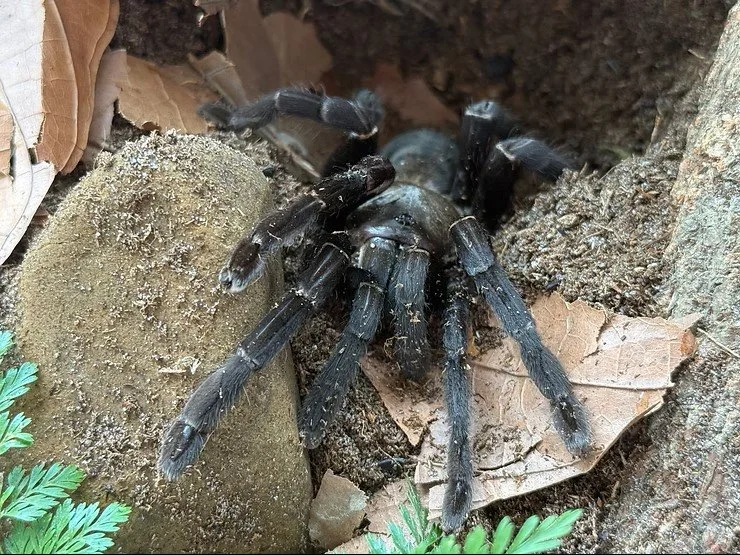
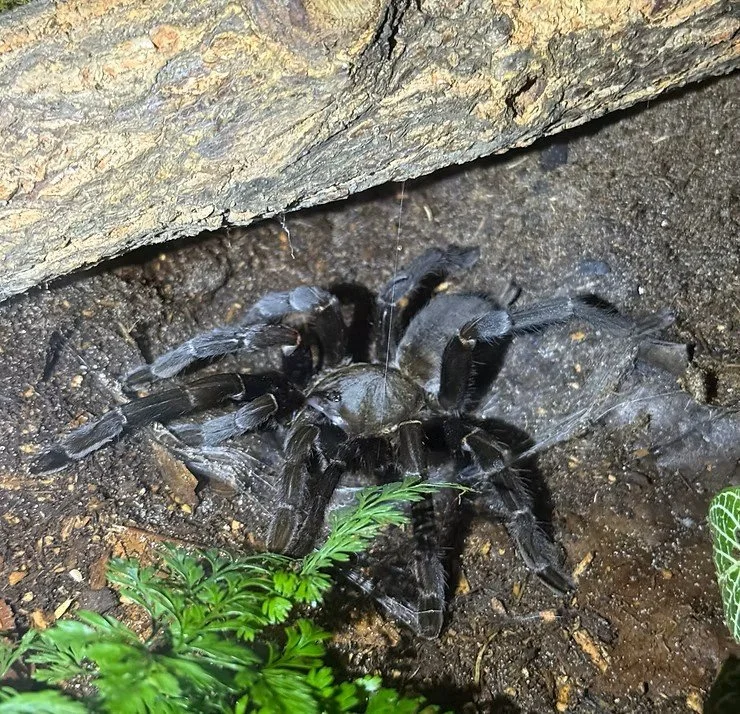
In appearance, it’s a dark, imposing spider. Adults are commonly described as black-brown to very dark brown overall, with the abdomen often showing distinct dark striping that becomes more noticeable under bright light or on fresh molts. Because it is an Old World tarantula, it should be treated as a “look-don’t-handle” species: fast, defensive when provoked, and potentially medically significant.
| Common name | Hainan Earth Tiger (also sold as Chinese Black Earth Tiger) |
|---|---|
| Origin | China (Hainan Island) |
| Natural habitat | Subtropical forest and hillside environments on Hainan; favors compact soils on slopes where it can build stable, deep burrows. |
| Lifestyle | Old World fossorial “earth tiger”; constructs deep silk-lined burrows with extensive webbing/alarm lines and ambushes prey from the entrance. |
| Adult size | ~6–8 in (15–20 cm) diagonal leg span (DLS) |
| Growth rate | Medium |
| Temperament | Fast and defensive if disturbed; medically significant Old World venom—best suited for experienced keepers. |
| Color & appearance | Dark brown to near-black overall; robust build. Often shows subtle patterning on the abdomen and darker “velvet” tones after fresh molts. |
Species History
Cyriopagopus hainanus is a large, fossorial tarantula endemic to Hainan Island in southern China. It was first described in 1999 as Selenocosmia hainana by Liang, Peng, Huang & Chen, based on specimens from Tongshi County, Hainan.
As more Chinese theraphosids were studied, the species was shuffled through several genera. In 2001 it was transferred to Ornithoctonus as O. hainana, then moved again in 2003 to Haplopelma (H. hainanum), a name that became widely used in the hobby.
A broader re-evaluation of Southeast Asian “earth tigers” later showed that many so-called Haplopelma species actually belong in Cyriopagopus. In 2015 the species was formally placed in Cyriopagopus as C. hainanus, which is the name now followed by the World Spider Catalog and major taxonomic databases.
Today, C. hainanus is recognized as a highly venomous “Chinese bird spider,” famous in venom research for its complex cocktail of hainantoxins, and in the hobby under common names like Chinese Black Earth Tiger and Chinese Giant Black Earth Tiger.
Natural Habitat
Cyriopagopus hainanus is endemic to Hainan Island off the southern coast of China, where it occupies warm, humid tropical rainforest in the island’s mountainous interior. It is known from very steep, south-facing mountain slopes (often 75–85°), where stable, well-drained soil allows it to construct deep burrows. A strictly fossorial species, it lives in silk-lined burrow systems, sometimes with radiating “trip lines” at the entrance, remaining hidden by day and emerging at night to ambush passing prey—primarily large insects and other small animals.
Our Specimen
“Karen” (pictured above and below) is a mature female with an unpleasant disposition. She is approximately 6 inches with beautiful earth tiger coloration. As expected, she spends most of her time in a deep burrow she has created. However, she periodically makes an appearance at the burrow entrance.