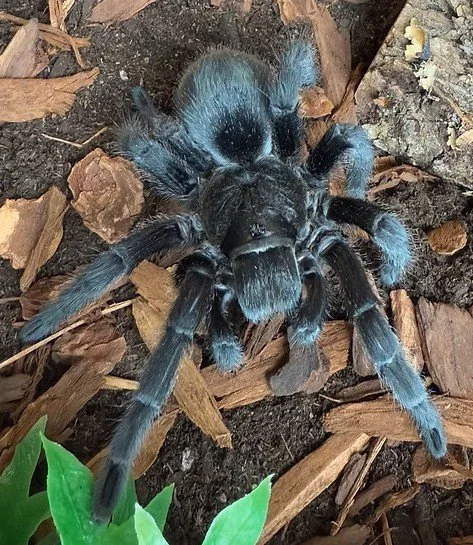
Grammostola
Grammostola is a South American tarantula genus established by French arachnologist Eugène Louis Simon in 1892. Today, around 20 recognized species are known from temperate and subtropical regions of Argentina, Bolivia, Brazil, Chile, Paraguay, and Uruguay, including several of the hobby’s most iconic “beginner” tarantulas such as G. rosea, G. pulchra, and G. pulchripes.
In the late 19th century, many South American tarantulas were being described and shuffled between genera. Simon erected Grammostola in 1892 to group a set of robust, ground-dwelling species with similar morphology, later designating Grammostola pulchripes (then described in 1891) as the type species. Over time, several older names and “mini-genera” (such as Lasiocnemus, Lasiopelma, Polyspina, Polyspinosa, and Sorata) were synonymized into Grammostola as taxonomists realized they were describing the same lineage under different labels.
Early descriptions were often brief and based on a handful of visible characters like color and size. For relatively uniform spiders like Grammostola, this led to a tangle of names and misidentifications—especially among Brazilian and Chilean species—because key diagnostic features (such as the shape of spermathecae and male palpal bulbs) weren’t described in detail. Modern authors have highlighted that this “morphological homogeneity” created long-standing confusion in the genus.
From the mid-20th century onward, large regional works and hobby literature tried to sort things out, but some names became entrenched in the pet trade even as scientific views shifted. A classic example is the Chilean rose group: names like G. spatulata, G. cala, and G. porteri circulated for decades before recent taxonomic revisions clarified the situation and synonymized several of these with Grammostola rosea, while also updating distributions of Chilean species.
In the 2000s and 2010s, researchers began using an integrative approach—combining detailed morphology, cladistic analyses, and distribution data—to clean up more than a century of accumulated confusion. Recent work has refined species boundaries (for example in G. pulchra and other Argentine and Brazilian species) and confirmed that Grammostola is a distinct, primarily temperate South American lineage with around twenty valid species as of current catalogs. This ongoing research underpins the names and localities used by breeders and keepers today, linking the spiders on hobby shelves back to over 130 years of taxonomic history.
Grammostola pulcra
Grammostola pulchra—the Brazilian Black—is one of the most iconic New World tarantulas in the hobby, prized for its deep, uniform velvet-black coloration and its typically calm, unhurried demeanor once established. It’s a terrestrial species that tends to spend much of its time near a favored retreat, emerging to investigate vibrations and prey. When threatened, it usually prefers to retreat or remain still, relying on urticating hairs as a primary defense if it feels pressured.
A major part of its appeal is its “all black” look, which becomes more consistent with maturity and can appear especially rich after fresh molts. While not a “hyper-active” display species, it’s an excellent choice for keepers who appreciate a robust, long-lived tarantula with a steady temperament and striking appearance.
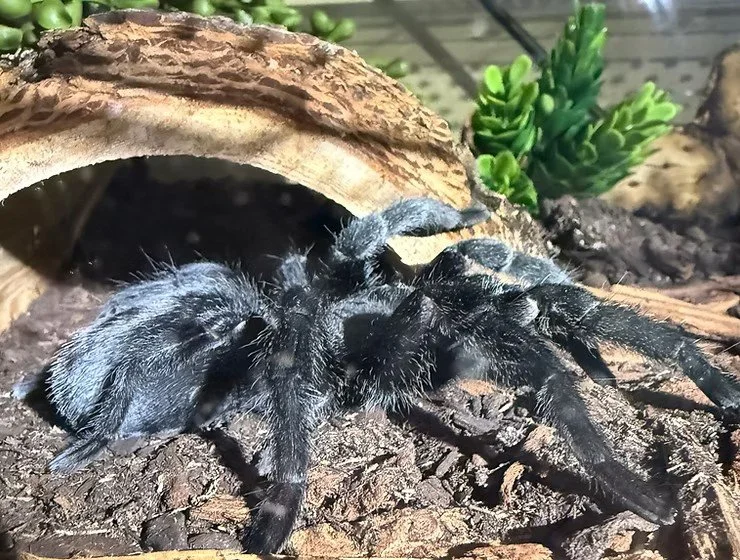
Common name: Brazilian Black Tarantula.
Origin: Brazil; the World Spider Catalog currently lists the species distribution as Brazil.
Lifestyle: New World terrestrial tarantula and opportunistic burrower that makes use of shallow burrows, hides, and sheltered ground-level retreats rather than living as a true arboreal species.
Adult size: Usually listed around 15–18 cm / 6–7" diagonal leg span, making it a medium-to-large terrestrial species.
Growth rate: Slow, with a long maturation period compared with many faster-growing tarantula species.
Temperament: Widely regarded as calm, docile, and slow-moving, though like any tarantula it can still react defensively if disturbed and is best appreciated as a display species first.
Color & appearance:
Spiderlings and juveniles are typically dark, but the species becomes increasingly more uniform and dramatic in color as it matures.
As they grow, they develop the deep, satin-like black look that makes the species so recognizable in the hobby.
Adults are especially known for their solid jet-black to velvety black appearance, thick build, and clean understated look compared with more boldly patterned species.
Species History
Original description (1921):
The species was formally described in 1921 by Cândido Firmino de Mello-Leitão, during early work clarifying South American Grammostola.
Mid-century taxonomic reshuffling:
As researchers compared similar-looking Grammostola across South America, the name pulchra was at one point treated as a subspecies (appearing in the literature as Grammostola pulchripes pulchra). This kind of shifting placement was common historically in tarantulas, where closely related species can look very similar externally and early descriptions often lacked the modern level of diagnostic detail.
Modern species delimitation (2016 onward):
In 2016, an integrative taxonomic study in Grammostola described Grammostola quirogai (a very similar “black Grammostola” associated with Uruguay). This helped clarify that not all “Brazilian black” tarantulas circulating in collections under the pulchra label necessarily matched the true Brazilian species concept.
Redescription and range clarification (2023):
A major modern milestone came in 2023, when researchers published a detailed redescription of G. pulchra and added new distribution records, using multiple lines of evidence (morphology plus genetic data). This work strengthened species-level diagnostics and helped stabilize how pulchra is identified and separated from similar regional relatives.
Natural Habitat
Biome and landscape:
Grammostola pulchra is associated with southern Brazil’s grassland and open plain systems (often discussed as campos/pampas-type habitats), where ground conditions range from firm soils to more humid low spots depending on local microclimate. These landscapes are typically open or lightly wooded, with grasses, scrub, and scattered cover.
Microhabitat and shelter use:
In the wild, G. pulchra is a ground-dwelling burrow user. Individuals create or occupy burrows and reinforced soil retreats, often positioned to take advantage of surface cover (vegetation clumps, root zones, fallen material). The burrow functions as a stable refuge from weather swings and predators, and as an ambush point for prey moving through the grass and leaf litter.
Our Specimen
“Celeste” is a family favorite (picture above and below). She has been with us for a long time. She has an engaging, inquisitive, and calm personality. Celeste has been in pre-molt for several months and we are eagerly awaiting her beautiful black coloration again. She is a mature female who is approximately 6 inches.
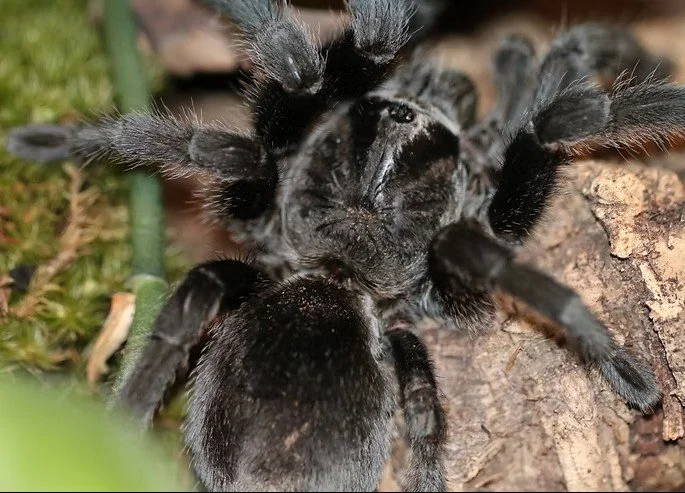
Grammostola sp. concepcion
Grammostola sp. “Concepción” is an undescribed New World tarantula in the hobby rather than a formally published species name. The genus Grammostola is currently recognized by the World Spider Catalog, but “Concepción” is not listed there as an accepted species epithet, so it is best presented as a hobby or locality form.
Best known in the hobby as the Concepción Tarantula, Concepción Gold, or Chilean Lava Cream, this is a Chilean terrestrial tarantula prized for its calm reputation, warm bronze-to-orange coloration, and pale striping on the legs. Recent hobby sources consistently describe it as one of the more attractive and easygoing Chilean Grammostola forms in captivity.
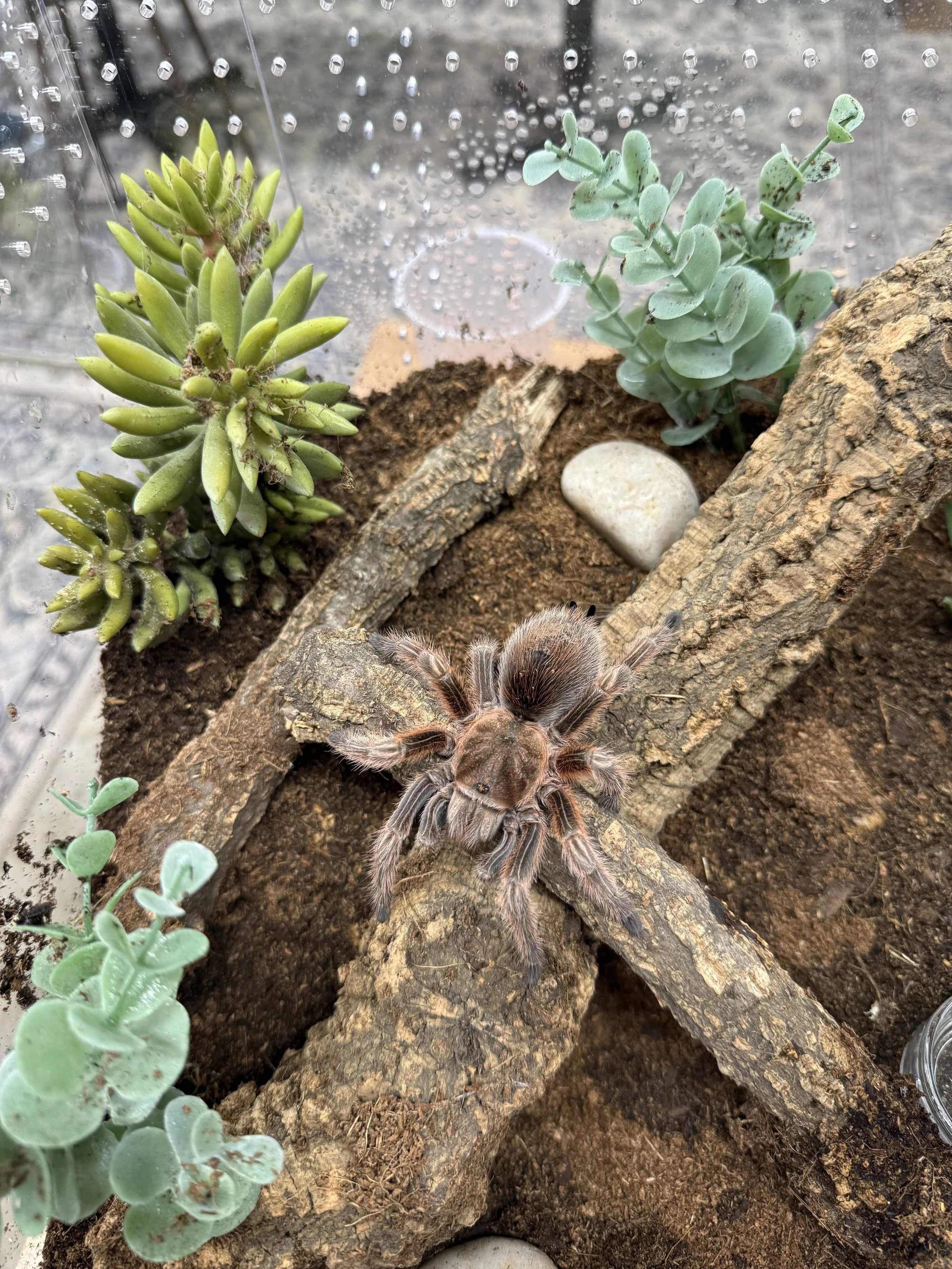
Common Name: Concepción Tarantula / Concepción Gold / Chilean Lava Cream.
Origin: Chile, associated in the hobby with the Concepción area on the south-central Chilean coast, with reports that it also occurs inland at elevations above 2,000 feet.
Lifestyle: Terrestrial, with hobby sources describing it as a calm ground-dweller that may use burrows or other sheltered retreats rather than remaining fully exposed at all times.
Adult Size: Commonly cited around 6 inches diagonal leg span.
Growth Rate: Slow.
Temperament: Usually described as relaxed, docile, and slow-moving, with multiple sellers specifically calling it a good beginner species.
Color & Appearance: Typically described as bronze-red to orange with a pale carapace and noticeable light striping or banding on the legs, giving it a brighter look than many standard Chilean rose-hair types.
Species History
Unlike formally described tarantulas on your page, “Concepción” is a hobby name rather than a published scientific species. It is therefore best written as Grammostola sp. “Concepción”, which signals that the spider is recognized in captivity but has not yet been formally described under a valid species epithet in the current catalog.
That fits how the animal is actually being used in the hobby right now. Current sellers and hobby references continue to market it as Grammostola sp. “Concepción” or similar variants rather than under a formal binomial, which is usually a good sign that the trade name has persisted without a matching published species description.
Natural Habitat
Because this spider remains undescribed, precise published habitat data are limited. The safest broad statement is that it is a Chilean Grammostola associated with the Concepción region of south-central Chile, near the mouth of the Biobío River. Concepción itself is widely described as having a warm-summer Mediterranean climate with mild, dry summers and much wetter winters.
That overall setting lines up well with the way hobby keepers describe the species: a hardy terrestrial tarantula from a relatively cool Chilean locality, rather than a tropical rainforest spider. Hobby reports also place it both near the coast and farther inland at higher elevation, which suggests some tolerance for seasonal variation within its range. This last point is an inference from locality and climate information rather than from a formal ecological study.
Our Specimen
“Scarlet” is very calm and has an overall pleasant disposition. She is approximately 5 inches in diagonal length with some room to grow. She is always on display and has not shown any tendencies to burrow.
Grammostola anthracina
Grammostola anthracina is an accepted South American theraphosid currently recognized by the World Spider Catalog. The catalog lists it as valid under Grammostola anthracina and gives its distribution as Brazil, Uruguay, Paraguay, and Argentina.
Best known in the hobby as the Brazilian Giant Tawny Red or simply the Tawny Red Tarantula, this is a large, robust Grammostola that has become especially prized for its size, longevity, and earthy red-brown coloration. Modern taxonomic work also clarified that the brown-reddish form remains G. anthracina, while the darker black morph was separated as G. quirogai.
Common Name: Brazilian Giant Tawny Red / Tawny Red Tarantula.
Origin: Brazil, Uruguay, Paraguay, and Argentina.
Lifestyle: Terrestrial and burrow-oriented; Uruguayan work describes it as associated with rocky hill systems and living in burrows built under stones.
Adult Size: Large and heavy-bodied; hobby sources commonly place mature specimens at around 6 inches or more in leg span.
Growth Rate: Slow. A Uruguayan thesis on the species notes that individuals may take about 10 years to reach sexual maturity and can live more than 30 years.
Temperament: Usually regarded in captivity as calm and well-tempered, though still best treated as a retreat-first New World terrestrial.
Color & Appearance: Usually dark brown to gray-black with reddish tones in the legs and body; mature males are especially distinctive, with a black body and stronger reddish coloration in the legs.
Species History
Grammostola anthracina was first described by C. L. Koch in 1842. Its taxonomic history later became tangled with names such as Grammostola mollicoma, but the current World Spider Catalog treats G. anthracina as the accepted name.
A major clarification came with the 2016 integrative study of Grammostola, which found that the animals historically grouped under G. anthracina actually included more than one species. That work restricted the name G. anthracina to the brown-reddish morph and described the black morph as Grammostola quirogai.
Natural Habitat
Although the catalog lists the species broadly across southern South America, some of the best natural-history detail comes from Uruguay. There, G. anthracina has been studied in association with rocky uplands and hill systems, where it occupies burrows under stones.
That habitat picture fits the species well in captivity too: a sturdy terrestrial spider that values shelter, stable ground cover, and a secure retreat rather than constant open exposure. During the reproductive period, adult males leave the burrow to search for females.
Our Specimen
Grammostola pulchripes
Grammostola pulchripes is an accepted South American theraphosid currently recognized by the World Spider Catalog, which also lists it as the type species of the genus Grammostola. The catalog gives its distribution as Brazil, Paraguay, and Argentina.
Best known in the hobby as the Chaco Golden Knee Tarantula, this species is one of the classic New World terrestrials: large, hardy, attractively patterned, and widely regarded as one of the best beginner tarantulas. It is especially appreciated for its calm nature and bold golden striping on the legs.
Common Name: Chaco Golden Knee Tarantula.
Origin: Paraguay and Argentina in most hobby references, with the World Spider Catalog also listing Brazil in the currently recognized distribution.
Lifestyle: Terrestrial and opportunistic burrower; it often uses pre-existing shelters, hollow logs, or natural cover instead of digging a deep permanent tunnel.
Adult Size: Commonly around 7 inches diagonal leg span.
Growth Rate: Medium.
Temperament: Usually calm, docile, and beginner-friendly.
Color & Appearance: Dark-bodied with bright golden striping at the knees and along the legs, giving it one of the most recognizable looks in the genus.
Species History
This species was originally described as Eurypelma pulchripes by Simon in 1891, and the World Spider Catalog now lists Grammostola pulchripes as the accepted name.
For years, many hobbyists knew this spider under the name Grammostola aureostriata. The catalog records that name in its synonymy, and the modern return to G. pulchripes is tied to later taxonomic corrections, including Gabriel’s 2009 treatment.
Natural Habitat
In nature, Grammostola pulchripes is associated with the grasslands of the Gran Chaco, the broad lowland region spanning parts of Paraguay and Argentina east of the Andes.
That landscape helps explain the species’ captive behavior: it is a heavy-bodied terrestrial that stays low to the ground, uses available shelter readily, and tolerates seasonal variation well. Most keepers describe it as more of an opportunistic burrower than a true deep fossorial species.
Our Specimen
Grammostola rosea
Grammostola rosea is an accepted South American theraphosid currently recognized by the World Spider Catalog, which lists its distribution as Bolivia, Chile, and Argentina.
Best known as the Chilean Rose Hair Tarantula, this is one of the most familiar tarantulas in the hobby. It is especially valued for its hardy nature, calm reputation, and the warm pinkish or rosy tones that give the species its name.
Common Name: Chilean Rose Hair Tarantula / Rose Hair Tarantula.
Origin: Chile, Bolivia, and Argentina.
Lifestyle: Terrestrial and opportunistic burrower; it commonly uses abandoned rodent burrows, rock crevices, and natural debris for shelter rather than constructing a deep permanent burrow.
Adult Size: Commonly cited around 6 inches diagonal leg span.
Growth Rate: Medium.
Temperament: Usually calm and slow-moving, though individuals can be unpredictable and occasionally defensive when disturbed.
Color & Appearance: Usually earth-toned overall, with the red form showing pinkish to rosy hues on the carapace and body; the species name rosea refers to that rose-colored look.
Species History
Grammostola rosea was originally described by Walckenaer in 1837, but its later history became unusually tangled. Over the years, Chilean rose-hair tarantulas circulated under several names, including Grammostola spatulata/spathulata, G. cala, and especially G. porteri, which is why older books, price lists, and hobby labels often disagree about what a “true” Chilean Rose Hair actually was. The current World Spider Catalog treats G. rosea as the accepted name and records G. porteri as a junior synonym following the 2022 revision of Chilean tarantulas.
That taxonomic confusion overlapped with the species’ rise as one of the most heavily sold tarantulas in the pet trade. Because it was hardy, long-lived, relatively forgiving, and usually calm, G. rosea became a classic beginner tarantula in American and European collections. Veterinary literature notes that the species has been harvested in great numbers from Chile for the international pet trade, which helps explain why it was so common and inexpensive for so many years compared with many other tarantulas.
Chilean conservation documents later began flagging that trade pressure more directly. A Chilean government species-assessment file states that G. rosea is one of the most sought-after tarantulas in major pet markets such as Germany and the United States, and it cites Chilean tarantula exports reaching about 57,071 individuals in 2016. Although those export statistics were not broken down by species, the document notes that comparisons with major pet-shop offerings suggested that a large share of that volume likely involved G. rosea.
That long sales history is part of why the species has recently received more formal trade attention. During CITES CoP20 in late 2025, a proposal concerning Grammostola rosea and look-alike tarantulas was narrowed and ultimately adopted so that G. rosea alone was added to Appendix II. U.S. Fish and Wildlife later noted that the Appendix II inclusion was adopted with a delayed entry into effect until June 5, 2027, reflecting the species’ importance in international trade and the growing concern over continued wild collection.
Natural Habitat
In the wild, Grammostola rosea is associated with semi-arid regions of Chile, Bolivia, and Argentina, where it inhabits scrublands, grasslands, and rocky desert terrain. These are comparatively dry habitats with seasonal temperature swings and modest humidity.
That ecology fits the species’ well-known captive reputation as a hardy, adaptable terrestrial tarantula. Rather than being a moisture-dependent tropical burrower, it is better understood as a dry-country opportunist that makes use of whatever sheltered retreat the landscape offers.
Our Specimen